artisan furniture

Mother of Pearl Table: The Art Behind the Craft & Why It's Worth Every Dirham

Mother of Pearl Table The Art Behind the Craft

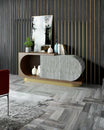
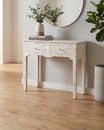
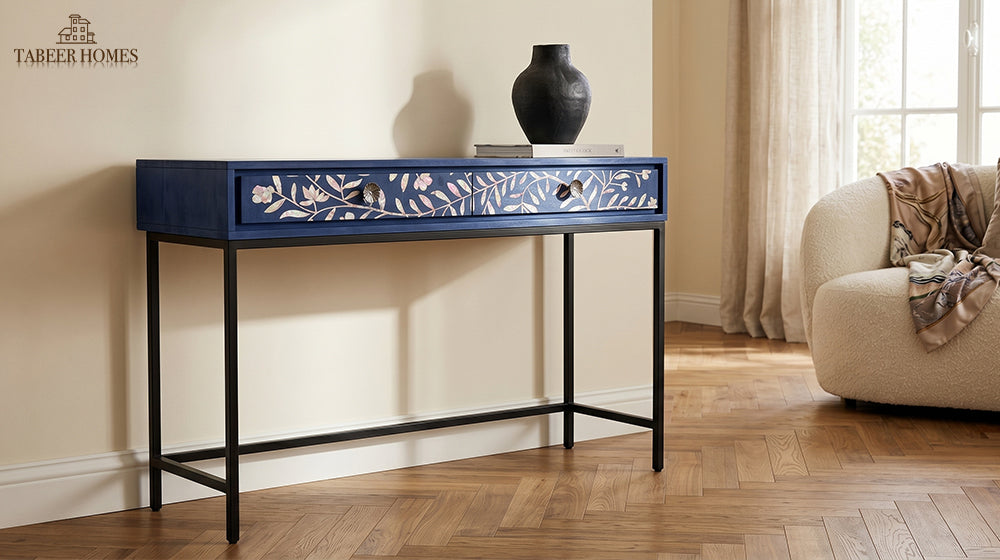
Pick up any object made with genuine nacre shell and hold it near a light source. The surface does not reflect the light back at a single angle the way glass or polished metal does. It separates it. The iridescence moves as you move, shifting through pale greens, creams, blues, and golds in a sequence that no manufactured finish has ever fully replicated. A mother of pearl table carries this quality across an entire surface, applied by hand, piece by piece, over hours or days of skilled craft work. In a region where handcrafted luxury furniture commands serious investment, understanding what that investment actually buys, what the craft involves, how quality is verified, and why these pieces hold their value in UAE and Gulf homes, makes the difference between buying with confidence and buying on faith. This guide covers all of it.

What Nacre Is and Why It Produces a Surface Nothing Else Can Replicate

The material at the centre of every mother of pearl table is nacre, the iridescent lining that certain mollusc species produce on the inner surface of their shells as a response to irritation or as a structural reinforcement of the shell wall itself. The species most commonly used in furniture production include the white-lip pearl oyster, found across the Indo-Pacific, the black-lip oyster for darker tonal ranges, and the freshwater mussel for thinner, more translucent fragments.

What makes nacre optically distinctive is its microstructure. The shell lining is built from microscopic layers of aragonite platelets, each approximately half a micron thick, stacked in a regular arrangement and bonded by an organic protein matrix. When light enters the surface, it travels through multiple semi-transparent layers before reflecting back out. 

This is why mother of pearl inlay table Dubai and UAE buyers consistently describe the material as alive in a way that painted or lacquered surfaces are not. The appearance is not fixed. It changes with the viewer's position, the time of day, and the quality of the light source. A mother of pearl table UAE piece in a room with warm directional evening light behaves differently from the same piece under neutral daylight.

The Craft Process: How a Mother of Pearl Table Is Actually Made

Understanding the making process is the most direct route to understanding why a genuine handcrafted mother of pearl table costs what it costs and why shortcuts in that process produce pieces that look similar initially but diverge significantly over time.

The process begins with the frame. A mother of pearl table is built on a lacquered wood carcass, typically in a hardwood or high-density MDF depending on the price point, that is prepared with multiple coats of lacquer to create a smooth, stable ground for the inlay work. The lacquer is not decorative at this stage. It is structural, acting as the adhesive bed into which the shell fragments will be set. The quality and thickness of this lacquer base determines how securely the inlay holds over years of use and how well it resists the expansion and contraction of the wood beneath it in variable humidity conditions.

Shell preparation comes next. Raw nacre shells are cleaned, dried, and cut into the shapes required by the specific pattern being applied. For geometric patterns, this means cutting shell into precise squares, diamonds, triangles, and other angular forms using fine-toothed saws and grinding wheels. 

Setting follows. Each shell piece is placed individually into the lacquered ground by hand, positioned to align with the pattern being built across the surface. A craftsperson working on a complex geometric pattern on a mother of pearl side table top is making hundreds of individual placement decisions per hour, each one affecting the precision of the overall pattern. This is the stage that separates master craft from journeyman work. The shell pieces must be level with each other and with the lacquered ground. The gap lines between pieces must be consistent. The pattern must resolve correctly at corners, junctions, and edges where geometry demands precision.

After setting, the gaps between shell pieces are filled with a coloured putty or resin that contrasts with or complements the shell tone, depending on the design. This filler serves both an aesthetic and a structural purpose, stabilising the shell pieces within the ground and creating the visual definition between individual inlay elements. Once the filler is cured, the entire surface is levelled by hand using progressively finer abrasives until the shell, the filler, and the lacquered ground form a single flat plane. The surface is then polished to the specified finish level, from a soft satin to a high gloss, depending on the design brief.

The total time investment for a single handcrafted mother of pearl table top in a complex geometric pattern runs from several hours for a small side table to multiple days for a full dining or console table surface.

Bone Inlay Table: How It Differs From Mother of Pearl and When Each One Suits

A bone inlay table UAE buyers frequently encounter alongside mother of pearl pieces uses an entirely different inlay material that produces a visually distinct result, and understanding the difference helps buyers choose the right piece for the right room.

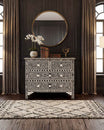
Bone inlay uses camel or buffalo bone that has been cleaned, bleached to a uniform white, cut into precise geometric shapes, and set into a lacquered surface in structured patterns. The bone is fully opaque, which means the colour of a bone inlay piece comes entirely from the pigment applied to the bone pieces and the lacquered ground between them. A teal and white bone inlay table UAE achieves its colour through dye. 

A mother of pearl table uses shell rather than bone, and the shell carries its own inherent iridescence independent of any applied pigment. The result is luminous where bone inlay is graphic, shifting where bone inlay is fixed, and materially complex where bone inlay is visually direct.

Feature

Mother of Pearl Table

Bone Inlay Table UAE

Material

Nacre shell

Camel or buffalo bone

Surface quality

Iridescent, light-shifting

Opaque, graphic, flat

Colour source

Natural shell + light interaction

Applied pigment dye

Visual character

Rich, luminous, complex

Precise, patterned, bold

Best room context

Where light reaches the surface directly

Where pattern is the focal point

Price range

Higher, reflects shell cost

Moderate to high

Combined version

Shell fragments within bone pattern

Bone geometry with pearl highlights

The two techniques are sometimes combined in a single  handcrafted mother of pearl table where bone inlay provides the geometric framework and mother of pearl fragments are inset within or alongside the bone to add iridescent highlights at key points in the pattern. Tabeer Homes produces pieces across all three approaches, including pure mother of pearl, pure bone inlay, and combined surface treatments on lacquered hardwood frames designed for living rooms, bedrooms, and entrance halls across UAE.

Why a Mother of Pearl Table Holds Its Value in UAE and Gulf Homes

The investment case for a genuine mother of pearl table UAE purchase rests on a combination of material scarcity, craft time, and the simple fact that the iridescent quality of nacre shell is not reproducible by any industrial process at any price point.

Printed surfaces, ceramic tops, and resin-cast finishes can approximate the visual appearance of mother of pearl at a distance and in a photograph. They do not replicate the material behaviour in a room. The light-shifting quality of genuine nacre depends on the actual microstructure of the shell, which produces interference colour as a physical optical phenomenon. A printed approximation produces a fixed image of iridescence that looks the same from every angle. Real nacre changes. That difference is visible to anyone who has spent time with both materials.

This irreproducibility gives a well-made mother of pearl side table or dining piece a quality that does not diminish with changing trends. Interior design directions shift every few years. The material richness of genuine handcrafted nacre inlay reads as valuable regardless of which style direction is dominant in any given cycle, because the quality is in the material rather than in the styling.

There is also a provenance dimension that matters in Gulf residential markets where furniture investment pieces are a considered part of interior specification. A mother of pearl inlay table Dubai buyer who can identify the producing workshop, the origin of the shell material, and the craft tradition behind the piece owns something with a traceable history. 

Placing a Mother of Pearl Table Where It Performs Best

A mother of pearl table placed in the wrong position in a room loses the quality that justifies its price. The iridescent surface depends on light reaching it from the right angle and in sufficient quantity to activate the optical properties of the nacre.

The positions where a mother of pearl side table , console, or coffee table performs at its highest level:

  • Against a wall that receives direct or near-direct natural light for part of the day, where the surface catches changing daylight as the day progresses
  • In a position where directional artificial lighting, a wall sconce, a directed spotlight, or an adjacent lamp, creates oblique light across the surface in the evening
  • In an entrance hall where a ceiling-mounted fixture illuminates the console directly from above and slightly to the front
  • As a bedside piece where a lamp on the surface creates close, warm light across the inlay each evening

Positions to avoid for any mother of pearl table UAE placement:

  • Recessed alcoves where light enters only from directly above and no oblique angle is available
  • Rooms with heavy window treatments that block natural light through most of the day
  • Directly beneath or adjacent to air conditioning vents, which create a drying microclimate that stresses the lacquer base over time and can cause inlay pieces to loosen at their edges

Caring for a Mother of Pearl Table in a UAE or Gulf Home

A handcrafted mother of pearl table in a UAE or Gulf home requires straightforward care rather than specialist maintenance. The surface holds up reliably under normal indoor conditions when a few basic protective habits are followed.

Daily and routine care practices:

  • Wipe the surface with a soft dry or very lightly dampened microfibre cloth. Abrasive cloths produce micro-scratches on the lacquered ground that accumulate into visible surface dulling over months.
  • Place a heat-resistant pad under any hot cup, plate, or object. The lacquer base is vulnerable to heat marking at sustained contact, and the mark left by a hot base on lacquer is not reversible without professional refinishing.
  • Wipe spills immediately rather than allowing liquid to sit on the surface. Water itself does not damage nacre, but pooled liquid at the seam between shell and filler can soften the adhesive bed over time if the surface is not dried promptly.
  • Polish the surface two to three times per year with a wax formulated for lacquered furniture. This maintains the protective layer over the lacquer and keeps the surface depth and iridescence at its best.

Frequently Asked Questions

What is a mother of pearl table and how is it made? 

A mother of pearl table is a piece of furniture with a surface inlaid with fragments of nacre shell, the iridescent inner lining of certain mollusc species, set by hand into a lacquered wood base. The making process involves preparing a lacquered ground, cutting shell into the required shapes, setting each piece individually into the ground, filling the gaps between pieces with coloured filler, levelling the entire surface flat, and polishing to the specified finish. 

How does a mother of pearl table differ from a bone inlay table? 

A mother of pearl table uses nacre shell as the inlay material, producing a surface that is naturally iridescent and shifts in colour with changing light angles. A bone inlay table UAE uses dyed camel or buffalo bone set in geometric patterns, producing an opaque, graphic surface whose colour comes from applied pigment rather than from the material itself. Mother of pearl reads as luminous and materially complex. 

Is a mother of pearl inlay table practical for everyday use in Dubai or UAE homes? 

A mother of pearl inlay table Dubai piece is practical for everyday use when basic protective habits are followed. The surface holds up well to normal handling and wiping. Heat from hot cups and plates should be avoided without a protective pad, and spills should be wiped immediately rather than left to the pool. 

What should I expect to pay for a handcrafted mother of pearl side table in the UAE?

 A genuine handcrafted mother of pearl table in side table configuration from a verified production workshop ranges from approximately 1,800 to 4,500 AED in UAE retail depending on surface complexity, shell quality, and frame construction. Pieces significantly below this range are typically produced through machine-assisted or simplified processes rather than traditional handcraft. 

How do I identify a genuine handcrafted mother of pearl table versus a machine-produced piece? 

Examine the surface at close range under oblique light. Genuine handcraft shows slight natural variation in shell piece size and setting across the surface, visible on close inspection, which distinguishes it from machine-placed inlay where every piece is identical and positioned to mechanical precision. Check pattern resolution at corners and junctions: a master craftsperson resolves the geometry cleanly at these points, while rushed or mechanised production shows gaps, misalignment, or pattern interruption. 

Why does a mother of pearl table cost more than a painted or lacquered table of similar size? 

The price premium of a mother of pearl table UAE piece over a comparably sized painted or lacquered table reflects three factors: the cost of the shell material itself, which is a natural product with limited and location-specific availability; the craft time invested in cutting, setting, levelling, and finishing the inlay, which for a complex surface runs from several hours to multiple days; and the skill level required to execute the pattern with precision across the full surface. 

Ending Words 

A mother of pearl table earns its price not through marketing or material rarity alone but through the convergence of an optical property that cannot be industrially replicated and a craft process that cannot be meaningfully shortened without visible consequence to the result. The iridescence of genuine nacre is a physical phenomenon produced by the shell's microstructure. No print, no coating, and no synthetic alternative produces the same behaviour in changing light. For UAE and Gulf buyers investing in furniture that holds its quality over years of daily use and retains its visual relevance across changing interior design cycles, a well-made mother of pearl side table , console, or coffee piece from a verified craft producer is a considered investment rather than a decorative indulgence. The craft is visible in the surface. The value is visible in the room.

قراءة التالي

Chest of Drawers
Mother of Pearl Coffee Table How to Style It

اترك تعليقًا

This site is protected by hCaptcha and the hCaptcha Privacy Policy and Terms of Service apply.