


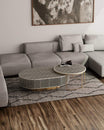
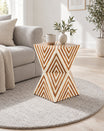

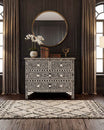
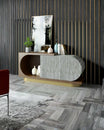




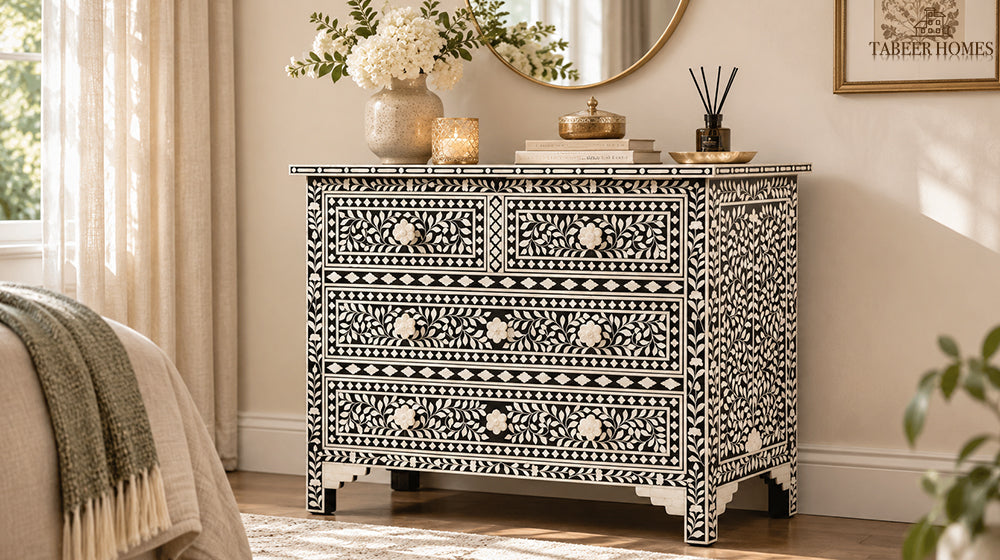
Every dresser drawer is a small decision about how you live. A tall stack of narrow drawers suits a short wall. A wide, low run of drawers suits a long one. Deep drawers hold knitwear, and shallow ones keep jewellery and underwear from turning into a jumble. Most bedrooms end up with the wrong dresser because nobody matched the drawer layout to the room and to what goes inside, even when the piece itself is well made.
This guide explains the main types, from tall narrow chests to wide dressers, small chests and bedside drawers. It covers the details that change how a drawer works every day, such as the front style, the handles and the glides. Then it shows how to match a type to your bedroom layout and storage needs. It uses the pieces Tabeer Homes lists, with the dimensions and drawer counts published on each product page, so you can test the advice against real numbers.
Tabeer Homes is a luxury furniture brand serving the GCC, with a flagship store in the UAE. Its pieces are handcrafted in its own ateliers in India, using bone inlay, mother of pearl, marble and solid wood. Its chest of drawers collection is large, with 75 products at the time of writing, so there is a lot to choose from and a lot to keep straight.
The Main Types of Dresser and Chest
The words dresser, chest of drawers , tallboy and bureau overlap, and shops use them loosely. These working definitions help.
|
Type |
Typical shape |
Best for |
|
Tallboy or tall chest |
Narrow and tall, often 120 to 140 cm high |
Short walls and small floor footprints |
|
Standard chest of drawers |
Roughly 80 to 120 cm wide and 80 to 90 cm high |
Most bedrooms |
|
Wide dresser |
130 cm wide and above, low |
Long walls and shared rooms |
|
Small chest |
Under about 90 cm wide |
Compact bedrooms and dressing corners |
|
Side drawer or bedside chest |
Around 45 to 55 cm wide and 55 to 60 cm high |
Beside a bed or sofa |
|
Console or dresser console |
Shallow, 35 cm deep or so, with drawers |
Hallways and slim walls |
Here is how Tabeer's pieces map onto those types, using the dimensions on each product page, written as width x depth x height.
|
Piece |
Type |
Size (W x D x H) |
Drawers |
|
Iris Big Chest of Drawers (grey mother of pearl) |
Tallboy |
85 x 45 x 135 cm |
5 per the meta text; "multiple" in the body |
|
Ewan Small Chest of Drawers (dark wood) |
Small chest |
80 x 45 x 85 cm |
6 per the meta text; "multiple" in the body |
|
Jade Chest of Drawers (black bone inlay) |
Standard chest |
110 x 45 x 80 cm |
4 |
|
Iris Chest of Drawers (pink mother of pearl) |
Standard chest |
108 x 50 x 85 cm |
4 |
|
Daraj Big Chest of Drawers (black wood) |
Wide dresser |
130 x 45 x 75 cm |
6 |
|
Piccolo Big Chest of Drawers (black wood) |
Wide dresser |
130 x 45 x 75 cm |
6 per the meta text |
|
Iris Chest of Drawers (pink mother of pearl, large) |
Wide dresser |
150 x 50 x 85 cm |
7 |
|
Zuri Chest of Drawers (black bone inlay) |
Wide dresser |
160 x 45 x 85 cm |
6 in the text, 7 in the image text |
|
Ameerah Chest of Drawers (black bone inlay) |
Wide dresser |
183 x 50 x 89 cm |
9 |
|
Luna Side Drawers (blue) |
Bedside chest |
45 x 40 x 55 cm |
2 per the image text |
|
Console |
90 x 35 x 80 cm |
2 |
Tabeer lists dozens of other chests in the Maze, Basel, Vaan, Kotor and Yasmine families, among others, and 52 side drawers. The collection page does not show dimensions, and this guide only uses pages whose dimensions were checked.
Drawer Fronts: How the Face of a Dresser Drawer Sits
The front of a dresser drawer affects the look and the way it opens.
- Inset fronts sit inside the frame and are flush with it. They look tailored and precise, and need tight tolerances to open smoothly.
- Overlay fronts sit over the frame and cover it. They are more forgiving, and the gaps between drawers are small.
- Flush or continuous fronts run as one surface, so the whole face reads as a pattern. This works well with inlay.
Tabeer's Zuri page describes drawers "concealed within the illusion-like façade", which suggests a continuous patterned face with the drawer lines hidden in the pattern. That is an attractive effect, but it means you have to look closely to find the drawer edges. Ask Tabeer how the drawers open, and check the photos.
Handles and Knobs
Hardware changes how a drawer feels in the hand and how it looks from across the room.
- Knobs are small and simple. They are easy to grip with one finger and suit a traditional or inlaid piece. Tabeer's pages mention crystal knobs on the Iris chests and the Luna side drawers, inlaid bone knobs on the Jade chest and brass-capped knobs on the Zuri.
- Pulls and lip handles give a bigger grip and suit heavy drawers. The Ameerah chest page describes brass lip handles, while its meta description says brass knobs, so ask which applies.
- Recessed or concealed grips keep the face clean but can be harder to use.
Think about the hand that opens the drawer. Small knobs suit light drawers, and heavy drawers full of denim are easier with a larger pull. If you have children or older family members, a bigger grip is easier to use.
Glides and Construction: The Part You Cannot See
The runner system decides whether a drawer glides or sticks. Common types include wood-on-wood runners, metal side-mounted glides and undermount glides, some with soft-close dampers.
Tabeer's pages say little about this. The Jade page says "the drawers glide smoothly", and the Zuri page mentions "smooth glide channels", but none of the pages checked state the runner type, whether the drawers fully extend, whether they close softly or what the drawer boxes are made from. Do not assume. Before you buy, ask Tabeer:
- What type of glides do the drawers use?
- Do the drawers extend fully?
- Is there soft-close?
- What is the drawer box made of, and how is it joined?
- What is the internal height and depth of each drawer?
Those five answers tell you more about daily use than the photos do.
Match the Type to Your Bedroom Layout
Short or narrow wall
A tallboy gives you the most drawers in the smallest footprint. The Iris Big Chest of Drawers (85 x 45 x 135 cm) packs five drawers into an 85 cm width. A tall piece also keeps the top at chest height, which can suit a dressing mirror hung close by. Keep in mind that the top will be out of reach for some people, and leave the surface clear of heavy items.
Standard bedroom wall
A chest of 100 to 120 cm wide, such as the Jade (110 cm) or the Iris (108 cm), suits a wall at the foot of the bed or beside a window. These give four drawers with a surface wide enough for a lamp and a tray.
Long wall or shared room
A wide dresser of 130 to 183 cm gives you six to nine drawers and room for two people's belongings. The Daraj and Piccolo (130 cm) and the Zuri (160 cm) suit a wall with space on either side. The Ameerah (183 cm) is a statement piece that needs a wall of at least 2.4 metres to leave clear space at each end.
Compact bedroom
The Ewan Small Chest of Drawers (80 x 45 x 85 cm) is the smallest full chest I could confirm in Tabeer's range, with six drawers listed in its meta text. At 80 cm wide it can fit beside a window or between a door and a wall. Bedside drawers, such as the Luna (45 x 40 x 55 cm), let you split storage on either side of the bed.
Dressing corner or hallway
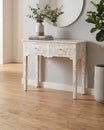
A shallow dresser console gives you drawers with a slimmer depth. The Iris Mini Dresser Console (90 x 35 x 80 cm) has two drawers and is the slimmest option listed.
Clearance: Room to Open the Drawers
Drawers need space in front. A common planning figure is the depth of the open drawer, roughly equal to the depth of the piece, plus about 60 cm to stand. For a 45 cm deep chest, that is around 105 cm in front. If the bed, a door or another piece of furniture sits closer than that, the drawers will not open fully or will block the way.
Check these before you buy:
- Bed distance. Stand where you would use the dresser and open the drawers on paper or tape.
- Door swing. The dresser must not block a door or a wardrobe.
- Window and sockets. Check sill height and socket positions behind and above the piece.
- Walkway. Leave about 90 cm where people pass.
Match the Type to What You Store
Think about what goes in each drawer, and then count.
|
What you store |
What suits it |
|
Folded T-shirts and everyday clothes |
Medium-depth drawers, three to four of them |
|
Knitwear and bulky items |
Deep drawers at the bottom |
|
Underwear, socks and accessories |
Shallow drawers at the top, with dividers |
|
Jewellery and small items |
A top drawer or a separate box on the surface |
|
Bed linen |
Wide, deep drawers, or a cabinet with doors |
|
Hanging clothes |
A wardrobe suits these better than a dresser |
A few guidelines help.
- Give each dresser drawer one job. One for nightwear, one for gym clothes, one for socks. Mixed drawers turn into a jumble.
- Put daily items in the top drawers. They are easiest to reach.
- Put heavy items low. Heavy drawers sit best at the bottom, and they stay stable.
- Fold vertically. Standing clothes on edge shows everything at once.
- Leave space. A packed drawer is hard to close.
Tabeer's pages usually give the number of drawers but not their internal dimensions, so a count of six does not tell you how much fits. Ask for the internal width, depth and height of at least the top and bottom drawers.
When a Cabinet Beats a Chest of Drawers
Drawers suit clothes and small items. For bulky or irregular things, such as bedding, shoes and boxes, a storage cabinet with doors and shelves can be a better choice. A small cabinet also gives a bedroom a spot for items that do not fold into a drawer.
Tabeer's cabinet range includes the Azure (112 x 48 x 90 cm, two doors with an interior shelf) and the Eve (160 x 40 x 90 cm, four doors with interior shelving). A mixed arrangement works well: a chest of drawers for clothing and a small cabinet for linen or luggage. Some pieces combine both, such as the Jade Sideboard Buffet with two top drawers and four doors.
Material and Finish: What Suits Daily Use
A dresser is opened and touched every day, so finish matters.
- Wood is warm and forgiving, and Tabeer's Ewan, Daraj and Piccolo chests are listed in mango wood and metal. Wood shows scratches but can be refinished.
- Bone inlay has a matte, patterned face. The Jade, Zuri and Ameerah chests use it. The pattern helps hide small marks.
- Mother of pearl has a shimmer that shows best in good light. The Iris chests use it. Tabeer's guide notes that shell can show scratches more visibly than matte bone.
The care text on Tabeer's product pages says to dust regularly with a soft, dry microfiber cloth and avoid harsh chemicals, abrasive cleaners and acidic substances. Wipe spills with a slightly damp cloth and dry the area at once. Use a tray under perfume bottles and anything wet.
For mother of pearl, Tabeer's guide adds that you should dust in the direction of the pattern, avoid abrasive cloths and keep the piece away from air conditioning vents, which can stress the lacquer base over time. In a bedroom, check where the air conditioning unit blows before you pick a spot.
Questions and Contradictions to Resolve Before You Order
Tabeer's pages contain several conflicts. Resolve these first.
- Drawer counts differ. The Zuri says six drawers in the text and seven in the image text. The Iris Big Chest and the Ewan state counts only in the meta text. The Piccolo gives its count only in the meta text.
- Hardware differs. The Ameerah chest describes lip handles in the text and knobs in the meta description.
- Base differs. The Ameerah chest lists a golden plinth base, a solid metal base and a wood and resin construction in different places.
- Colour differs. The Piccolo is titled black but described as dark grey in the meta text. The Zuri is titled black but its image text says black and white.
- Materials differ. The Zuri lists resin in one place and brass hardware in another.
- Stock conflicts. Many pages show an in-stock tag next to a back-in-stock form or a Pre-order button. The collection lists 11 chests as ready to ship and 64 as pre-order.
- Lead times conflict. The Zuri and the Iris Big Chest show 8 to 12 weeks, and the policy says 6 to 10 weeks for pre-orders.
Get the drawer count, the hardware, the finish and the delivery date in writing.
Ordering: Delivery, Lead Times and Policy
These are the facts from Tabeer's published policy:
- In-stock items delivered within the UAE take 2 to 4 working days.
- In-stock items shipped internationally take 8 to 12 working days.
- Pre-orders take 6 to 10 weeks.
- Large pieces receive white-glove delivery, with basic on-site assembly where applicable.
- Customs duties, taxes and import charges, where they apply, are included in the product or shipping price.
- Payment can be split with Tabby instalments.
- All sales are final. Returns are accepted only for verified damage reported within 24 hours of delivery.
- Slight variation in pattern and tone is treated as part of handcrafted work.
Prices are left out of this guide because Tabeer runs a sitewide sale that changes them often. Measure the doorway, lift and corridor before you order, since a 183 cm chest has to reach the room. You can reach Tabeer on +971 4 251 5171 or at info@tabeerhomes.com.
Common Mistakes When Choosing a Dresser
- Choosing by drawer count alone. Six small drawers can hold less than four deep ones.
- Ignoring clearance. Drawers need space to open, and the bed often gets in the way.
- Skipping the internal dimensions. Ask for them.
- Forgetting the glides. Ask about the runner type and soft-close.
- Picking a wide dresser for a short wall. A tallboy may fit better.
- Putting heavy items at the top. Keep them low.
- Placing it by an AC vent or in strong sun. Both can stress the finish.
- Leaving page conflicts unresolved. Where a page contradicts itself, ask.
Final Thoughts
A good dresser starts with the wall and the clothes. Measure the wall, allow for open drawers, then count what you actually store. A tallboy suits a short wall, a standard chest of drawers suits most rooms and a wide dresser suits a long wall or a shared room. A small cabinet or storage cabinet takes the bulk that drawers cannot.
In Tabeer's range, the Iris Big Chest and the Ewan Small Chest are the compact options, the Jade and Iris chests are the standard sizes and the Daraj, Piccolo, Zuri and Ameerah are the wide ones. The pages leave drawer counts, hardware and glide details unclear in places, so ask before you pay. Tape the footprint on the floor, check the clearance, request the internal drawer sizes and get the delivery date in writing. Choose the right type, and every dresser drawer will open easily and hold what you need it to.
Frequently Asked Questions
What are the main types of dresser drawer layouts?
The main layouts are tall narrow chests, standard chests, wide dressers, small chests, bedside drawers and shallow dresser consoles. Each suits a different wall width and storage need.
How many drawers do I need in a dresser?
Count your categories: everyday clothes, knitwear, underwear and accessories, and nightwear. Four to six drawers suit most people, and a shared room may need seven to nine.
What is the best dresser for a small bedroom?
A tallboy uses the least floor space, and a small chest keeps the footprint low. At Tabeer, the Iris Big Chest of Drawers (85 x 45 x 135 cm) and the Ewan Small Chest of Drawers (80 x 45 x 85 cm) are the compact options I found.
How much space do I need in front of a dresser?
Around 105 cm is a common planning figure for a 45 cm deep piece, which covers the open drawer and room to stand. Leave about 90 cm where people walk past.
Should I choose knobs or pulls for a dresser drawer?
Knobs suit light drawers and a traditional look. Pulls or lip handles are easier for heavy drawers. Tabeer's pages mention crystal, inlaid bone and brass-capped knobs.
Is a chest of drawers better than a storage cabinet?
For clothing, yes. For bedding, shoes and bulky items, a storage cabinet with doors and shelves suits better. Many bedrooms use one of each.
Does Tabeer publish drawer glide details?
Not on the pages I checked. The pages say the drawers glide smoothly, but they do not state the runner type, extension or soft-close. Ask Tabeer.
How do I clean an inlaid chest of drawers?
Dust with a soft, dry microfiber cloth, wipe spills with a slightly damp cloth and dry them at once, and avoid abrasive cleaners, harsh chemicals and acidic substances.
How long does delivery take?
Tabeer's policy states 2 to 4 working days for in-stock items in the UAE and 6 to 10 weeks for pre-orders. Some product pages show 8 to 12 weeks, so confirm the date for your piece.


اترك تعليقًا
This site is protected by hCaptcha and the hCaptcha Privacy Policy and Terms of Service apply.