









You need a mirror for the blank wall by your front door, and the plain glass rectangle at the hardware store feels like giving up before you have even started. A bone inlay mirror solves the same practical problem, somewhere to check your reflection before you leave the house, while doubling as a genuine piece of decorative art. But bone inlay mirrors come in a wider range of sizes, patterns, and price points than most first-time buyers expect, and a few informed decisions before you order will save you from a piece that looks stunning online and awkward on your actual wall.
What Is a Bone Inlay Mirror?
A bone inlay mirror is a wall mirror framed with hand-carved bone segments set into a resin bed cut into a solid wood border, using the same centuries-old Rajasthani inlay technique applied to furniture. The mirror glass itself sits at the center, while the surrounding frame carries the pattern, whether a bold geometric checkerboard, a delicate floral motif, or a clean linear border. For a deeper look at how the underlying craft works, our guide on what bone inlay furniture actually is covers the carving and setting process in detail.
Bone Inlay Mirror Vs Mother of Pearl Mirror
The same material choice that applies to furniture applies directly to mirror frames, and the difference matters more on a mirror than almost anywhere else, since the frame surrounds a reflective surface that already draws the eye.
|
Feature |
Bone Inlay Mirror |
Mother of Pearl Mirror |
|
Frame finish |
Matte, earthy |
Glossy, iridescent, shifts with light |
|
Typical colors |
White, ivory, dyed black or brown |
White, plus natural pink, blue, and green tones |
|
Visual effect |
Bold, graphic contrast around the glass |
Soft shimmer that echoes the mirror's own reflectivity |
|
Best suited to |
Rooms wanting strong pattern and contrast |
Rooms wanting a softer, more luminous accent |
A mother of pearl mirror frame tends to visually blend with the reflective glass itself, since both materials catch and shift light, producing a softer, more unified glow around the edges. A bone inlay frame creates more contrast against the glass, since its matte finish reads as a distinct, separate border rather than an extension of the mirror's own shine. Neither is objectively better, and the choice largely comes down to whether you want the frame to announce itself or to work with the mirror's reflectivity rather than against it.
Common Bone Inlay Mirror Shapes and Frame Styles
Bone inlay mirrors are produced in a wider range of shapes than most other inlay furniture pieces, since the mirror itself, rather than a storage cavity, defines the core structure.
- Rectangular frames , the most common format, suit hallways, above consoles, and above sideboards where a defined width matters.
- Round and oval frames , which soften a room with many straight lines and pair especially well above a rectangular console or sideboard for contrast.
- Arched or cathedral-top frames , adding height and a slightly more traditional silhouette, well suited to entryways with taller ceilings.
- Checkerboard and geometric patterns , producing a bold, graphic frame that works as a statement piece even in a relatively simple room.
Bone Inlay Mirror Price Ranges: What Drives the Cost
As with bone inlay furniture, the price difference between a plain framed mirror and a bone inlay one comes down almost entirely to labor rather than the raw material itself. A compact wall mirror frame can still involve hundreds of individually carved and set bone segments, each shaped by hand before the resin filling and polishing stages begin, and pattern density plays a direct role in cost: a dense floral or checkerboard design across the full frame takes considerably longer to produce than a simpler linear border with fewer inlay segments. Frame size also compounds this effect rather than scaling it evenly, since a full-length mirror frame does not simply cost proportionally more than a compact wall mirror, it requires enough additional carving time that the price gap between the two formats is often larger than the size difference alone would suggest.
Custom and Made-to-Order Bone Inlay Mirrors
Many bone inlay workshops, including those supplying frames for the UAE and wider GCC market, offer customization on dimensions, color palette, and pattern density beyond what is shown in a standard product listing. This matters most for buyers who need a specific width to match an existing console or sideboard, or who want a full-length mirror sized to a particular wall rather than settling for whatever floor-mirror dimensions happen to be in stock. Custom orders generally extend the production timeline beyond what a ready-to-ship wall mirror requires, so buyers working toward a fixed move-in or renovation date should confirm lead times explicitly before committing to a custom size or pattern rather than assuming a made-to-order piece will arrive on the same schedule as an in-stock item.
Bone Inlay Mirror Sizes: Wall Mirrors Vs Full-Length
Most bone inlay mirrors sold as decorative wall pieces run in a compact range, typically 55 to 90 cm tall, sized for hanging above a console, sideboard, or dresser rather than for full-body viewing. A bone inlay mirror full length piece, generally defined as tall enough to reflect a person from roughly the knees or waist up to well above head height, usually starts around 150 cm and can run considerably taller for a genuine floor mirror. Because the inlay technique is labor-intensive per square centimeter of frame, a true full-length bone inlay mirror requires substantially more carving work than a compact wall mirror, and workshops that offer the format typically do so as a made-to-order piece with a longer production lead time rather than a stocked, ready-to-ship item. If a full-length inlay mirror is what you are after, confirming lead time and customization options directly with the retailer before ordering will save you from an unexpected wait.
How to Choose the Right Size for Your Wall
A mirror that is the right shape but the wrong size for its wall rarely reads as intentional, regardless of how well-crafted the frame itself is.
- Match the mirror's width to the furniture beneath it. A wall mirror hung above a console or sideboard generally looks most proportional at 60 to 80 percent of that furniture's width, rather than spanning the full length or looking undersized in the center.
- Leave breathing room on either side of the wall. Even a mirror sized correctly to the furniture below it can look cramped if it runs edge to edge on a narrow wall, so leaving at least 15 to 20 cm of visible wall on either side keeps the arrangement from feeling crowded.
- Hang it at a height that works for its purpose. For a functional entryway or dressing mirror, the center of the glass should sit roughly at eye level for the household's average height. For a purely decorative mirror above furniture, leaving 15 to 20 cm of clearance between the top of the furniture and the bottom of the frame generally reads as well-proportioned.
- Consider the mirror's depth for a full-length piece. A framed floor mirror with a wood and inlay border adds noticeably more depth than a frameless glass leaner, so measure the available floor space with the frame's full thickness in mind, not just the glass dimensions listed in a product description.
Buying Guide: What to Check Before You Purchase
A few practical checks separate a mirror that will hold up for years from one that becomes a maintenance headache within months.
- Glass thickness and quality. Reputable mirrors use glass in the 4 to 6 mm range, thick enough to resist warping and to hold a true, undistorted reflection across the full surface.
- Backing and safety film. A quality mirror includes a protective backing that helps prevent shattering into sharp fragments if the glass is ever cracked, an especially relevant consideration for larger or full-length pieces in a household with children.
- Mounting hardware rated for the actual weight. Bone inlay frames are heavier than plain wood or metal frames due to the resin and bone layer, so confirming the mirror ships with (or specifies) hardware rated for its true weight prevents a wall-mounting failure down the line.
- Frame material underneath the inlay. As with furniture, a solid wood base, typically mango wood, holds the carved channel work and resin bond better over time than a composite or particleboard substrate.
- Ethical sourcing confirmation. As with any bone inlay piece, a reputable seller will describe the bone as an ethically sourced byproduct of the meat industry rather than remaining vague about where the material comes from.
- Return and installation policy for larger pieces. Full-length and other large-format mirrors are harder to return or exchange once shipped, given both their weight and the risk of glass damage in transit, so confirming the seller's policy on this specific product category before ordering avoids an unpleasant surprise if the piece does not fit as expected.
Styling a Bone Inlay Wall Mirror by Room
The same mirror shape and size can play a different role depending on which room it hangs in.
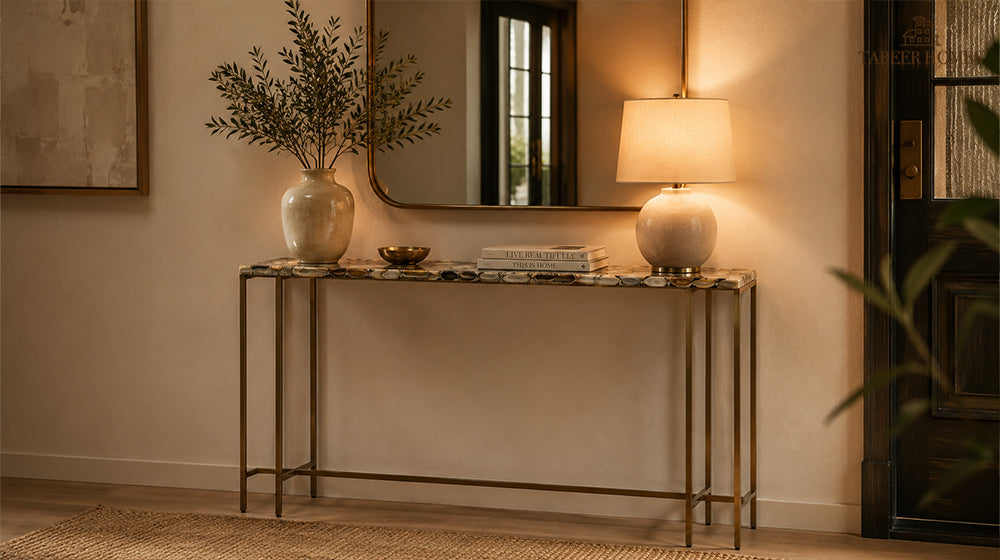
- Entryway. A rectangular or arched bone inlay mirror above a console table gives arriving and departing guests a functional check-in point while doubling as the first strong design statement in the home. Our guide on styling an entryway console table covers how to build the rest of the vignette around a mirror like this.
- Dining room. Hung above a sideboard or buffet cabinet, a bone inlay mirror bounces candlelight and overhead lighting back into the room during meals, making the space feel brighter and larger than its actual dimensions.
- Living room. A round or oval bone inlay mirror above a media console or low credenza softens a room full of rectangular furniture, while a larger rectangular frame can serve as the room's primary art statement above a sofa.
- Bedroom. A full-length or near-full-length bone inlay mirror leaned against a wall or mounted beside a dresser adds genuine function alongside the decorative pattern, particularly useful in a room that otherwise lacks a dedicated dressing area. A leaned floor mirror also has the advantage of being repositioned easily if furniture in the room changes, unlike a wall-mounted piece that commits to a fixed spot once installed.
Caring for a Bone Inlay Mirror Frame
Mirror frames need the same gentle care as any other bone inlay piece, with one additional consideration for the glass itself.
- Dust the frame weekly with a soft, dry microfiber cloth , following the pattern's direction rather than wiping across it.
- Clean the glass separately from the frame , using a standard glass cleaner applied to the cloth rather than sprayed directly onto the mirror, since overspray can seep into the resin seams at the frame's inner edge.
- Keep the piece away from direct sunlight and high humidity , since both can affect the bone's tone and the resin bond over time, the same precaution that applies to any bone inlay furniture.
- Check wall anchors periodically , especially for larger or full-length pieces, since the added weight of an inlay frame puts more ongoing strain on mounting hardware than a lightweight glass mirror would.
Common Mistakes When Buying an Inlay Wall Mirror
A handful of avoidable errors account for most of the disappointment buyers report with decorative mirror purchases.
- Judging scale from a product photo alone. Product images rarely include a clear size reference, so a mirror that looks large and dramatic online can arrive smaller than expected relative to the actual wall.
- Skipping the weight and mounting hardware question. Assuming a bone inlay mirror can be hung with the same basic hardware as a lightweight glass mirror is a common and avoidable mistake, particularly for larger frames.
- Choosing a pattern that fights with an already busy room. A heavily patterned checkerboard or floral bone inlay frame can compete visually with an equally patterned rug or wallpaper nearby, so matching the frame's boldness to the room's existing pattern density matters as much as matching its color.
- Assuming full-length availability without checking lead time. Since true full-length bone inlay mirrors are typically made to order, assuming one is available for quick delivery the way a compact wall mirror often is can derail a moving or renovation timeline.
Bringing It All Together
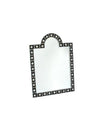
A bone inlay mirror earns its place on a wall for the same reason bone inlay furniture does, it turns a purely functional object into a handcrafted focal point without asking the room to compromise on either. Whether you choose a compact rectangular mirror for above a console, a round frame to soften a living room full of straight lines, or a made-to-order full-length piece for a bedroom, the sizing and mounting checks matter as much as the pattern itself. Tabeer Homes' Maze Mirror in brown bone inlay (60 x 3 x 90 cm) shows how a checkerboard frame reads as a bold focal point even at a compact wall-mirror scale, while the Yasmine Mirror in black bone inlay (61 x 3 x 91 cm) demonstrates the same principle in a higher-contrast black and white palette. Comparing a few frame styles and finishes against your actual wall measurements, rather than choosing on pattern alone, is the single best way to land on a mirror that looks as considered in your home as it does in a product photo.
Frequently Asked Questions
What is a bone inlay mirror made from?
A bone inlay mirror pairs standard mirror glass with a frame made from hand-carved bone segments set into resin on a solid wood base, using the same technique applied to bone inlay furniture.
Is a bone inlay mirror or a mother of pearl mirror better?
Neither is inherently better. Bone inlay frames offer a bold, matte, high-contrast look, while mother of pearl frames offer a softer, glossy shimmer that blends more closely with the mirror's own reflectivity.
Can you get a bone inlay mirror in full length?
Yes, though true full-length bone inlay mirrors, generally 150 cm or taller, are typically made to order rather than stocked as a ready-to-ship item, given the additional carving work a larger frame requires.
How much does a bone inlay mirror weigh?
Weight varies with size, but bone inlay frames are noticeably heavier than plain wood or metal frames due to the resin and bone layer, so confirming wall-rated mounting hardware before installation is important.
Where should a bone inlay mirror be hung?
Common placements include above an entryway console, above a dining room sideboard or buffet, or in a bedroom as a full-length or near-full-length piece, with the ideal height depending on whether the mirror serves a functional or purely decorative role.
How do you clean a bone inlay mirror?
Dust the frame with a soft dry cloth in the direction of the pattern, clean the glass separately with a standard glass cleaner applied to a cloth rather than sprayed directly on the mirror, and keep the piece away from direct sunlight and high humidity.


Leave a comment
This site is protected by hCaptcha and the hCaptcha Privacy Policy and Terms of Service apply.