



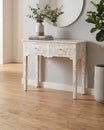
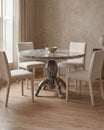

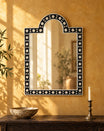

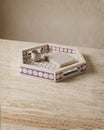
A sideboard buffet cabinet is the hardest-working piece in a room that has one. It holds tableware and linen, it gives you a surface for serving, lamps and flowers, and it anchors the wall it stands against. Placed well, it makes a dining room look finished and a living room look planned. Placed badly, it blocks a door, crowds a walkway or sits against a wall that is too short for it.
This guide goes through the rooms of a home one at a time. For each, it covers where the cabinet should go, how much space it needs, what to put inside and what to put on top. It uses the pieces Tabeer Homes lists, with the dimensions published on each product page, so you can test each idea against real numbers.
Tabeer Homes is a luxury furniture brand serving the GCC, with a flagship store in the UAE. Its pieces are handcrafted in its own ateliers in India, using bone inlay, mother of pearl, marble and solid wood. Its Cabinets & Buffets collection is one of the largest in the shop, with 64 products at the time of writing, ranging from two-door cabinets to long sideboards.
What a Sideboard Buffet Cabinet Is, and How It Differs From Its Neighbours
The names overlap, and shops use them loosely. These working definitions keep the rest of the guide clear.
- A sideboard buffet cabinet is long and low, usually 140 to 190 cm wide and 80 to 100 cm high, with a mix of doors and drawers. It is built to store tableware and to serve from. The word buffet points to the serving role.
- A console table is shallow, often 30 to 45 cm deep, and mostly open or fitted with drawers. It is more of a surface than a store.
- A storage cabinet is a general term for a piece with doors and shelves. It can be tall or low, narrow or wide. A sideboard is one kind of storage cabinet.
The choice between them depends on what you need to hide. If you need to store bulk, such as plates, glasses, linen and serving dishes, a sideboard or storage cabinet is the answer. If you only need a place to drop keys and put a lamp, a console table takes less room.
Tabeer's Sideboards and Cabinets at a Glance
The table below uses the dimensions published on each product page at the time of writing, written as width x depth x height. Prices are left out because Tabeer runs a sitewide sale that changes them often.
|
Piece |
Finish |
Size (W x D x H) |
Doors, drawers and shelves as stated |
|
Saphed Sideboard |
Black bone inlay, checkered pattern |
180 x 50 x 80 cm |
Not stated |
|
Jade Sideboard Buffet |
Black bone inlay |
175 x 45 x 92 cm |
4 doors per the meta text; one interior shelf in the description, two shelves in the meta text |
|
Jade Sideboard Buffet |
White mother of pearl (description says grey) |
175 x 45 x 90 cm |
2 top drawers, 4 doors, one interior shelf |
|
Jade Sideboard Buffet |
Yellow bone inlay |
175 x 45 x 90 cm |
4 doors, 2 upper drawers; gold metal base |
|
Jade Sideboard Buffet |
Black mother of pearl |
175 x 45 x 90 cm |
2 top drawers, 4 doors, one interior shelf |
|
Luna Sideboard |
Green mother of pearl |
160 x 40 x 81 cm |
2 doors, 3 drawers |
|
Eve Cabinet |
Black bone inlay |
160 x 40 x 90 cm |
4 doors, interior shelving; brass-finish metal legs |
|
Maze Sideboard Buffet |
Black bone inlay |
150 x 50 x 100 cm |
"Spacious drawers and cabinets"; counts not stated |
|
Ameerah Cabinet |
Black and white bone inlay |
150 x 45 x 86 cm |
Layout unclear on the page |
|
Lekh Cabinet |
Black and white bone inlay |
145 x 45 x 100 cm |
3 leaf doors, shelves and compartments |
|
Aatma Cabinet |
Black and white bone inlay |
110 x 50 x 92 cm |
A shelf; doors and drawers not stated |
|
Azure Cabinet |
Black mother of pearl |
112 x 48 x 90 cm |
2 doors, interior shelf |
|
Luna Cabinet |
Green mother of pearl |
100 x 45 x 87 cm |
2 doors |
The collection also lists tall cabinets, bar counters and TV units from the Luna, Lipari, Jade, Ameerah and Iris families, whose dimensions this guide does not use.
Several points on these pages are worth knowing before you plan around any of them.
- Door and drawer counts are often missing. The Saphed, Maze, Aatma and Ameerah pages do not state them. Ask Tabeer for the exact layout.
- Colours conflict on several pages. The white Jade Sideboard Buffet is described as grey in its own text. The Luna Sideboard and the Luna Cabinet are titled green but described as deep blue in places.
- Leg descriptions conflict. The Luna Sideboard has gold legs in one description and black legs in the image text.
- Heights differ between fields. The white Jade Sideboard Buffet page gives 90 cm in the product details and 80 cm in a social description. The black bone inlay Jade is 92 cm.
- Stock status conflicts. Many pages show an in-stock tag next to a Pre-order button or a back-in-stock form. The Cabinets & Buffets collection shows 14 of its 64 products in stock and 50 on pre-order.
Sizing and Placement Rules That Apply to Every Room
A few rules hold in any room.
- Leave clear wall at each end. A common guide is 20 to 30 cm on each side, so the cabinet does not look squeezed. A 175 cm sideboard suits a wall of at least 2.2 metres.
- Check depth against the walkway. Tabeer's sideboards are 40 to 50 cm deep. Keep about 90 cm of clear floor in front where people pass.
- Allow for the doors and drawers. A drawer needs its depth plus room to stand. A door needs to swing without hitting a chair. For a 45 cm deep piece, around 105 cm in front is a common planning figure.
- Think about height above. Pieces range from 80 to 100 cm tall. A taller cabinet leaves less wall for art or a mirror.
- Centre it on something. A window, a doorway or a light fitting gives the cabinet a reason to be where it is.
- Check the delivery route. A 175 to 180 cm piece must pass through the door and lift before it reaches the room.
Mark the footprint on the floor with masking tape, and add the clearance. Leave it for a day.
Dining Room
The dining room is where a sideboard buffet cabinet does the job it was named for.
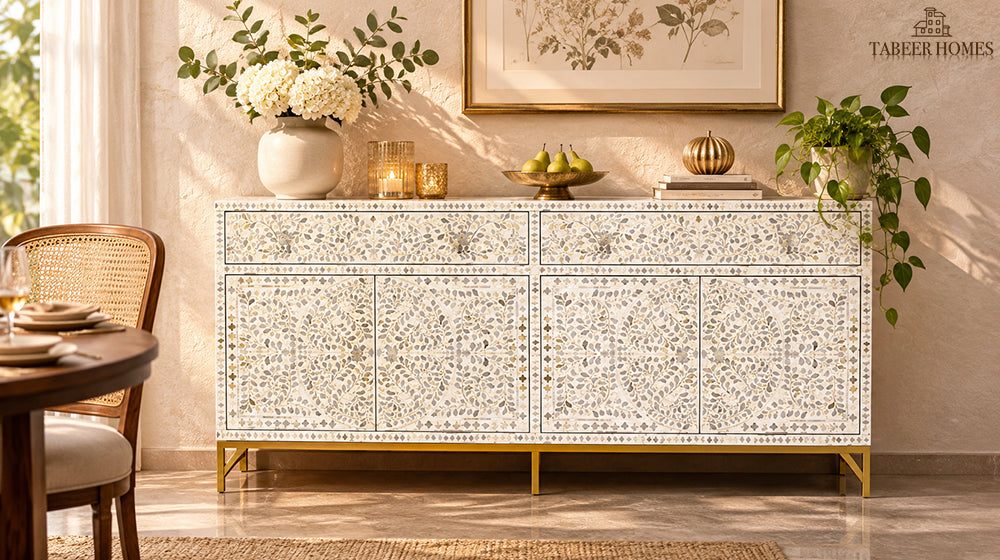
Placement. Put it on the wall opposite the entrance or along the longest wall. Keep it at least 90 cm from the back of the dining chairs so people can pass when guests are seated. In a room with an eight-seat table, a 175 cm piece such as the Jade Sideboard Buffet works well along a long wall.
What goes inside. Plates, glasses, serving dishes, table linen and candles. Use the drawers for cutlery, napkins and small items. Put the heaviest items on the lowest shelf. Tabeer's Jade pages list two top drawers and four doors, with one interior shelf.
What goes on top. Two or three objects and a lamp. A pair of lamps looks formal, and a single lamp with a tray and a vase looks relaxed. Leave a clear stretch for serving dishes, and use trivets under hot dishes. Tabeer's care text asks for coasters or pads under hot and wet items, so a pot straight from the stove should never go directly on an inlaid top.
Above it. A large mirror opposite a window doubles the light in the room. A framed print works too. Hang the bottom of the frame 15 to 25 cm above the cabinet top.
Living Room
Placement. The wall opposite the sofa, behind a sofa that floats in the room, or under a window. Behind a sofa, a shallow piece such as the Luna Sideboard (160 x 40 x 81 cm) or the Eve (160 x 40 x 90 cm) works best, since 40 cm leaves more space.
What goes inside. Throws, board games, extra cushions, photo albums, entertaining pieces and remote-control clutter. This is where a storage cabinet earns its keep, keeping the living room clear of loose items.
What goes on top. A lamp, a stack of books, a bowl and a plant. Keep the arrangement lower than the sofa back if the cabinet sits behind it.
TV placement. Tabeer lists separate TV unit cabinets in the Luna, Lipari, Jade, Ameerah and Iris families. For a sideboard used as a TV stand, ask Tabeer for the weight it can carry and whether the top suits your screen. The Ameerah Cabinet page calls the piece a TV console in one place, yet gives no weight limit.
Entryway and Hallway
Placement. The slimmest pieces fit here. The Luna Sideboard and the Eve are 40 cm deep, and a narrow hall may need something shallower still. Tabeer's console tables are slimmer, for example the Iris Console & Dresser (100 x 35 x 80 cm) and the Iris Mini Dresser Console (90 x 35 x 80 cm). The black Jade Console Table (120 x 45 x 80 cm, three drawers) is another option.
Sideboard or console table? If the entry hall is wider than about 150 cm, a sideboard of 40 to 45 cm depth gives you real storage for shoes, bags and seasonal items. If the hall is narrower, a console table with drawers leaves more walkway. Measure first.
What goes on top. A tray for keys, a lamp and a mirror above. Keep the top mostly clear, since this surface gets used daily.
Bedroom
Placement. At the foot of the bed, under a window or along a wall opposite the bed. A sideboard in a bedroom works as extra storage and a dressing surface.
What goes inside. Bed linen, towels, spare bedding, shoes and luggage. A storage cabinet with doors suits these better than drawers.
Scale. A 175 cm sideboard is large for most bedrooms. The Azure (112 x 48 x 90 cm), the Aatma (110 x 50 x 92 cm) or the Luna Cabinet (100 x 45 x 87 cm) fit better.
What goes on top. A lamp, a small tray for jewellery and perfume, and one decorative object. Keep scented bottles on a tray.
Home Office or Study
Placement. Behind the desk, along a side wall or opposite the desk. A long cabinet behind the chair works as a credenza.
What goes inside. Files, stationery, printer, chargers and archive boxes. Doors hide the clutter.
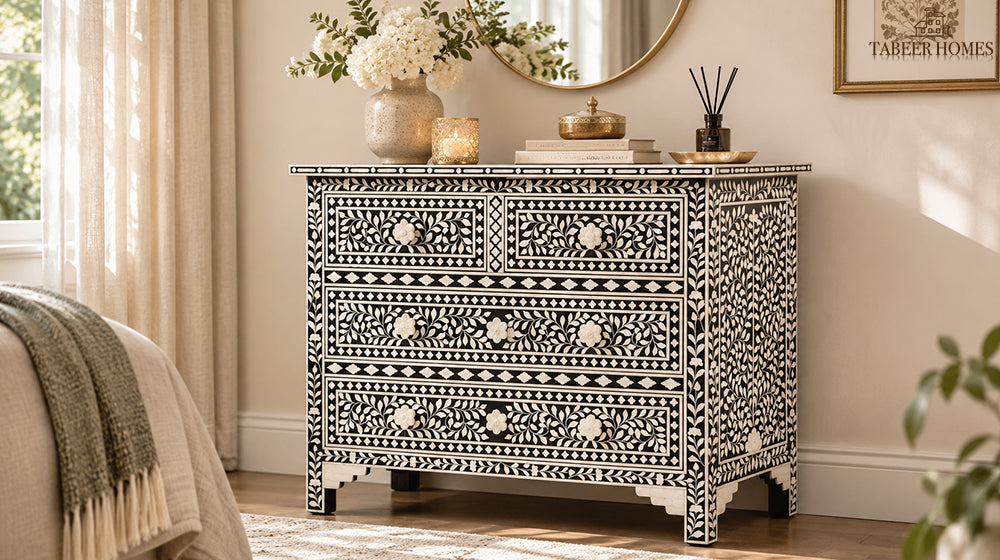
What goes on top. A lamp, a few books, a plant and a framed print. A dark piece such as a black bone inlay cabinet suits a study, since it gives the room a grounded feel.
Open-Plan Living and Dining
In an open-plan flat, a sideboard can mark the edge of the dining area. Place it with its back to the living area so the front faces the table. If the back will be visible from the sofa, ask Tabeer how the rear is finished, since not all pages say. A low piece around 80 to 92 cm tall, such as the Saphed Sideboard (180 x 50 x 80 cm), keeps sightlines open.
Styling the Top of a Sideboard
The same rules apply in every room.
- Use odd numbers. Three objects of different heights look natural.
- Vary the height. A lamp, a vase and a bowl give the eye a path.
- Leave a third empty. The empty space gives the display room.
- Add one metallic or light element. A brass tray lifts a dark cabinet.
- Match the scale. A 175 cm cabinet can take a larger lamp or two smaller ones. A 100 cm piece needs smaller objects.
- Keep cables behind. A cord across an inlaid front undoes the effect.
- Use trays. They protect the surface and group small items.
Keep the inlay in mind. These pieces already carry pattern, so the objects on top should be calm.
Choosing a Finish and Colour
Tabeer's sideboards come in many finishes.
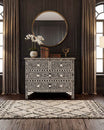
- Black bone inlay (Saphed, Maze, Jade, Eve) gives a graphic look against a pale wall and a moody look against a dark one.
- Black and white bone inlay (Lekh, Ameerah, Aatma) adds pattern and contrast.
- Mother of pearl (Jade white or grey, Azure black, Luna green) has a shimmer that shows best in good light.
- Coloured finishes such as yellow, green and blue bring colour into a neutral room. Treat them as the main accent, and keep the surroundings calm.
Think about the wall colour behind. A black cabinet on a warm neutral wall reads as a graphic anchor. A pale cabinet on a deep wall reads as a feature. Test paint samples before you decide.
Caring for an Inlaid Sideboard
The care text on Tabeer's product pages says to:
- Dust with a soft, dry microfiber cloth.
- Wipe spills with a slightly damp cloth and dry the area at once.
- Avoid harsh chemicals, abrasive cleaners and acidic substances.
- Use coasters or pads under anything hot or wet.
For mother of pearl, Tabeer's guide adds that you should dust in the direction of the pattern, avoid abrasive cloths and keep the piece away from air conditioning vents, which can stress the lacquer base over time. It also advises keeping its pieces out of prolonged direct sunlight. In a dining room, serving dishes, candles and plants bring heat and moisture, so use trays and trivets every time.
Ordering: Delivery, Lead Times and What to Confirm
These are the facts from Tabeer's published policy:
- In-stock items delivered within the UAE take 2 to 4 working days.
- In-stock items shipped internationally take 8 to 12 working days.
- Pre-orders take 6 to 10 weeks.
- Large pieces receive white-glove delivery, with basic on-site assembly where applicable.
- Customs duties, taxes and import charges, where they apply, are included in the product or shipping price.
- Payment can be split with Tabby instalments.
- All sales are final. Returns are accepted only for verified damage reported within 24 hours of delivery.
- Slight variation in pattern and tone is treated as part of handcrafted work.
Product pages give other figures. The white Jade Sideboard Buffet page quotes dispatch within 1 to 3 working days for in-stock items and 6 to 10 weeks for pre-orders. Other pages show 8 to 12 weeks. These figures do not match each other, so get the delivery date for your piece in writing.
Because all sales are final, confirm the door and drawer layout, the finish, the leg colour and the exact dimensions in writing before you pay. You can reach Tabeer on +971 4 251 5171 or at info@tabeerhomes.com.
Common Mistakes With a Sideboard
- Choosing a piece too long for the wall. Leave clear wall at each end.
- Ignoring depth. Check the walkway in front.
- Forgetting door swing and drawer pull-out. Check both against chairs and sofas.
- Putting hot dishes straight on the top. Use trivets and trays.
- Hanging art too high. Keep it 15 to 25 cm above the cabinet top.
- Crowding the top. Three objects and a clear third look better than ten.
- Placing it by an AC vent or in strong sun. Both can stress the finish.
- Leaving layout questions unanswered. Where a page does not state doors or drawers, ask.
Final Thoughts
A sideboard works hardest when the room decides its size and position. Measure the wall, check the walkway and the door swing, and choose the depth that suits the room. Then dress the top simply and fill the inside with what the room needs.
In Tabeer's range, the 175 to 180 cm pieces (Jade and Saphed) suit dining rooms and long living room walls, the 160 cm pieces (Luna Sideboard and Eve) suit shallower spaces, and the 100 to 112 cm cabinets (Luna Cabinet, Aatma, Azure) suit bedrooms and compact corners. Pages leave several door counts, colours and leg details unclear, so ask before you pay. Tape the footprint, check the clearance, get the layout and delivery date in writing and measure the route. Do that, and your sideboard buffet cabinet will be the part of the room that makes everything else look better.
Frequently Asked Questions
What is a sideboard buffet cabinet used for?
A sideboard buffet cabinet stores tableware and linen and gives you a surface for serving. It is also used in living rooms, entries and bedrooms as general storage.
How wide should a sideboard be?
Leave about 20 to 30 cm of clear wall at each end. A 175 cm sideboard suits a wall of at least 2.2 metres.
What is the difference between a sideboard and a console table?
A sideboard is deeper, with doors and drawers for storage. A console table is shallow and works more as a surface. Tabeer's consoles are 35 to 45 cm deep.
Can I use a sideboard as a TV stand?
Possibly. Tabeer lists separate TV unit cabinets, and for a sideboard you should ask for the weight it can carry and the height that suits your screen.
How deep is a sideboard?
Tabeer's sideboards are 40 to 50 cm deep. Keep about 90 cm of clear floor in front where people walk.
What goes on top of a sideboard?
Two or three objects of different heights, such as a lamp, a vase and a bowl. Leave a third of the surface clear and use trays.
Is a sideboard the same as a storage cabinet?
A sideboard is a type of storage cabinet , usually long and low. Other storage cabinets can be tall or narrow.
How do I clean an inlaid sideboard?
Dust with a soft, dry microfiber cloth, wipe spills with a slightly damp cloth and dry them at once, and avoid abrasive cleaners, harsh chemicals and acidic substances.
How long does delivery take?
Tabeer's policy states 2 to 4 working days for in-stock items in the UAE and 6 to 10 weeks for pre-orders. Some product pages say 8 to 12 weeks, so confirm the date for your piece.

Leave a comment
This site is protected by hCaptcha and the hCaptcha Privacy Policy and Terms of Service apply.