


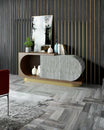
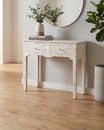




An entryway is the smallest room in most UAE homes and the one that sets the first impression. A bone inlay console table suits that job well: it gives you a surface for keys, a lamp and a tray, and it carries enough hand-set pattern to make a plain wall look finished. The difficulty is that a console is easy to get wrong. A table that is too deep blocks the walkway, one that is too short looks lost on the wall, and one placed against a door swing is a daily annoyance.
This guide covers the practical decisions in the order you will make them: what a bone inlay console is made of, how to work out the right size for your wall, where it can go beyond the front door, how to style it, and how to look after it. It uses real dimensions from Tabeer Homes' console range so you can compare actual products rather than guess.
What a Bone Inlay Console Is Made Of
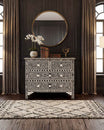
A bone inlay console is a slim table with a decorated top and front. Small pieces of bone are cut by hand, set into a wood base in a pattern, and the gaps are filled with coloured resin. The surface is then sanded flush and finished. Tabeer's product pages list the materials for its consoles as bone, resin, wood and, on some models, metal. The Larisa Console Table, for example, is described as having solid wood construction with a bone inlay surface.
That construction answers two questions buyers often ask. First, the piece is heavy and stable for its slim profile, because it sits on a solid base. Second, the pattern is part of the surface, so it will not rub off the way a printed finish can, though the surface still needs sensible care.
How to Size a Console Table for Your Wall
Size is the decision that matters most when buying a bone inlay console table , and it follows from three measurements: the wall, the walkway and the height of anything above the table.
Depth: Keep the Walkway Clear
Most entryway consoles are shallow, and for good reason. Tabeer's own styling guidance puts the typical depth of an entryway console at roughly 30 to 45 cm, and recommends at least 90 cm of clear walking space in front of it. Measure from the wall to the opposite wall or the nearest obstacle, subtract the console depth, and check that at least 90 cm remains. In a narrow apartment foyer, a 40 cm console is easier to live with than a 50 cm one.
Width: Leave Margins
A console that runs from corner to corner looks built in, which is rarely the intention. A margin of roughly 15 to 20 cm on each side keeps the table looking placed rather than wedged. The calculation is simple: take the wall width, subtract the margins, and that is your maximum table width.
For example, a 180 cm wall with 20 cm margins gives a maximum width of 140 cm. A 140 cm table fits exactly. A 120 cm table gives you more breathing room and 30 cm on each side. On a 110 cm wall, a 120 cm table does not fit at all, so you would need a slimmer or shorter piece.
Height: Match What Hangs Above
Console tables usually stand between about 75 and 85 cm high. Pick a height that works with whatever hangs above it. A mirror or artwork should clear the table top by roughly 15 to 20 cm, so the arrangement reads as one composition. If a lamp will stand on the console, check that the total height of table plus lamp suits the wall and any wall lighting.
Real Sizes From Tabeer's Console Range
|
Console |
Size (W x D x H) |
Notes |
Suits |
|
Saphed Console Table, black and white bone inlay |
120 x 40 x 80 cm |
Lower shelf |
Narrow foyers, walls around 160 cm |
|
Larisa Console Table, black and white bone inlay |
140 x 40 x 80 cm |
Solid wood construction, spacious top |
Standard entry walls around 180 cm |
|
Jade Console Table, grey bone inlay |
135 x 45 x 75 cm |
Slightly deeper, lower height |
Wider hallways, walls around 175 cm |
|
Taara Console Desk, black bone inlay |
135 x 50 x 75 cm |
Drawers for storage |
Wider spaces where depth is available |
|
Rosetta Console, green bone inlay |
85 cm high |
Arched legs |
Check the width on the product page |
The sizes above are taken from the product pages at the time of writing. Dimensions can differ between variants and colourways, so confirm the figure on the exact page before you order. The Rosetta is listed here without a width because the figure shown across Tabeer's own pages is not consistent, so check it directly.
Where a Console Table Works in a UAE Home
The entryway is the obvious place for a console table , but it has other good positions.
Apartment foyer. Choose the shallowest, shortest-width option and check the door swing. A 120 cm piece such as the Saphed, with a lower shelf for shoes or baskets, uses the wall well without crowding the entrance.
Villa entrance hall. Larger walls and higher ceilings need a larger composition. A 140 cm console such as the Larisa, a tall mirror and a pair of lamps will hold a double-height wall better than a single small table. Scale the mirror and lamps up with the ceiling.
Behind a sofa. In an open-plan living room, a console behind a floating sofa defines the seating area and gives you a surface for lamps. Keep it the same height or slightly lower than the sofa back, and leave a few centimetres of gap so it does not look jammed.
Along a hallway. A slim console in a long hallway adds interest and a place to put things. Keep it shallow, at around 35 to 40 cm, and check that it does not narrow the hallway below a comfortable width.
Dining room wall. A console can act as a small serving surface in a dining room where a full sideboard is too large. It holds a tray, glasses or a serving platter on the day you need them.
Under a window. If the window sill is above the console height, a console adds a surface and a place for a lamp that works with the natural light.
If you are unsure whether you need a console or a larger sideboard, the deciding factor is storage. A console is a display surface with little or no storage, while a sideboard or buffet cabinet is built to hold things behind doors. Tabeer's drawer-fitted pieces, such as the Taara console desk and the dresser consoles, sit between the two.
Choosing Between the Models
Once you know your wall and walkway, the shortlist usually narrows to two or three pieces. These are the trade-offs that decide it.
Saphed, for tight spaces. At 120 cm wide and 40 cm deep, it is the smallest of the verified options, and the lower shelf gives you somewhere to put a basket for shoes, scarves or post. The shelf also means the piece reads as heavier near the floor, so it suits an entry with a stone or tile floor better than one with a deep-pile rug.
Larisa, for a standard wall. At 140 cm it has a long, clear top that takes a lamp, a tray and a vase without crowding. It has no stated drawers or shelf, so it works best where storage is handled elsewhere, such as a built-in cupboard or a separate shoe cabinet.
Jade, for a lower, wider look. At 135 x 45 x 75 cm it is a little deeper and a little lower than the Larisa. The lower height suits a wall with a wide, low mirror or a piece of art hung close to the table. It is listed as a pre-order, so plan for the wait.
Taara, for storage. As a console desk at 135 x 50 x 75 cm with drawers, it doubles as a place for keys, chargers and papers. The 50 cm depth is the largest in the group, so check the walkway before you commit. It also works as a small writing desk in a hallway nook.
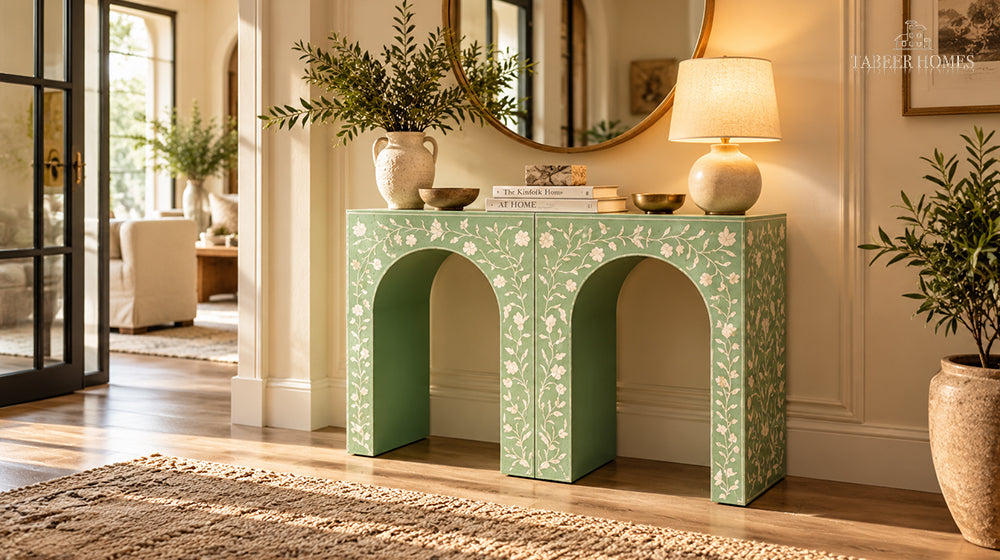
Rosetta, for a statement. The arched legs and the green inlay make it the most decorative of the group. Because the width is listed inconsistently, confirm it with Tabeer before ordering.
If two pieces look equally right on paper, pick the one with the shallower depth. A console you walk past forty times a week is judged by how it feels in the walkway, not by how it looks in a photograph.
Wood Console Table: What to Know Before You Buy
Many buyers search for a wood console table , and a bone inlay console is one. The wood is the structure, and the bone is the surface decoration. Tabeer's consoles are built on wood, with some pieces described as mango wood, and finished with inlay on the visible surfaces. Its dedicated wooden collection currently consists of black wood chests of drawers and side drawers, so if you want a console that is purely wood with no inlay, check what is available before assuming.
Questions to ask about the wood in any wood console table you consider:
Is the frame solid wood or engineered board? Solid wood is heavier and more durable. Ask the seller to specify the frame, top and drawers.
What species is it? Mango, sheesham and teak are common in Indian furniture making. Each has different weight and grain.
How is it finished? The finish determines how you clean it, so ask whether it is matte lacquer, semi-gloss or wax.
Does it suit the climate? Wood furniture does best with steady indoor conditions. Avoid placing a console where it receives direct, prolonged sun or sits next to a vent or a wet area.
Choosing a Pattern and Colour
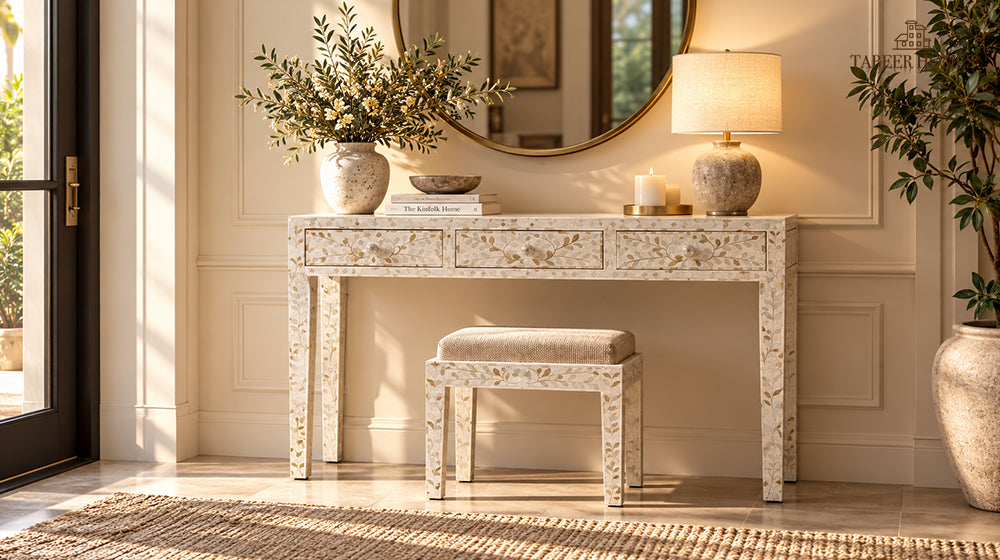
Bone inlay consoles come in several colourways. Tabeer's range includes black and white designs such as the Larisa and Saphed, grey designs such as the Meena and Jade, black on the Taara console desk, and green on the Rosetta. Cream and white mother of pearl versions sit in the related dresser console pieces, such as the Vaan and the Iris, which add drawers and sometimes a matching stool.
Black and white is the easiest to place. It reads as graphic and works with most wall colours, metal tones and floor finishes.
Grey is softer and suits calm, contemporary entryways with pale walls and stone floors.
Green and other colours make the console the focal point. Use them where the surrounding wall, floor and accessories are quiet.
A useful rule is to pick the console colour from a repeated colour elsewhere in the home, such as a rug, a cushion or art. A console that echoes something nearby looks planned.
Styling a Bone Inlay Console
Tabeer already publishes a guide to styling a console table in the entryway, with ten ideas such as a mirror above, a statement lamp, a tray for keys and mail, and a high-medium-low arrangement of objects. Those ideas work well on an inlay console. A few additions apply specifically to a patterned top.
Let the top show. The pattern is the decoration, so avoid covering it. Leave at least a third of the surface clear.
Use plain accessories. A solid-colour tray, a simple vase and a plain lamp base let the pattern stand out. Patterned accessories on a patterned top compete.
Match the metals. Pick brass, gold or black for the lamp, tray and frame, and repeat it.
Keep the middle of the table quiet. Put the lamp to one side, and use a tray near the door for keys, which keeps the working layer separate from the display.
Mind the light. Inlay looks best with side light. A table lamp or wall sconce lights the pattern better than a single downlight.
Use a small rug or runner under it. In a tiled entry, a rug under and in front of the console adds warmth and defines the zone.
Lighting, Mirrors and Heat in a UAE Entry
Entryways in the UAE often have two conditions that affect a console: strong light from a glazed front door or a nearby window, and air conditioning that runs for most of the year. Neither is a problem, but both are worth planning for.
Direct afternoon sun falling across a wood and inlay surface for hours each day can fade finishes and dry out wood over time. If your door or window faces the sun, use a sheer curtain or place the console on a wall that sits out of the direct beam. Avoid putting it directly under or in front of an air conditioning vent for the same reason.
For mirrors, a console under a mirror doubles the visual depth of a small foyer, and the reflected light helps in entries with no window. A round or arched mirror softens the straight lines of a console, while a tall rectangular mirror suits a villa hall with a high ceiling. Hang the mirror so the bottom edge sits about 15 to 20 cm above the console top, and centre it on the table rather than on the wall if the two do not line up.
Wall lights on either side of the mirror are a practical alternative to table lamps when the console is shallow. They free the top for the pattern and keep cords off the surface.
Caring for an Inlay Console
Care instructions on Tabeer's product pages are brief. Dust regularly with a soft, dry microfiber cloth. If a spill occurs, wipe with a slightly damp cloth and dry immediately. Avoid harsh chemicals, abrasive cleaners and acidic substances, and use coasters, trays or protective pads to prevent scratches, heat marks and stains. Keys, bags and metal objects dragged across the surface can scratch it, so a tray near the door helps.
Buying Notes: Stock, Lead Time and Policies
Check the stock status on the page. Tabeer's collection pages label products as ready to ship, pre-order or arriving soon. The shipping policy states in-stock delivery of 2 to 4 working days within the UAE and an estimated 6 to 10 weeks for pre-orders from order confirmation, although some individual pre-order pages state 8 to 12 weeks. Ask for a written date for your exact piece before you plan around it.
The refund policy states that all sales are final, with returns accepted for verified damage reported within 24 hours of delivery. Slight variation in pattern and tone is described as inherent to artisanal craftsmanship and not a defect. Measure the wall, the walkway and the route into the home before you order. Our guide to buying luxury furniture online walks through the full process, and our guide to judging handcrafted furniture quality shows what to check on delivery.
Common Mistakes
Most problems with a console table come from a short list of avoidable errors.
A console that is too deep. Anything that leaves less than about 90 cm of walkway will annoy you daily.
A console that is too wide for the wall. Skip the margins and the table looks wedged.
A mirror that is too small. A mirror above a console should be about two thirds to three quarters of the console width.
Ignoring the door swing. Check where doors open before you fix the position.
Covering the pattern. Piling items onto the top hides the feature you paid for.
Ordering without the dimensions of the exact variant. Sizes differ between models.
Final Thoughts
A well-chosen bone inlay console table does a lot for a small amount of floor space. Start with the wall, the walkway and the height of whatever hangs above, then choose a size from real dimensions, pick a colour that repeats something in the room, and keep the styling quiet so the pattern shows. Done in that order, a console turns an anonymous entrance into the part of the home people remember.
Frequently Asked Questions
What size bone inlay console table should I buy for my entryway?
Measure the wall, subtract roughly 15 to 20 cm of margin on each side, and keep the depth shallow enough to leave at least 90 cm of walkway. Tabeer's consoles range from 110 to 140 cm in width and from 40 to 50 cm in depth, depending on the model.
How deep should a console table be?
Most entryway consoles are about 30 to 45 cm deep. In a narrow foyer, 40 cm or less is easier to live with.
How high should a console table be?
Between about 75 and 85 cm is typical. Choose a height that works with the mirror or art above, with roughly 15 to 20 cm between the table top and the bottom of the frame.
Is a bone inlay console a wood console table?
It is built on a wood base with bone inlay on the visible surfaces. Ask the seller whether the frame, top and drawers are solid wood or engineered board, and which species it is.
Can I use a console table somewhere other than the entryway?
Yes. Consoles work behind a sofa, along a hallway, on a dining room wall or under a window, as long as the depth leaves enough clearance.
How do I clean a bone inlay console?
Dust with a soft, dry microfiber cloth, wipe spills promptly with a slightly damp cloth and dry immediately, and avoid harsh chemicals and abrasive cleaners.
How long does delivery take?
For in-stock pieces within the UAE, Tabeer's policy states 2 to 4 working days. For pre-orders it states an estimated 6 to 10 weeks, and some individual pages state 8 to 12 weeks, so confirm the date for the exact piece.

اترك تعليقًا
This site is protected by hCaptcha and the hCaptcha Privacy Policy and Terms of Service apply.