





A hallway or entryway console table gets seen more often than almost any other piece of furniture in a home, passed by dozens of times a day, and yet it frequently receives the least styling attention of any surface in the house. A mother of pearl console table changes that equation immediately, its shimmering inlay catching light every time someone walks past rather than fading into the background the way a plain console often does. This guide focuses on getting the styling right once the table is in place, alongside the sizing and shape decisions that determine whether it fits the entryway it needs to serve.
What Makes an MOP Console Different From a Standard Console
An MOP console pairs a wood or resin base with hand-cut mother of pearl shell segments set into the surface, producing a finish that shifts in color and luminosity depending on the light hitting it. Unlike a plain lacquered or veneered console, the inlay work means no two consoles are ever fully identical, and the shimmer effect changes throughout the day as natural light moves or evening lamps come on. This light-reactive quality is part of why the console works so well specifically in a hallway or entryway, spaces that people pass through rather than linger in, since the table's shimmer registers even in a brief glance in a way a flat, matte finish would not.
Choosing the Right Shape and Footprint
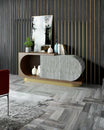
An inlay console table needs to fit its hallway both physically and visually, and getting the footprint right matters more in a narrow entryway than in almost any other room. Most mother of pearl consoles run 90 to 120 cm wide and 35 to 45 cm deep, a range narrow enough to leave walking clearance in a typical hallway while still offering enough surface for styling. Curved-leg consoles, without straight structural legs, tend to feel lighter and less visually blocking in a tight space, while consoles with a lower shelf or drawer add functional storage at the cost of a slightly bulkier footprint. Tabeer Homes' Iris Console in pink mother of pearl inlay measures 100 x 35 x 80 cm, fully sheathed in inlay from the tabletop down through its curved legs, with no metal accents breaking up the shimmer, a design suited to a hallway that wants the console itself to be the singular statement piece rather than one element among several. Height across the category stays relatively consistent, generally 75 to 85 cm, since this range comfortably supports both a mirror hung above and a lamp placed on top without either element crowding the other, a proportion worth keeping in mind even when comparing consoles that differ more significantly in width or depth.
Sizing for a Hallway Console Vs Entryway Console
A hallway console and an entryway console face slightly different constraints even though they often look identical as standalone pieces. A hallway console typically sits along a longer, narrower walking path, making depth the more critical measurement, since anything deeper than about 35 to 40 cm can start to feel obstructive in a corridor under a meter wide. An entryway console, often positioned in a slightly more open foyer space near the front door, can generally accommodate a deeper table, up to 45 cm, along with a wider footprint since the space typically allows people to pass around it rather than squeezing directly beside it. Confirming your specific space's width before ordering, leaving at least 90 cm of clear walking path regardless of which type of space you're furnishing, prevents a console that looks proportional in a product photo from becoming a genuine daily obstruction.
Building an Entryway Inlay Table Vignette: Where to Start
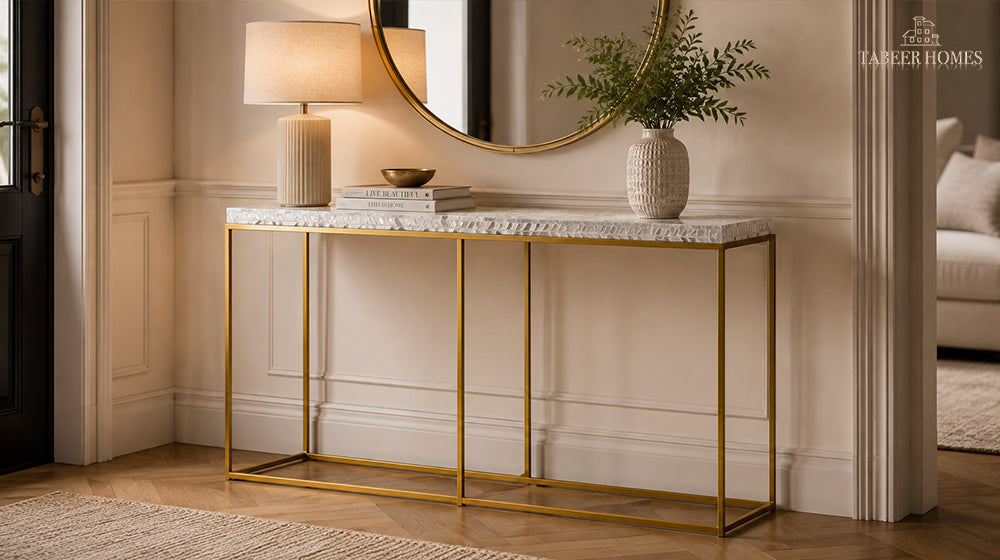
Once the table itself is in place, the styling process for an entryway inlay table benefits from a clear starting point rather than adding objects piece by piece without a plan. Begin with the wall above: a mirror or a single piece of art gives the vignette its anchor and, in a mirror's case, adds practical function alongside the visual one. From there, add one lamp or a pair of matching lamps if the console is long enough to support symmetry, since an entryway console frequently doubles as a light source in an otherwise dim transition space. Only after the anchor and lighting are settled should smaller decorative objects, a tray, a small bowl, a single vase, enter the arrangement, layered in rather than dropped on all at once. This sequential approach, anchor first, function second, decoration last, tends to produce a more considered result than styling everything simultaneously, since each layer can be evaluated against what came before it rather than guessed at all at once. Stepping back and viewing the console from the far end of the hallway, the vantage point most people will actually experience it from during daily use, also helps catch proportion issues that are harder to notice up close, where every object looks reasonably sized in isolation.
Styling Principles Specific to a Shimmering Surface
A mother of pearl console's own shimmer changes how styling choices read compared to a plain wood or lacquered surface. Because the tabletop itself already carries visual movement, objects placed on top benefit from simpler, more matte finishes, a ceramic bowl, a linen-covered box, a plain glass vase, rather than another reflective or glossy material that competes with the table's own light-catching quality. A single striking object generally reads better against a mother of pearl surface than a cluttered grouping, since the table's shimmer already provides enough visual activity on its own without additional competing texture. Positioning the console where it catches natural light during the day, near a window or a glass-paneled front door, and adding a warm-toned lamp for evening hours, lets the shimmer register at its best across the full day rather than only in specific lighting conditions.
Pairing a Console With a Mirror or Art
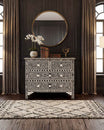
The wall above a console table does as much for the overall look as the table itself, and a few principles keep the pairing proportional. A mirror or art piece works best at roughly 60 to 80 percent of the console's width, avoiding both an undersized frame that looks lost on a wider wall and an oversized one that overwhelms a narrower console. Leaving 15 to 20 cm of clearance between the top of the console and the bottom of the frame keeps the pairing from feeling cramped. A mirror adds genuine function in an entryway, letting people check their appearance before heading out, while a piece of art creates a more gallery-like, purely decorative statement, and the choice between the two often comes down to whether the household actually uses the entryway as a final check-in point before leaving.
Functional Styling for a Daily-Use Entryway Console
An entryway console needs to hold up to daily function alongside its decorative role, and building that function into the vignette from the start prevents the table from accumulating loose clutter that undermines the careful styling. A small dish or shallow bowl positioned near the door-facing edge catches keys and sunglasses without requiring a search through a bag. A tray groups smaller functional items, mail, a phone charger, sunglasses, into one contained, liftable unit that keeps the console's broader surface looking intentional even when daily items are present. Consoles with a lower shelf or drawer extend this function further, offering enclosed storage for shoes or scarves that would otherwise need to sit visibly on the surface itself.
Base Materials and Leg Styles for MOP Consoles
The structure beneath a mother of pearl tabletop affects both the console's visual weight and how it fits a specific hallway's proportions. Fully-inlaid consoles, with mother of pearl covering the legs as well as the tabletop, produce the most cohesive, singular statement, since there is no material break between the top and the base to interrupt the shimmer. Metal-legged consoles, pairing an inlaid tabletop with slender brass, black, or chrome legs, offer a lighter visual footprint, useful in a narrower hallway where a fully-clad wood or resin base might feel visually heavier than the space can comfortably hold. Curved or scalloped legs, as seen on fully-inlaid designs like the Iris Console, add a softer silhouette that suits a more traditional or romantic entryway aesthetic, while straight, angular legs suit a more contemporary or minimalist hallway. Consoles built with a lower shelf add genuine storage capacity at the cost of some visual lightness, a worthwhile tradeoff in a household that needs somewhere to stash shoes or bags near the entrance, but less necessary in a hallway used purely as a passage rather than a functional drop zone.
Lighting Considerations for a Shimmering Console
Because a mother of pearl console's appeal depends so heavily on how light interacts with its surface, the lighting in its specific location matters more than it would for a plain wood piece. A console positioned in a hallway with little natural light benefits significantly from a dedicated lamp or nearby wall sconce, since the shimmer effect depends on some light source to catch, and a console left in near-darkness loses much of its visual impact regardless of how fine the inlay work is. Warm-toned bulbs, rather than cool white LEDs, tend to complement mother of pearl's natural iridescence better, producing a softer, more flattering glow than a harsher, bluer light source. For hallways that do receive natural daylight, even briefly during certain times of day, positioning the console to catch that light directly, rather than in a shadowed corner just out of the window's reach, makes a meaningful difference in how often the shimmer effect is actually visible during daily use.
Coordinating a Console With the Rest of Your Entryway
A mother of pearl console rarely needs to be the only patterned or decorative element in an entryway, but coordinating it with nearby furniture and finishes produces a more cohesive result than treating it as an isolated statement piece. If the entryway includes a bench, a coat rack, or a shoe cabinet, repeating one element, a matching metal finish, a related wood tone, or a shared color note, ties the space together without requiring every piece to match exactly. Flooring matters more in an entryway than in most rooms, since it is the first surface a guest actually steps onto, and a console with warmer wood or metal tones generally suits a wood or warm-toned tile floor better than a stark, cool marble entryway, where a console with cooler metal accents might read as more cohesive instead.
Common Styling and Buying Mistakes
A handful of recurring errors undercut both the buying decision and the eventual styling result for this category.
- Choosing a console based on product photos alone without checking the hallway's actual width. A console that looks proportional online can obstruct a narrower hallway than expected once physically in place.
- Overcrowding the surface with too many competing reflective or patterned objects. Since the tabletop's own shimmer already provides visual interest, adding several more glossy or heavily patterned items tends to compete rather than complement.
- Skipping the wall-anchor step (mirror or art) and going straight to smaller decor objects. Without an anchor above, the vignette lacks a clear focal point and can read as scattered rather than composed.
- Ignoring daily function entirely in favor of pure styling. A console with no catch-all tray or dish tends to accumulate loose clutter regardless of how carefully the rest of the surface was styled.
Bringing It All Together
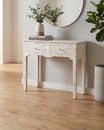
A mother of pearl console table earns its place in an entryway or hallway by doing double duty, catching light every time someone passes and providing genuine daily function for keys, mail, and the small items that otherwise scatter across a home. The styling sequence matters as much as the table itself: an anchor above, function built in early, and decoration layered on last, tends to hold up better over months of daily use than a vignette assembled all at once and never revisited. Tabeer Homes' Iris Console in pink mother of pearl inlay offers a compact, fully-inlaid option well suited to a hallway or entryway wanting a singular statement piece, while the Iris Mini Dresser Console in grey mother of pearl inlay, at 90 x 35 x 80 cm, brings a slightly more compact footprint with added drawer storage for a tighter space. Matching the console's size to your actual hallway width, anchoring the wall above with a mirror or art, and building the vignette in layers rather than all at once will do more for the final result than choosing on pattern alone.
Frequently Asked Questions
What size should a mother of pearl console table be for a hallway?
Most hallway consoles run 90 to 120 cm wide and 35 to 45 cm deep, with narrower depths better suited to tighter corridors and wider footprints working better in a more open entryway space.
How do I style a mother of pearl console table?
Start by anchoring the wall above with a mirror or art, add a lamp for warmth and function, then layer in smaller decorative objects using simpler, matte finishes that complement rather than compete with the table's shimmer.
Should I hang a mirror or art above my entryway console?
Either works well. A mirror adds practical function for checking your appearance before leaving, while art creates a more purely decorative, gallery-like statement.
Can a mother of pearl console table handle daily use?
Yes, with a functional layer built into the styling, a catch-all dish or tray for keys and mail keeps the console both decorative and genuinely useful for daily entryway routines.
How is an MOP console different from a bone inlay console?
Mother of pearl produces a glossy, iridescent shimmer that shifts with light, while bone inlay offers a matte, more graphic finish, making the two suited to different entryway moods rather than one being objectively better.
What should I avoid when styling a mother of pearl console table?
Avoid overcrowding the surface with competing reflective or heavily patterned objects, and avoid skipping a wall anchor like a mirror or art, since the vignette needs a clear focal point to read as intentional.

اترك تعليقًا
This site is protected by hCaptcha and the hCaptcha Privacy Policy and Terms of Service apply.