


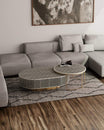
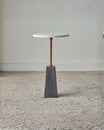

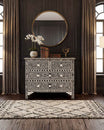
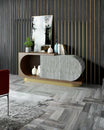
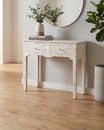
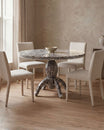

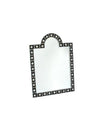

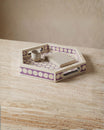





If you have typed furniture near me into a search bar, you probably want to do the one thing a website cannot do: stand next to a piece and judge it with your own eyes and hands. That is the right instinct, and it is worth doing well. A showroom visit only helps if you know what to look for, because a polished display and a friendly salesperson can make an average piece look excellent.
This guide gives you a practical inspection routine for handcrafted furniture in the UAE. It covers what "handcrafted" should mean, a ten-point check you can run in any showroom, what to look for in bone inlay furniture specifically, how to judge a piece from photographs when you buy luxury furniture online , and which questions separate a maker who knows their product from one who only sells it. Tabeer Homes examples appear where they are useful, and where the brand has not published a detail, the guide says so and tells you to ask.
What "Handcrafted" Should Mean
"Handcrafted" is not a regulated word, and it covers a wide range. At one end, a piece is designed, cut, joined, inlaid and finished mainly by hand. At the other, a machine-made frame has a hand-applied detail and the whole piece is sold as handcrafted. Both can be described accurately or misleadingly, depending on what the seller says.
Three terms are worth separating when you talk to a seller.
Hand-made. The main making steps, such as shaping, joining and inlay setting, are done by hand.
Hand-finished. The piece is built with machine help and finished or detailed by hand.
Hand-crafted. A looser term, often used for either of the above. Ask which one applies.
You do not need a perfect answer. You need a specific one. A seller who says "the bone pieces are cut and set by hand in our workshop in India, then sanded flush and lacquered" is giving you something you can check against the piece in front of you. A seller who says "all our furniture is handcrafted with love" is giving you nothing.
Tabeer describes its furniture as made in its own ateliers in India, with hand-cut bone and mother of pearl motifs, and its refund policy notes that slight variations in pattern, tone, texture or finish are inherent to artisanal craftsmanship. That variation is also a sign to look for: true hand work is rarely perfectly uniform.
Before You Go: What to Bring
A short kit makes a showroom visit far more useful.
A tape measure. Check the real dimensions against the product page, and measure the space and doorways at home beforehand.
Your phone torch. You will use it for raking light, explained below.
Your phone camera. Photograph the piece, the joins and the back, and photograph the tag with the product name and price.
Photos of your room. They help you judge colour and scale.
A list of questions. The list near the end of this guide works well.
If you are searching for furniture near me in Dubai, remember that many specialist showrooms sit in clusters, such as Al Quoz, which lets you compare several makers in one trip. Tabeer's published business listing places its UAE store in Al Quoz Industrial 1, but directory details can be out of date, so call or message the brand to confirm the address and opening hours before you travel. The contact page lists +971 4 251 5171 for phone and WhatsApp.
The Ten-Point Showroom Inspection
Run these checks in order. Most take under a minute, and together they tell you more than the price tag does.
1. Judge the Weight
Lift one corner of a small piece, or push a large one gently. Solid wood and stone are heavy, and a piece that feels light for its size deserves a question about what is inside it. Weight is not proof of quality, but an unexpectedly light carcass often means engineered board or hollow construction. Ask what the frame is made from.
2. Test the Stability
Place your hands on the top and apply light pressure from different angles. The piece should not rock, twist or creak. Check each leg or the base for contact with the floor, since an uneven floor can mask a wobble. A table that moves under light pressure in a showroom will move more at home.
3. Look at the Joinery
Open a drawer and look at the corners. Dovetail joints, interlocking fingers of wood, usually indicate careful construction. Metal staples, visible glue lines and butt joints held by nails usually indicate speed. Look inside a cabinet at where the shelves meet the sides and at the back panel. Quality shows in places that most buyers never examine.
4. Run Your Fingers Across the Surface
On inlay or any mixed-material surface, slide your fingertips lightly across the transition between materials. A gentle, barely perceptible change in height where bone meets resin or wood is normal in hand-set work. Sharp edges, rough patches, or gaps you can catch a fingernail in are not.
5. Use Raking Light
Hold your phone torch almost flat against the surface and sweep it across at a low angle. This reveals gaps, pitting, air bubbles in resin, uneven sanding and ripples in the finish that normal overhead light hides. It is the single most useful trick in this guide, and it works on any surface.
6. Check Pattern Alignment and Spacing
Step back and look at the whole pattern. On a symmetrical design, compare the left and right halves. Spacing between motifs should look intentional, lines should run true, and repeated shapes should be consistent without being identical. In hand-set work, expect small variation from piece to piece. Expect no jarring breaks, missing pieces or visibly mismatched sections.
7. Inspect Edges and Corners
Edges take the most wear and show the most shortcuts. Look for chips, sharp edges, exposed core material, and finish that has pooled or thinned at corners. A well-made edge is smooth and consistent along its length.
8. Operate Doors and Drawers
Open and close every door and drawer several times. They should move smoothly without catching, gaps between them and the frame should be even, and hinges should feel solid. Hardware that feels light or loose in a showroom tends to get worse with use.
9. Look at the Back and Underside
Pull the piece slightly away from the wall if you can, or look underneath. Unfinished or rough backs are acceptable on some pieces, but a finish that stops where the eye stops is a sign of limited care. Check that the base and any metal parts are properly attached.
10. Judge the Finish Consistency
Look at the colour and sheen from several angles and under different light. The finish should be even, with no streaks, drips, dull patches or sticky areas. A matte finish should look matte across the piece, and a semi-gloss should be uniformly semi-gloss.
Bone Inlay Furniture: What to Check Specifically
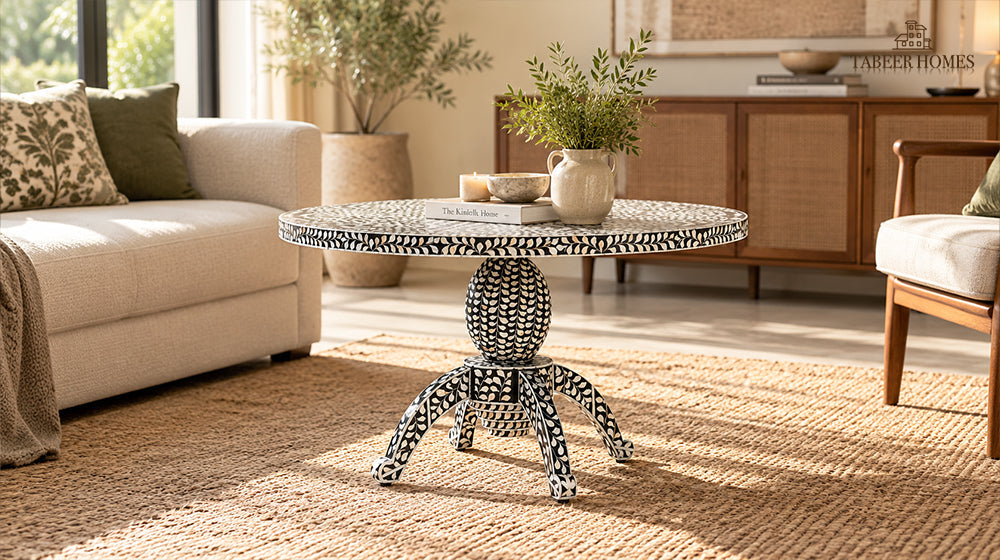
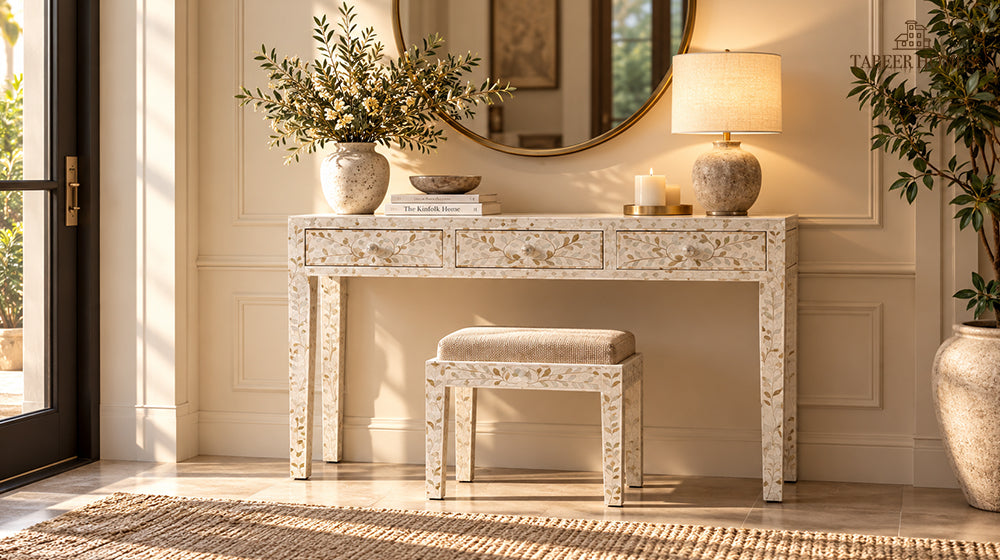
Bone inlay furniture is made by cutting small pieces of bone into shapes, setting them into a wood base in a pattern, filling the gaps with coloured resin, sanding the surface flush and applying a protective finish. It is slow work, and the quality of each step shows in the finished piece.
Tabeer describes its bone as ethically sourced, carved and handset by master artisans, and its pieces as made in India's Rajasthani region. Its product pages list materials such as bone, resin, wood and metal for the Jade Sideboard Buffet, and a mango wood base for the Mosaic Side Table. Use those details as a starting point for questions, not as a substitute for inspection.
Is It Real Bone, a Printed Surface or a Resin Imitation?
This is the question most buyers want answered, and the answer is that no single quick test proves it. Cheap imitations exist, including printed patterns on engineered board and moulded resin made to look like bone. Some indicators help.
Natural variation. Real bone pieces differ slightly in tone, grain and translucency from one fragment to the next. A surface in which every piece looks identical may be moulded or printed.
Tactile relief. A tiny change in height where bone meets resin can be a sign of hand-set inlay. A perfectly glassy, uniform surface can be a sign of a printed or moulded layer under a thick coating.
Edge and raking-light inspection. Under low-angle light, individual pieces and the resin between them should be visible as separate elements.
Weight and construction. A genuine inlay piece on a solid wood base is heavy for its size. Compare it with a similar piece in the same shop.
Joinery and back panel. Careful joinery is more common on pieces where the surface decoration is also carefully made.
Treat these as indicators, not proof. Avoid DIY tests that could damage the piece, such as pressing a hot needle into the surface. The more reliable route is to ask the seller to state the material in writing, including which animal the bone comes from, where it is sourced and what the base is made from. Sellers do not all give the same answer on the species, which is why the question is worth asking. Tabeer's own materials pages do not specify the species of bone or the wood used for every piece, so ask the team directly before you order.
Check the Resin and the Gaps
The coloured resin between the bone pieces should be smooth, consistent in colour and flush with the bone. Look for pits, bubbles, hairline cracks, and patches where the resin has sunk below the surface. Small imperfections can occur in hand work, but widespread problems suggest rushed finishing.
Check the Base
The wood base carries the whole piece. Mango, sheesham and teak are commonly used in Indian furniture making, and each has different weight and grain. Ask what the carcass, top and drawer boxes are made from, and whether any part is engineered board. Solid construction shows in weight, in the end grain at exposed edges, and in the joinery.
Check the Finish and Ask About Care
Finishes vary from matte lacquer to semi-gloss lacquer to wax. Ask which one is used, because it determines how you clean and maintain the piece. Tabeer's product pages advise dusting with a soft dry microfiber cloth, wiping spills with a slightly damp cloth and drying immediately, avoiding harsh chemicals, abrasive cleaners and acidic substances, and using coasters or protective pads to prevent heat marks and scratches.
Judging Quality From Photos When You Buy Luxury Furniture Online
When you buy luxury furniture online , you cannot run the ten-point check, so you need the seller to give you the next best thing. Ask for these before you order.
Close-up photos of the surface and an edge. You want to see the inlay, the resin gaps and the edge treatment up close.
A photo taken in raking light. It reveals flatness and finish quality.
A photo of the back, the underside or the inside of a drawer. It shows the joinery and the finishing standard.
A photo with something for scale. A hand, a ruler or a familiar object shows the true proportions.
A short video. A video shows how the colour changes in movement and light.
The written material list. Wood, bone or shell, resin, metal, finish.
Many sellers will send extra images on request through WhatsApp or email. How willing and how specific the response is tells you a great deal about the seller. A brand that happily sends a close-up of a drawer interior is usually proud of how it is built.
Read the policies too. Tabeer's refund policy states that all sales are final, that returns are accepted for verified damage reported within 24 hours of delivery, and that variation in pattern and tone is not considered a defect. That means your inspection effort belongs before you order and again on the day of delivery. Our guide to buying luxury furniture online covers the full ordering and delivery process.
Red Flags and What to Ask
|
What you see or hear |
Why it matters |
What to ask |
|
"Premium finish" with no material detail |
The seller may not know or may not want to say |
What are the wood, inlay and finish? |
|
Perfectly identical pieces and glassy surface |
Could be printed or moulded |
Is each piece cut and set by hand? |
|
Light weight for the size |
Possible engineered board or hollow core |
What is the carcass made from? |
|
Staples or visible glue in drawer corners |
Quick construction |
How are the drawers jointed? |
|
Rough, unfinished back panel |
Limited finishing |
Is the back finished and attached properly? |
|
No stated lead time |
Planning risk |
Is it in stock, and when will it arrive? |
|
Policies unavailable before purchase |
You cannot judge the risk |
Can I read the return and damage policy now? |
|
Price far below similar pieces |
Materials or labour may be cut |
What explains the price difference? |
Questions to Ask Any Maker or Seller
- What is this piece made from, including the frame, top, drawer boxes and back?
- Where is it made, and are the main steps done by hand?
- For inlay, what material is used, and where is it sourced?
- What finish is on it, and how should I care for it?
- Is this exact piece in stock, or is it made to order, and how long will it take?
- How do I report damage, and by when?
- What is your policy on variation between the photo and the piece?
- Is there a warranty, and what does it cover?
- Can the piece be repaired or refinished if it is damaged later?
- Can you send close-up photos or a video of the exact piece I will receive?
Judging Value Beyond the Price
Handcrafted furniture costs more than machine-made furniture because it takes longer and uses harder-to-work materials. The useful question is whether the price matches the evidence you can see and verify. Compare two similar pieces on materials, construction, finish and policies. A piece that costs more but gives you a documented solid wood frame, hand-set inlay and clear policies may be better value than a cheaper one with vague descriptions.
Price movements also matter. Sellers run promotions, and a sale price does not change the quality of the piece. Judge the piece first and the discount second.
Inspecting on Delivery Day
The final inspection happens when the piece arrives. Check corners, edges, the surface and the base, confirm it sits level, compare it with your photos and order, and photograph everything. Where a short reporting window applies, such as Tabeer's 24 hours for verified damage, report any problem in writing the same day.
Final Thoughts
Judging handcrafted furniture is a skill you can learn in one afternoon. Check the weight and stability, look at the joinery, run your fingertips over the surface, shine a torch across it at a low angle, and ask specific questions about materials and making. Apply the same routine to every piece and every seller, and the differences become obvious. Whether you visit a showroom after searching for furniture near me or shortlist a piece online, the best purchase is the one where the seller's answers match what you can see and feel.
Frequently Asked Questions
How can I tell if bone inlay furniture is genuine?
No single quick test proves it. Look for natural variation between bone pieces, a slight tactile change where bone meets resin, weight that suits solid construction, and consistent inspection results under raking light. Ask the seller to state the material in writing, including the source of the bone and the base wood.
What is the difference between bone inlay and a printed pattern?
Bone inlay is made by setting individual pieces of bone into a wood base and filling the gaps with resin, then sanding flush. A printed pattern is a design applied to the surface of a board and coated. Printed surfaces tend to look uniform and glassy with no variation between motifs.
Is slight unevenness normal in handcrafted furniture?
Slight variation in tone, spacing and surface texture is normal and expected in hand-set work. Sharp edges, large gaps, pitting, cracks and uneven doors or drawers are not, and you should ask about them.
How do I find reliable bone inlay furniture near me?
Look for specialist showrooms that name where and how they make their pieces, publish their policies, and let you inspect the piece. Visit more than one, run the same inspection checklist in each, and compare answers to the same questions.
What should I look at inside a drawer?
Check the joinery at the corners, the smoothness of the runners, the finish inside the box and the evenness of the gaps around the front. Dovetail joints and a clean interior finish are good signs.
Can I trust photos when buying handcrafted furniture online?
Photos are a starting point. Ask for close-ups, a raking-light image, a view of the back and a video, read the policies before paying, and inspect the piece carefully on delivery. Expect the real piece to resemble the photo rather than copy it exactly.

اترك تعليقًا
This site is protected by hCaptcha and the hCaptcha Privacy Policy and Terms of Service apply.