


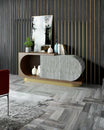
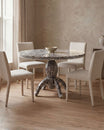


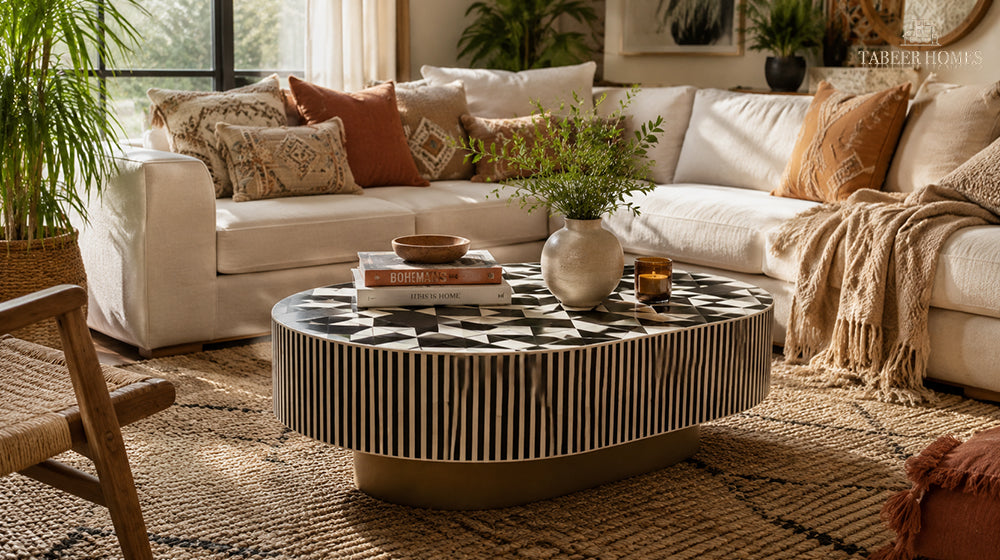
A coffee table anchors a living room more than almost any other single piece, sitting at the center of every seating arrangement and catching every eye that scans the room. A bone inlay coffee table takes that central role and gives it genuine handcrafted detail, a bold, matte geometric pattern that reads as a focal point rather than a neutral backdrop for whatever gets placed on top. This guide covers the shape, pattern, and sizing decisions specific to this category, along with the styling and care habits that keep a heavily used surface looking sharp for years.
What Makes a Bone Inlay Coffee Table Different
A bone inlay coffee table pairs a tabletop covered in hand-carved bone segments, set into resin and polished flush with the surface, over a base typically finished in metal or wood. Unlike a printed or laminate finish, genuine inlay coffee table surfaces carry a matte, textured quality with small natural variations between segments, a sign of hand-carving rather than a manufacturing defect. Where mother of pearl produces a glossy, light-shifting shimmer, bone inlay's matte finish reads as bolder and more graphic, holding its own as a strong visual statement even in a room with plenty of ambient light rather than depending on reflectivity to make an impact.
Round Bone Inlay Tables: Why the Shape Dominates This Category
Browse any collection of bone inlay coffee tables and one pattern becomes obvious quickly: the overwhelming majority are round. A round bone inlay table suits the material for a specific reason, geometric and radial patterns, sunbursts, concentric circles, radiating segments, display naturally on a circular surface in a way they cannot on a rectangular one. Tabeer Homes' Ameerah Coffee Table in black bone inlay demonstrates this directly, its round tabletop carrying a bold geometric pattern over a sturdy gold cylindrical base at 115 x 115 x 45 cm. The round shape also suits a coffee table's function well beyond pattern display, offering no sharp corners for people to bump into during regular living room use, a practical advantage in households with children or a smaller room where furniture sits close together. Rectangular bone inlay coffee tables do exist, though considerably less commonly than round ones, typically carrying a checkerboard or linear pattern that translates more naturally to straight edges than a sunburst design would. Buyers set on a rectangular shape for a longer sofa arrangement should expect a narrower selection of pattern options compared to the round category, since the majority of workshops producing bone inlay coffee tables have built their collections around the round format specifically.
Common Patterns on a Patterned Coffee Table
A patterned coffee table in bone inlay typically falls into one of a few recognizable pattern families, each suited to a slightly different room mood.
- Geometric patterns , using straight-edged bone segments arranged into bold, angular designs, common on tables like the Ameerah, well suited to contemporary and eclectic interiors.
- Sunburst patterns , radiating bone segments outward from the table's center, a design that makes full use of a round tabletop's natural geometry and reads as especially dramatic at a larger scale.
- Checkerboard patterns , alternating bone and resin squares in a simple, high-contrast grid, offering a slightly more restrained graphic statement than a full sunburst.
- Two-tone black and white patterns , as seen on tables like the Kadri Coffee Table, delivering maximum contrast and a distinctly modern, graphic presence regardless of the underlying geometric layout.
Standard Sizes for a Bone Inlay Coffee Table
Sizing for a bone inlay coffee table follows the same general logic as any coffee table category, scaled to the seating arrangement it serves. Tabeer Homes' Jade Coffee Table comes in multiple sizes, including a 100 x 100 cm version in white bone inlay and a 90 x 90 cm version in blue bone inlay, both suited to a mid-size living room built around a standard sofa and one or two accent chairs. The larger Ameerah Coffee Table at 115 x 115 x 45 cm suits a more generous seating arrangement or a room where the coffee table is meant to serve as a genuine centerpiece rather than a supporting element. As a general rule, a round coffee table's diameter should leave 35 to 45 cm of clearance to surrounding seating on every side, keeping the space walkable while still positioning the table within comfortable reach.
Nesting Bone Inlay Coffee Tables: A Space-Saving Alternative
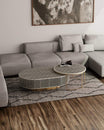
For smaller living rooms or buyers who want flexibility, a nesting coffee table set offers an alternative to a single large tabletop. Tabeer Homes' Saphed Nesting Coffee Table in black bone inlay includes two round tables, a 100 x 100 x 45 cm main table and a smaller 66 x 66 x 38 cm companion, both featuring a geometric sunburst pattern that can be styled together for a layered look or separated when extra surface area is needed elsewhere in the room. This format suits a smaller apartment living room particularly well, since the smaller table can tuck beneath or beside the larger one when not in active use, effectively reducing the coffee table's footprint without sacrificing the option of extra surface space during gatherings. A nesting set also offers practical flexibility beyond space-saving: the smaller table can migrate to a different spot in the room entirely, serving as an impromptu side table beside an armchair or extra seating surface when guests visit, a versatility a single fixed-size coffee table cannot match. For buyers drawn to the sunburst pattern but hesitant about committing to a single large statement piece, a nesting set also allows the bolder pattern to appear twice at different scales, letting the design register at both a larger and more intimate size within the same room.
Choosing a Bone Inlay Coffee Table for Your Living Room
Bringing bone inlay into a bone inlay living room works best when the table's boldness is weighed against the room's existing pattern density rather than added on top of an already busy space. A living room built around plain, solid-color upholstery and simple wall treatments has the most room to absorb a bold geometric or sunburst pattern without feeling overloaded. A living room that already carries a patterned rug, textured throw pillows, or an accent wall benefits from a simpler, more restrained inlay pattern, a checkerboard rather than a dense sunburst, so the coffee table complements rather than competes with what is already there. Lighting also matters more for bone inlay than for a glossy material like mother of pearl, since the matte finish depends less on reflectivity and holds its visual impact consistently across both bright daylight and dimmer evening lighting. Households debating between bone inlay and mother of pearl for the same living room often find the deciding factor comes down less to the room's color palette and more to how much existing pattern the space already carries, since bone inlay's boldness demands slightly more restraint elsewhere than mother of pearl's softer shimmer typically requires.
Base Materials: Gold, Black Metal, or Wood
The base beneath a bone inlay tabletop shapes the table's overall character nearly as much as the pattern itself. A gold or brass cylindrical base, as seen on the Ameerah Coffee Table, adds warmth and a sense of glamour that plays well against bone inlay's matte, earthy pattern, producing a striking contrast between the warm metal and the cooler stone-like inlay surface. A black metal base offers a more restrained, contemporary alternative, letting the tabletop's own pattern carry the visual weight without an additional warm accent competing for attention. A wood base, less common in this category than metal, provides the most grounded, traditional pairing, suited to a room already built around natural wood tones elsewhere in the furniture mix.
Styling a Bone Inlay Coffee Table
Because a bone inlay coffee table's pattern already provides significant visual interest, styling it well means restraint more than addition.
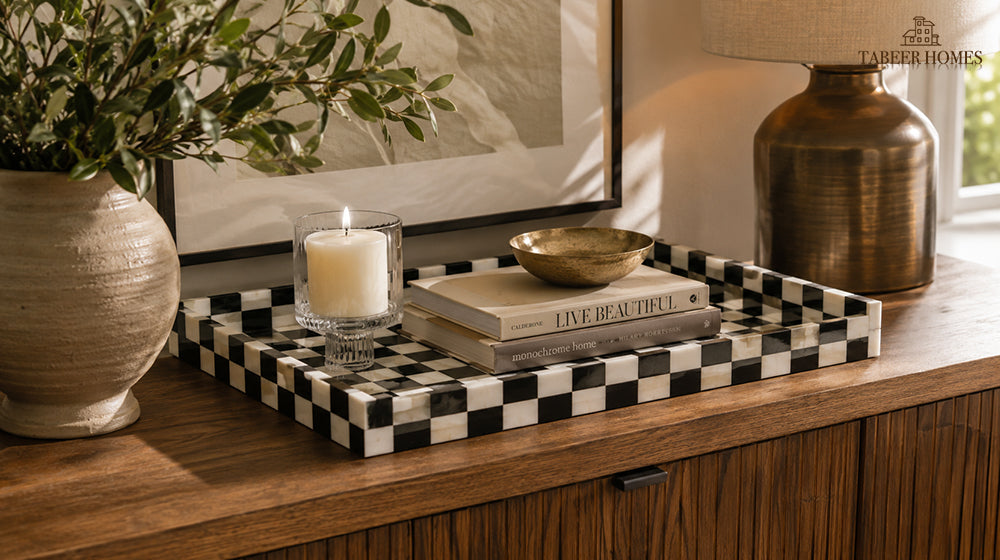
- Keep decorative objects to a minimum. A single tray, one stack of books, or a small decorative bowl is usually enough; overloading the surface competes with the table's own pattern rather than complementing it.
- Use a tray to protect the surface during active use. Grouping drinks or small objects on a tray keeps the table's own pattern visible around the edges rather than fully obscured.
- Choose simple, matte accessory finishes. Since bone inlay is already a matte, textured material, pairing it with equally matte ceramics or linen-covered boxes maintains a cohesive look, while overly glossy objects can feel visually mismatched.
- Let the pattern be the room's focal point. In rooms with a bone inlay coffee table as the centerpiece, keeping nearby rugs and textiles simpler helps the table's geometric or sunburst design remain the clear visual anchor.
Caring for a Bone Inlay Coffee Table Surface
A coffee table experiences more daily contact than most other bone inlay furniture, and its care routine benefits from a few surface-specific habits.
- Use coasters for every drink , since standing liquid, even briefly, can seep into the resin seams between bone segments over time.
- Avoid placing hot items directly on the surface , as sustained heat can affect both the resin bond and the bone's natural tone.
- Dust weekly with a soft, dry microfiber cloth , moving in the direction of the pattern rather than across it.
- Blot spills immediately rather than wiping , since a horizontal surface at coffee table height sees more direct, repeated contact than a wall-mounted or vertical piece.
- Keep the table out of a direct, sustained sun path , since bone inlay's pale tones can yellow gradually with prolonged UV exposure, a particular risk for a coffee table positioned near a large window.
Pairing a Bone Inlay Coffee Table With Existing Furniture
A bold, patterned coffee table rarely needs matching furniture around it to look intentional, and in most cases too much matching pattern actually undermines the table's impact rather than reinforcing it. Against a solid-color sofa in a neutral or muted tone, a bone inlay table's geometric pattern gets to function as the room's clear focal point without competing for attention, making this pairing the safest default for buyers unsure how bold to go elsewhere. Against a textured or patterned sofa, a bouclé weave, a bold print, or a heavily tufted upholstery, the coffee table benefits from a simpler pattern choice, a checkerboard rather than a dense sunburst, since two strong focal points positioned this close together tend to cancel each other out rather than build on one another. A rug beneath the seating arrangement should generally stay simpler in pattern than the table itself, since a heavily patterned rug directly beneath a heavily patterned tabletop creates visual competition at floor level that a room rarely benefits from. Side tables flanking the sofa do not need to match the coffee table's bone inlay exactly, but repeating the base metal finish, gold with gold, black with black, helps the room read as considered rather than assembled from unrelated pieces bought at different times.
Common Buying Mistakes to Avoid
A handful of recurring errors account for most of the regretted bone inlay coffee table purchases.
- Choosing pattern density without considering the room's existing pattern load. A dense sunburst or checkerboard pattern can overwhelm a room that already carries several other bold textiles or patterns nearby.
- Underestimating the table's visual weight relative to the base. A gold cylindrical base paired with a bold black and white pattern reads as considerably more dramatic than either element alone, worth factoring in for buyers wanting a more understated result.
- Assuming all bone inlay coffee tables handle daily contact identically. A table intended for genuine daily use benefits from confirming resin quality and a smooth, fully sealed finish, more than a purely decorative piece would need.
- Overlooking nesting table options for a smaller room. Buyers defaulting to a single large tabletop sometimes miss that a nesting set can offer more flexible surface area within a smaller overall footprint.
Ending Words
A bone inlay coffee table earns its place at the center of a living room through bold, matte pattern work that holds its visual impact regardless of lighting conditions, unlike a glossier material that depends more heavily on light interaction. Whether you choose the Ameerah Coffee Table 's dramatic black geometric pattern over a gold base, the Jade Coffee Table 's round white or blue bone inlay in a more compact footprint, or the Saphed Nesting Coffee Table 's flexible two-piece sunburst set, matching the table's scale and pattern density to your room's existing style will do more for the final result than choosing on pattern alone. For a broader look at how bone inlay compares to its closest material relative before committing to a full room built around either, our guide on bone inlay versus mother of pearl furniture covers the practical differences in more depth.
Frequently Asked Questions
What is a bone inlay coffee table made from?
A bone inlay coffee table pairs a tabletop covered in hand-carved bone segments set into resin, typically over a metal or wood base, producing a matte, textured finish with natural pattern variation.
Why are most bone inlay coffee tables round?
Round tables suit geometric and radial patterns, like sunbursts and concentric designs, particularly well, since the circular shape naturally supports these layouts and also avoids sharp corners in everyday living room use.
How big should a bone inlay coffee table be?
Sizing depends on your seating arrangement, but most round bone inlay coffee tables run between 90 and 115 cm in diameter, with 35 to 45 cm of clearance recommended between the table and surrounding seating.
Are nesting bone inlay coffee tables a good option for small living rooms?
Yes, a nesting set offers flexible surface area within a smaller overall footprint, since the smaller table can tuck beside or beneath the larger one when extra space is not needed.
How is a bone inlay coffee table different from a mother of pearl one?
Bone inlay produces a matte, graphic finish that holds its visual impact regardless of lighting, while mother of pearl offers a glossy, iridescent shimmer that depends more on light interaction to show its full effect.
How do I care for a bone inlay coffee table?
Use coasters for drinks, avoid placing hot items directly on the surface, dust weekly with a soft dry cloth, and keep the table out of prolonged direct sunlight to prevent yellowing over time.

اترك تعليقًا
This site is protected by hCaptcha and the hCaptcha Privacy Policy and Terms of Service apply.