




A rug does more design work per square metre than almost any other single purchase in a home, and it's also one of the easiest to get wrong. The wrong size makes a well-furnished room look unfinished. The wrong material wears unevenly within a year. The wrong pattern competes with everything else in the space instead of grounding it. Rugs Kuwait homeowners choose well tend to share the same starting point: sizing and material decided before pattern and colour, not the other way around.
This guide walks through how to size a rug correctly for your room, what the main material options actually offer in terms of look and durability, and how to choose a pattern that works with the room rather than against it.
Why Sizing Comes Before Everything Else
The single most common rug mistake isn't choosing the wrong colour or pattern, it's choosing the wrong size, and it's also the mistake that's hardest to notice from a product photo alone. A rug that's too small for its room, often referred to as a "postage stamp" rug, makes the furniture around it look like it's floating in unrelated space rather than anchored together.
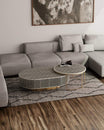
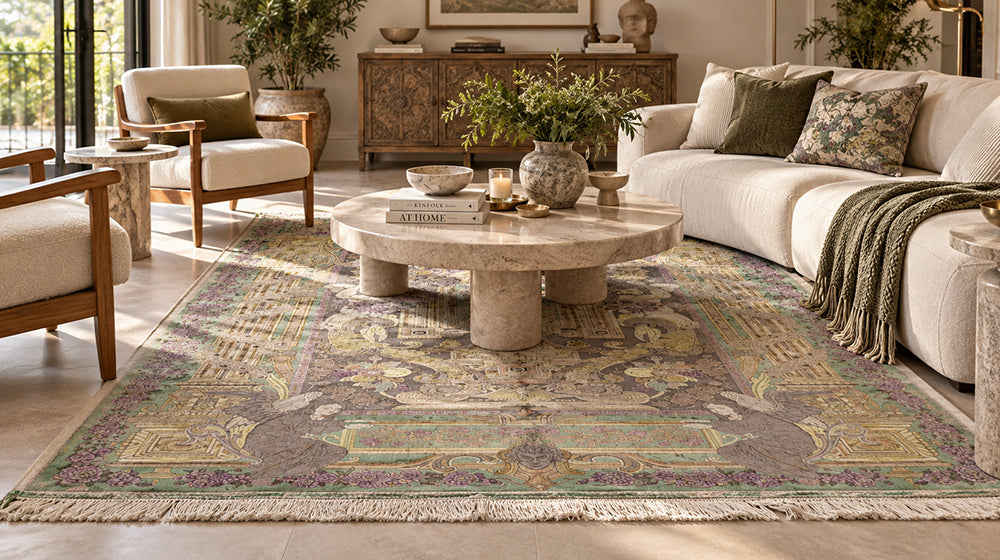
The general rule for a living room rug is that at minimum, the front legs of every major seating piece, sofa, armchairs, should rest on the rug, with the ideal being that all four legs of each piece sit on it. A rug that only reaches the coffee table, with sofas and chairs entirely off its edges, is almost always too small for the room it's in, regardless of how attractive the rug itself is.
Area Rugs Kuwait Homeowners Should Size By Room, Not Just by Budget
Area rugs Kuwait buyers select should be sized to the specific room and furniture arrangement, not simply the largest size that fits the budget. As a general guide:
|
Room Type |
Typical Rug Size |
Placement Rule |
|
Small living room or apartment |
200 x 300 cm |
Front legs of sofa and chairs on the rug |
|
Standard living room |
250 x 350 cm |
All furniture legs on the rug where possible |
|
Large majlis or formal living room |
300 x 400 cm and above |
Full seating arrangement contained within rug edges |
|
Bedroom, under bed |
200 x 300 cm |
Rug extends at least 45-60 cm beyond each side of the bed |
|
Dining area |
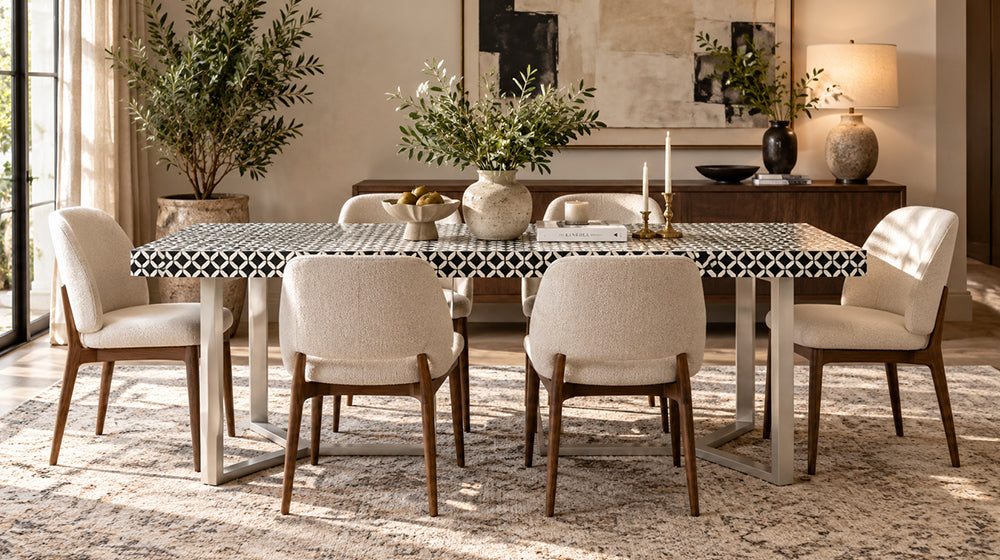
Table length plus 70 cm on each side |
Chairs remain on the rug even when pulled out |
Tabeer's silk rug collection spans this full range, from a compact 150 by 100 cm format suited to a smaller accent area or beside a bed, through 200 by 300 cm and 225 by 150 cm formats for standard living rooms, up to larger 350 by 250 cm and 400 by 300 cm pieces for majlis-scale or formal living spaces.
Living Room Rugs Kuwait Buyers Choose by Pattern and Colour
Once size is settled, pattern and colour are where a living room rugs Kuwait search actually gets interesting, since this is where the rug either grounds the room's existing colour scheme or becomes the room's primary decorative statement.
Persian and Medallion Patterns
Classic Persian medallion designs remain a consistently popular choice, featuring a central ornamental medallion surrounded by floral or geometric border work. Tabeer's range includes multiple takes on this format: the Soraya Silk Rug in red with a Persian medallion, the Simin Silk Rug in ivory and navy, and the Firuzeh Silk Rug with a turquoise Persian dome medallion. These patterns suit a more traditional or formal living room, particularly one with existing dark wood furniture or classical architectural details.
Floral and Botanical Designs
Floral patterns range from dense, intricate all-over designs to more restrained single-motif layouts. The Solene Silk Rug, in ivory with an intricate floral pattern bordered in navy, and the Elaris Silk Rug, a pastel floral medallion in ivory and gold, represent the softer end of this category, suiting a lighter, more feminine colour palette. The Regalia Silk Rug, featuring horses and floral border work in turquoise, and the Azerra Silk Rug, with animal motifs and hunting scene imagery, bring a bolder, more narrative quality to the same general floral-pattern family.
Tree of Life and Bird Motifs
A distinct pattern family within the collection uses tree of life imagery combined with bird motifs, a design tradition with deep roots across Persian and Central Asian rug-making. The Zyra Silk Rug and Azura Silk Rug both feature this tree of life and bird pattern in burgundy, navy, and gold, while the Liora Silk Rug offers a variation with flying birds set against a floral tree in gold and blue. This pattern family tends to work well as a genuine focal point in a room, since the imagery carries enough visual interest to anchor a space on its own.
Handmade Rugs Kuwait: What Craftsmanship Actually Adds
Handmade rugs Kuwait buyers specifically search for are choosing craftsmanship over the speed and lower cost of machine production, and the difference shows up in ways that go beyond the visible pattern. Tabeer's silk rug range is described by the brand as handcrafted silk weave with traditional artisan detailing, a construction approach that reflects the same hand-set, artisan-led philosophy the brand applies across its bone inlay and mother of pearl furniture lines.
The practical case for handmade over machine-made comes down to two things: density and longevity. A hand-woven rug typically achieves a tighter, more consistent weave over its lifetime of use than a machine-made equivalent, and because the weave isn't produced by a repeating mechanical pattern, no two handmade rugs, even in the same design, are ever perfectly identical. If you're specifically prioritising handmade construction for your purchase, it's worth asking the retailer directly to confirm the exact weaving method used for a given piece, since "handcrafted" and "hand-knotted" can describe meaningfully different production processes and it's worth understanding which applies to the specific rug you're considering.
Material Options Beyond Silk
While silk dominates Tabeer's rug range, other materials are worth understanding for different rooms and use cases. A cotton rug, such as the Zira Cotton Rug with its bold chevron pattern, offers a more casual, everyday-use alternative to silk, generally at a lower price point and with easier day-to-day maintenance, making it a reasonable choice for a high-traffic family room rather than a formal living or majlis space. A cow hide rug, such as the Kairo Cow Hide Rug in natural beige and chestnut tones, offers a completely different texture and visual language, working well as a smaller accent piece in a study, entryway, or beside a reading chair rather than as a full living room's primary rug.
Silk itself carries a specific set of trade-offs worth understanding before choosing it over a more durable alternative. It produces a noticeably fine, lustrous sheen that shifts subtly depending on the light and the direction you view it from, which is part of why silk rugs read as more luxurious than wool or cotton equivalents. The trade-off is that silk is a more delicate fibre, better suited to lower-traffic formal rooms, a sitting room, a bedroom, a majlis used mainly for guests, than a high-traffic family space where daily foot traffic and spills are a constant.
This makes room-matching as important a decision as pattern-matching. A silk rug placed in a genuinely high-traffic hallway or a family room used daily by children and pets will show wear considerably faster than the same rug placed in a formal sitting room reserved mainly for guests, regardless of how well it's cared for. Matching the material to the room's actual daily use, not just its intended decorative role, is what determines whether a silk rug purchase holds up as a long-term investment or needs replacing within a few years.
Layering a Rug Over Existing Flooring
Kuwait homes commonly feature marble, tile, or polished stone flooring throughout living and dining areas, which changes how a rug should be chosen compared with a home built on wood or carpeted floors. Stone and tile floors are cool underfoot and highly reflective, both of which a rug directly counteracts, adding warmth and softening the acoustics of a room that would otherwise carry more echo across a hard, reflective surface.
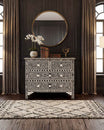
Against a light-coloured marble or tile floor, a rug with a darker base tone, such as the navy-heavy Firdaus Silk Rug or the burgundy Zyra Silk Rug, creates a clear visual boundary that defines the seating area distinctly from the surrounding floor. Against a darker or more richly patterned stone floor, a lighter-based rug, such as the ivory Elaris or Solene designs, prevents the room from feeling visually heavy across its entire lower half. In either case, the goal is contrast between rug and floor rather than a close colour match, since a rug that blends too closely into the floor tone loses the defining, anchoring effect a rug is meant to provide in the first place.
Rug Placement in Open-Plan Living and Dining Spaces
Many contemporary Kuwait homes and apartments use an open-plan layout where the living and dining areas share one continuous space without a dividing wall. In this arrangement, rugs do double duty as informal room dividers, using pattern and placement rather than architecture to signal where one function ends and another begins.
A large-format rug, 300 by 400 cm or above, can be sized to contain the entire living seating arrangement while leaving the dining area on bare flooring or under its own smaller rug, creating two visually distinct zones within a single open room. Alternatively, two coordinating rugs in a shared colour family but different pattern scale, a bolder medallion design under the living seating and a more restrained pattern under the dining table, achieve the same zoning effect while giving each area its own specific character. What doesn't work well in an open-plan layout is a single rug sized only for one function, living or dining, left as the sole rug in an otherwise large shared space, since this tends to make the unrugged portion of the room feel like an afterthought rather than a deliberately bare zone.
Colour Palette Considerations for Kuwait Interiors
Kuwait's interior palette often leans toward warm neutrals, gold accents, and rich jewel tones, which several of Tabeer's rug patterns are specifically built around. The Aurum Silk Rug, in turquoise, gold, and maroon with a medallion design, and the Zafina Silk Rug, combining blue and gold in a medallion pattern with floral accents, both work naturally within this warmer, more saturated palette without needing the surrounding room to be redesigned around them.
For a room built around a more restrained, contemporary palette, lighter options such as the Celina Silk Rug, a turquoise and navy medallion on a 200 by 200 cm square format, or the Elaris Silk Rug's pastel floral medallion, provide pattern interest without the same intensity of colour saturation.
Rug Care and Maintenance
Silk rugs require more deliberate care than synthetic alternatives, and understanding this upfront helps set realistic expectations before buying. Regular vacuuming on a low-suction setting, without a beater bar attachment, removes surface dust while preserving the weave's integrity. For spills, blot immediately with a clean, dry cloth rather than rubbing, since rubbing can push the spill deeper into the fibres and spread it across a wider area. Gentle spot cleaning with water-based solutions is generally acceptable, followed by thorough air drying, while professional cleaning is recommended periodically for a deeper refresh that at-home care can't fully replicate. Rotating the rug occasionally also promotes more even wear, particularly in a spot that receives consistent direct sunlight or heavy foot traffic.
Where to Buy Rugs in Kuwait
Once size, material, and pattern are settled, the practical question becomes where to source a genuinely handcrafted rug rather than a machine-printed imitation sold at a similar price point. This distinction matters more with rugs than with most other furniture categories, since a printed pattern on a synthetic base can visually resemble a handcrafted silk rug in a product photo while offering none of the same durability, texture, or long-term value.
Tabeer Homes' rug collection, spanning over a hundred silk rug designs across multiple size formats alongside cotton and cow hide options, gives Kuwait buyers a genuine range to shortlist from within a single retailer specialising in handcrafted pieces, rather than a single token rug included within a broader, mostly non-rug catalogue.
Price is worth comparing across the size range before settling on a specific piece, since silk rug pricing scales meaningfully with dimensions rather than staying flat across the collection. Tabeer's smaller 150 by 100 cm formats sit at the lower end of the range, while the largest 400 by 300 cm pieces command a considerably higher price, reflecting both the additional material and the extended weaving time a larger handcrafted piece requires. Comparing price per square metre across a few candidate sizes, rather than comparing total price alone, gives a clearer sense of relative value between a smaller premium design and a larger, simpler one.
Final Thoughts
Choosing rugs in Kuwait comes down to the same sequence regardless of which pattern eventually catches your eye: size to the room and furniture arrangement first, choose a material suited to how the space is actually used, and let pattern and colour follow from there rather than lead the decision. A handcrafted silk rug, sized correctly and cared for with the light touch the material asks for, becomes one of the most durable and visually rewarding investments a living room can hold.
Frequently Asked Questions
What size rug should I buy for a standard living room in Kuwait?
A standard living room typically suits a 250 by 300 cm or 250 by 350 cm rug, sized so that at minimum the front legs of the sofa and chairs rest on the rug's surface. A smaller living room or apartment can work with a 200 by 300 cm format, while a larger majlis or formal living space often calls for 300 by 400 cm or larger.
Are silk rugs practical for everyday use?
Silk rugs suit lower-traffic formal spaces, a sitting room, a bedroom, or a majlis used primarily for guests, better than a high-traffic family room. For a space with constant daily foot traffic and a higher risk of spills, a cotton rug offers a more practical, easier-to-maintain alternative at a lower price point.
What makes a rug genuinely handmade versus machine-made?
Handmade rugs are produced through hand-weaving techniques rather than mechanical looming, which typically results in a tighter, more consistent weave and natural, piece-to-piece variation that a machine-made rug, produced from a repeating mechanical pattern, doesn't have. If handmade construction specifically matters to your purchase, ask the retailer to confirm the exact weaving method used, since terms like handcrafted can describe a range of production processes.
How do I clean a silk rug without damaging it?
Vacuum regularly on a low-suction setting without a beater bar attachment. Blot spills immediately with a dry cloth rather than rubbing, and use water-based solutions sparingly for spot cleaning, followed by full air drying. Professional cleaning periodically is recommended for a deeper clean that home care alone can't achieve.
Can I mix a patterned rug with an already patterned sofa or curtains?
Yes, but it works best when one pattern is clearly dominant and the other is more restrained. A bold medallion rug pairs well with a solid or subtly textured sofa, while a more solid-colour or fine-pattern rug gives a patterned sofa or curtain fabric room to be the room's primary pattern statement without visual competition.


اترك تعليقًا
This site is protected by hCaptcha and the hCaptcha Privacy Policy and Terms of Service apply.