


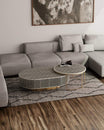


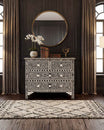
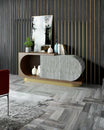
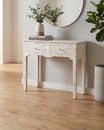





A desk spends more hours in direct use than almost any other piece of furniture in a home, holding a laptop, papers, and the accumulated small objects of a working day. A mother of pearl desk turns that daily workspace into something with genuine visual presence, its shimmering inlay catching light every time you glance up from a screen. This guide covers what to look for in this category, how sizing and layout affect daily comfort, and what to expect from an inlay writing desk's construction, care, and price positioning before you commit to one for a home office.
What Is a Mother of Pearl Desk?
A mother of pearl desk pairs a wood base, typically mango wood, with hand-cut shell segments set into resin across its front panels, drawer faces, or full exterior, producing the same light-reactive shimmer found in other mother of pearl furniture at a scale built for writing and computer work. An inlay writing desk in this material differs from a plain wood or laminate desk primarily in its surface treatment, since the underlying desk structure, drawers, a writing surface, often a knee well for seated use, remains largely the same regardless of finish. The inlay work adds both cost and genuine handcrafted character, turning a purely functional workspace into a piece that reads as furniture in its own right rather than disappearing into the background of a home office.
Console Desk Vs Traditional Writing Desk
Many pieces marketed in this category function more specifically as console desks than traditional writing desks, and understanding the distinction helps set realistic expectations before shopping. A console desk typically offers a single continuous surface with a knee well and often minimal drawer storage, prioritizing a clean, furniture-like silhouette over dedicated organizational compartments. A traditional writing desk usually includes more built-in storage, multiple drawers, sometimes a small hutch or shelf above the surface, prioritizing organization over the console desk's more streamlined look. For a home office that needs to hold significant paperwork or supplies, a traditional writing desk configuration generally serves better, while a console desk suits a household that primarily needs surface space for a laptop and minimal daily paperwork. This distinction matters more in the inlay furniture category specifically than it might for standard office furniture, since the console desk format, sharing much of its silhouette with a console table, has become the more commonly available configuration among workshops producing handcrafted inlay pieces, meaning buyers set on a heavily storage-oriented traditional writing desk in this material may find fewer options than those open to the console-style alternative.
Standard Sizing for a Luxury Home Office Desk
A luxury home office desk in this category generally follows standard desk proportions regardless of its decorative finish. Height typically runs 75 to 78 cm, matching standard chair and keyboard ergonomics. Width varies more significantly depending on function, ranging from a compact 90 to 100 cm for a console-style desk suited to a smaller room, up to 140 to 160 cm for a more substantial writing desk intended as a genuine home office centerpiece. Depth generally falls between 45 and 60 cm, with the deeper end of that range offering more comfortable space for a keyboard, mouse, and monitor setup without feeling cramped. Buyers planning to use the desk for genuine computer work, rather than primarily writing or occasional laptop use, should prioritize the wider and deeper end of these ranges to accommodate a full monitor setup comfortably. Knee well width and height also deserve attention beyond the desk's overall footprint, since a beautifully proportioned desk can still prove uncomfortable for extended use if the actual seated clearance beneath the surface is narrower or shallower than a standard office chair requires, a detail more easily checked against the specific product's stated dimensions than assumed from the desk's overall silhouette alone.
Choosing Between Mother of Pearl and Bone Inlay for a Desk
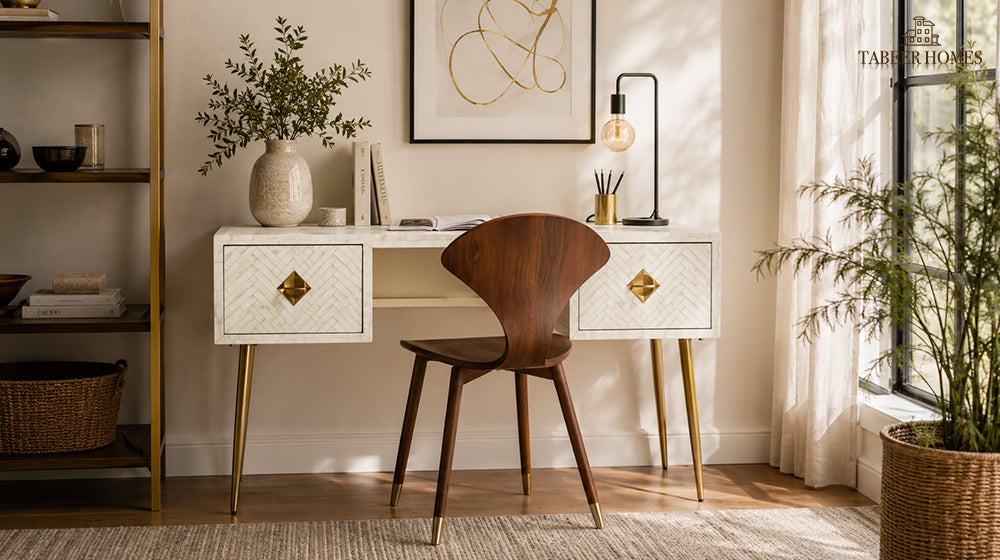
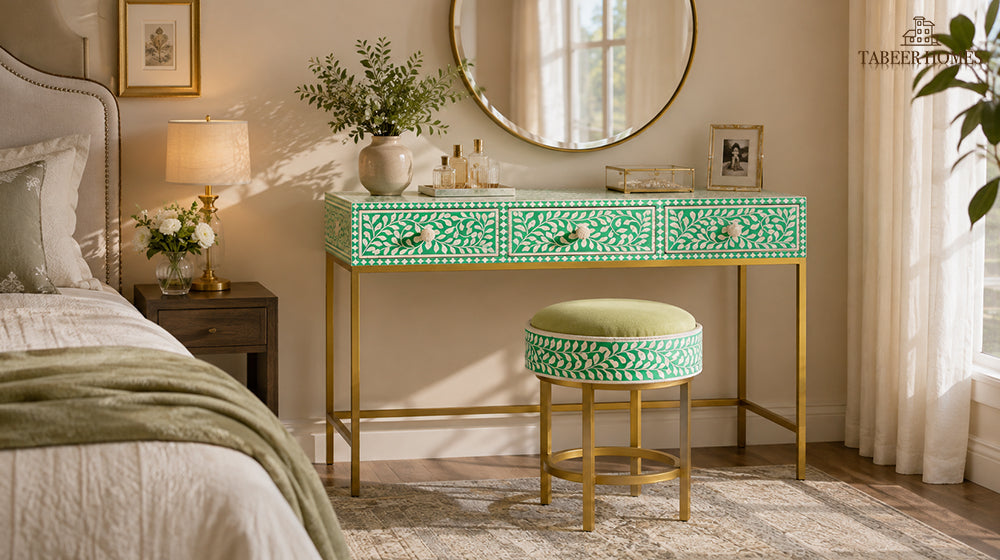
Since a desk sees more direct daily contact than most decorative furniture, the choice between mother of pearl and bone inlay for this specific piece carries slightly different practical weight than it does for a purely display-oriented item. Mother of pearl's glossy surface can show fingerprints and light scuffs more visibly over time given the frequency of hand contact a desk experiences, while bone inlay's matte finish tends to disguise minor daily wear more effectively. That said, both materials hold up well with reasonable care, and the choice often comes down more to the desired visual effect, mother of pearl's shimmer versus bone inlay's bold, graphic contrast, than to a meaningful durability difference. Tabeer Homes currently offers this desk category specifically in bone inlay, with the Ameerah Console Desk available in both black and white bone inlay and the Taara Console Desk in a distinctive green bone inlay, both built as console-style desks suited to a home office, entryway workspace, or a compact writing nook. Buyers weighing this decision purely on visual grounds, independent of the current catalog gap, might also consider how the desk's finish will read under typical work lighting: a glossy mother of pearl surface can occasionally produce mild glare under a desk lamp positioned at certain angles, while bone inlay's matte finish avoids this concern entirely regardless of lighting placement.
Layout Considerations for a Home Office Statement Desk
Positioning a decorative desk in a home office involves a slightly different set of considerations than placing a purely functional one. Natural light matters considerably for both practical work and for showing off the desk's inlay detail, making a window-adjacent placement preferable to a windowless interior wall when floor plan allows. Cable management deserves attention before purchase, since a desk without built-in cable routing can leave cords visibly draped across an otherwise polished inlay surface, undermining the piece's decorative impact. Confirming adequate knee clearance and legroom, particularly important for a console-style desk with a shallower depth than a traditional writing desk, prevents a beautiful piece from becoming uncomfortable for actual extended work sessions.
Pairing a Statement Desk With the Right Chair
A desk this visually distinctive deserves a chair chosen with equal consideration, since a mismatched or purely utilitarian office chair can undercut the desk's overall impact. A chair with a simpler, more neutral upholstery generally complements a heavily patterned inlay desk better than another boldly patterned piece, letting the desk's own detail remain the room's clear focal point. Material coordination matters as well: a chair with wood or brass accents echoing the desk's own finish tends to read as more considered than a chair chosen purely for ergonomic function with no visual relationship to the desk itself. For a genuinely luxury home office setup, prioritizing a chair with both real ergonomic support and a finish that complements the desk avoids the common trap of choosing style over comfort, or comfort over any visual coordination at all.
Storage and Cable Management for a Pearl Inlay Desk
A pearl inlay desk benefits from thoughtful storage planning given how much daily activity concentrates on this single surface compared to more occasional-use furniture. Drawers, when included, suit smaller items, stationery, chargers, notebooks, that need to stay close at hand without cluttering the visible desk surface. For desks without built-in drawers, a separate small storage unit or a decorative box on the desk's surface can fill the gap without requiring a full redesign of the piece itself. Cable management solutions, whether a built-in grommet hole, a cable tray mounted beneath the surface, or simply a cable sleeve routed along one leg, keep the visible surface clean and let the desk's inlay pattern remain the clear visual focus rather than competing with a tangle of cords.
Caring for a Mother of Pearl or Bone Inlay Desk
A desk's daily use calls for a slightly more vigilant care routine than a purely decorative inlay piece.
- Use a desk pad or mat for regular work , protecting the inlay surface from the repeated contact of a laptop, keyboard, or notebook resting directly on it throughout the day.
- Dust regularly with a soft, dry microfiber cloth , moving in the direction of the pattern rather than across it.
- Wipe up spills immediately , particularly coffee or tea, common companions to desk work that can stain the resin surface if left standing.
- Keep the desk out of direct sunlight when possible , since prolonged UV exposure can affect both mother of pearl's iridescence and bone inlay's pale tones over time.
- Avoid placing hot mugs directly on the surface , using a coaster to prevent heat marks on the resin finish.
A Brief History of Mother of Pearl Desks
Mother of pearl inlay applied to writing furniture has a documented history stretching back further than most buyers expect. Ancient Egyptian and Mesopotamian craftsmen used shell inlay to decorate thrones and furniture for royalty, and the technique later became closely associated with fine writing furniture in European and colonial-era design, including ornate lap desks and bureau surfaces crafted for wealthy households. Antique mother of pearl writing desks and lap desks from the 19th century still circulate in vintage and antique markets today, valued both for their craftsmanship and their historical association with formal correspondence in an era before typewriters or computers, some featuring hidden compartments and fold-out writing surfaces alongside their decorative inlay work. Modern mother of pearl desks descend from this same decorative tradition, applying the identical hand-inlay techniques used in Rajasthani and Gujarati furniture workshops to contemporary desk forms built for laptops and monitors rather than quill pens, though the underlying handcraft process has changed remarkably little across that span of time.
Where a Statement Desk Fits in a Modern Home
Beyond a dedicated home office, a heavily patterned desk of this kind increasingly finds a place in multi-purpose rooms where a purely utilitarian desk would feel out of place. In an open-plan living area, a console-style desk positioned along one wall can double as a display surface when not in active use, its inlay pattern reading as decor rather than office furniture during hours when work is not happening. In a bedroom, a smaller desk serves the same dual role as a dressing table discussed elsewhere in this material family, handling both occasional desk work and daily personal routines. In a formal study or library, a larger, more traditional writing desk configuration suits a room already built around books, artwork, and other collected objects, where the desk's own handcrafted detail fits naturally alongside the room's existing character rather than needing to justify its presence as a standalone statement piece.
Common Buying Mistakes to Avoid
A handful of recurring errors account for most of the regretted purchases in this category.
- Prioritizing pattern over ergonomic function. A stunning desk that sits at an uncomfortable height or offers insufficient legroom undermines its own purpose regardless of how striking the inlay work looks.
- Underestimating cable management needs before purchase. A desk without adequate cable routing can quickly accumulate a visible tangle of cords that detracts from the piece's decorative value.
- Choosing a console desk configuration for heavy storage needs. Buyers who genuinely need multiple drawers for paperwork and supplies are often better served by a traditional writing desk layout than a streamlined console-style design.
- Assuming mother of pearl and bone inlay are equally available across every desk style. As this category illustrates, specific finishes are not universally available across every workshop's desk collection, making it worth confirming material availability directly rather than assuming based on other furniture categories from the same source.
Ending Words
A statement desk earns its place in a home office by combining genuine daily function with handcrafted detail that makes a working space feel considered rather than purely utilitarian. While a dedicated mother of pearl desk was not available in Tabeer Homes' current catalog at the time of writing, the Ameerah Console Desk , available in both black and white bone inlay, and the Taara Console Desk in green bone inlay both bring the same category of handcrafted, statement-making detail to a home office setup. Buyers specifically set on mother of pearl for this furniture type should confirm current availability directly with the retailer, since inlay furniture collections do expand over time, or consider whether a bone inlay desk paired with mother of pearl accents elsewhere in the room, a tray, a small box, a nearby side table, achieves a similar material presence in the space. Sizing and ergonomics matter as much as material choice for a piece that will see genuine daily use, so measuring your actual workspace and confirming knee clearance before ordering protects against a beautiful desk that ultimately proves uncomfortable for real working hours. For a broader comparison of the two materials before deciding, our guide on bone inlay versus mother of pearl furniture covers the practical differences in more depth.
Frequently Asked Questions
What is a mother of pearl desk made from?
A mother of pearl desk pairs a wood base, typically mango wood, with hand-cut shell segments set into resin across its surface, producing a shimmering finish that shifts with light.
Is a console desk the same as a writing desk?
Not exactly. A console desk typically offers a single surface with minimal drawer storage and a cleaner silhouette, while a traditional writing desk usually includes more built-in storage for paperwork and supplies.
What size should a home office desk be?
Standard desk height runs 75 to 78 cm, with width ranging from 90 to 160 cm depending on function, and depth between 45 and 60 cm, with deeper desks better suited to a full monitor setup.
Is bone inlay or mother of pearl better for a desk?
Bone inlay's matte finish tends to disguise daily fingerprints and light wear more effectively than mother of pearl's glossier surface, though both hold up well with reasonable care and coasters or a desk pad.
How do I protect an inlay desk surface during daily use?
Use a desk pad for regular typing and writing, dust regularly with a soft dry cloth, wipe up spills immediately, and avoid placing hot mugs directly on the surface without a coaster.
Does Tabeer Homes sell mother of pearl desks?
At the time of writing, Tabeer Homes' desk category is available in bone inlay rather than mother of pearl, with the Ameerah and Taara Console Desks offered as statement pieces for a home office.

Leave a comment
This site is protected by hCaptcha and the hCaptcha Privacy Policy and Terms of Service apply.