


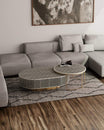
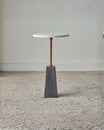
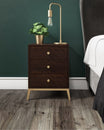
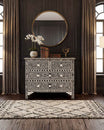


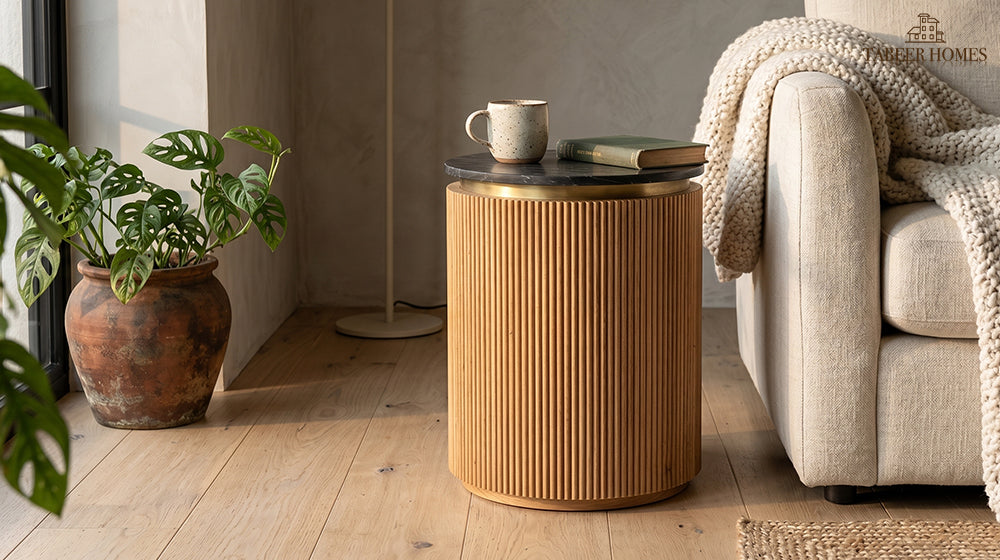
There is a reason the wooden side table has outlasted every furniture trend of the past three decades while ceramic accent tables, acrylic ghost tables, and powder-coated metal frames have cycled in and out of fashion. Wood reads as finished in a room that is still being assembled, it holds its appearance longer than most other materials under daily use, and it carries warmth that synthetic and metal alternatives approximate but never quite replicate. A wooden side table placed beside a sofa, a bed, or a reading chair looks like it belongs there in a way that a more trend-specific piece frequently does not. This guide covers why that is, which wood types and configurations suit which rooms, and what to check when buying across the UAE and GCC in 2026.
Why Wood Works Across Every Room and Every Style
The versatility of a wooden side table is not accidental. It comes from a set of material and visual properties that combine in ways other furniture materials do not.
Wood carries texture at a scale the eye reads as natural rather than manufactured. A marble surface is visually smooth. A metal frame is visually geometric. A wooden surface has grain variation, tonal depth, and occasional character marks that make each piece slightly different from the last. This natural variation means a wooden side table does not compete with other furniture in a room the way a highly distinctive material does. It occupies its position and adds warmth without announcing itself.
Wood is also physically forgiving in ways that reward daily use rather than penalising it. A small scratch on a well-oiled hardwood surface can be addressed with a cloth and a drop of wood oil in under two minutes. The equivalent mark on a lacquered ceramic, a marble top, or a powder-coated metal frame requires professional attention or is simply accepted as permanent damage. In wooden side table UAE households where furniture is touched, leaned on, and used continuously across the cooler entertaining months from October through April, this repairability matters more than product descriptions acknowledge.
Finally, wood transitions between interior styles more successfully than almost any other material. A solid wood side table Dubai interior designers specify for a contemporary villa and a rustic wooden side table chosen for a traditionally furnished sitting room are both wooden side tables. The material category spans that range without contradiction.
Wood Types and What Each One Delivers
Not all wood behaves the same way, looks the same under finishing, or performs equally in the conditions UAE homes present. Understanding the main wood types used in side table construction helps narrow the decision before any product is shortlisted.
Teak
Teak is among the most climate-resilient hardwoods available, which is why it has been used in UAE and GCC furniture for generations. Its natural oil content makes it highly resistant to moisture variation, it does not warp or split under the cycling between outdoor humidity and air-conditioned interiors that other woods struggle with, and its warm golden-brown tone deepens attractively with age. A wooden side table in teak is a long-term purchase. Well-maintained teak furniture holds its structural integrity and surface appearance for decades.
The trade-off is price. Teak commands a significant premium over other hardwoods, and the price difference reflects genuine material quality rather than branding. For a bedside piece used daily or a side table in a high-traffic living room position, the investment is justified. For a decorative accent piece in a low-use position, alternative hardwoods deliver adequate performance at lower cost.
Sheesham (Indian Rosewood)
Sheesham, also called Indian rosewood or Dalbergia sissoo, is the most commonly specified hardwood in mid-range to upper-mid-range furniture across the UAE retail market. Its grain is pronounced and visually interesting, its natural colour ranges from warm honey to rich reddish-brown depending on the specific piece, and it is dense enough to hold hardware and runner fittings securely over years of use.
A wooden bedside table in sheesham suits a bedroom with warm wood tones in the flooring, other furniture, or soft furnishings because the red-brown character of the wood adds to that warmth rather than introducing a conflicting tone. In bedrooms with a cooler, more neutral palette, sheesham can read as too warm unless the finish brings the tone toward grey or natural.
Mango Wood
Mango wood has become one of the most visible materials in the mid-range wooden side table UAE market over the past three years. It is widely available, relatively affordable, and produces furniture with a genuinely attractive grain pattern that includes natural figuring and occasional colour variation between heartwood and sapwood sections.
The practical consideration with mango wood is porosity. Mango is a less dense hardwood than teak or sheesham, which means it requires thorough sealing to perform well in variable humidity. A mango wood wooden side table with a quality oil or lacquer finish performs adequately in normal UAE indoor conditions. One with a thin or poorly applied finish will show moisture-related surface changes within one to two years of use in coastal locations including Dubai, Sharjah, and Abu Dhabi.
Oak
Oak is less common in UAE retail than teak or sheesham but increasingly available through higher-end furniture importers and direct-to-consumer brands operating across the solid wood side table Dubai market. European oak carries a cooler, lighter tone than the warm tropical hardwoods, with a more linear grain pattern and a finish that suits contemporary and Scandinavian-influenced interiors rather than warm traditional ones.
A wooden side table in oak sits naturally in a bedroom or living room with light walls, natural linen upholstery, and a restrained neutral palette. In a room already anchored by warm wood tones in flooring or cabinetry, oak can read as slightly cold unless the finish bridges the tonal gap.
|
Wood Type |
Climate Performance |
Grain Character |
Typical Tone |
Price Range AED |
Best Use Case |
|
Teak |
Excellent |
Medium, consistent |
Warm golden brown |
1,200 and above |
High-use or outdoor-adjacent positions |
|
Sheesham |
Excellent |
Pronounced, variable |
Warm reddish brown |
700 to 1,800 |
Bedrooms, traditional interiors |
|
Mango wood |
Good with sealing |
Figured, varied |
Honey to warm brown |
400 to 1,200 |
Mid-range living rooms and bedrooms |
|
Oak |
Good |
Linear, clean |
Cool light to medium |
900 to 2,200 |
Contemporary and neutral interiors |
|
Pine |
Moderate |
Knotted, casual |
Pale warm yellow |
300 to 800 |
Rustic, children's rooms, low-traffic |
Wooden Side Table with Shelf: When the Extra Level Changes Everything
A wooden side table with shelf is one of the most functionally complete configurations in the side table category, and it is consistently underrepresented in how buyers approach the purchase. The shelf level beneath the primary surface changes the piece from a single-surface table to a two-level storage and display unit without adding any floor footprint.
The practical uses of a lower shelf vary considerably by room position. Beside a sofa, the shelf holds books, magazines, or a basket for remote controls that would otherwise share the top surface with a lamp and a drink. Beside a bed, it holds the items that are needed in the room but not on the bedside surface: a water bottle, a pair of headphones, shoes that are worn again tomorrow. In a reading corner, the shelf holds the books that will be read this week without requiring a separate book surface elsewhere in the room.
The shelf configuration also adds visual weight to a wooden side table with shelf in a way that prevents lighter or smaller pieces from looking inconsequential in a large room. A small wooden side table with a narrow frame can disappear beside a substantial sofa or bed. The same piece with a lower shelf reads as a complete, intentional unit rather than an afterthought.
What to check in shelf configurations before buying:
- Shelf clearance height. The space between the floor and the shelf should be sufficient to hold whatever you intend to store there. Baskets, books lying flat, and water bottles all have minimum clearance requirements. Standard shelf clearance on a wooden side table with shelf runs between 20 and 35 cm.
- Shelf depth relative to top. Some designs taper the shelf to be shallower than the top surface. This affects what can be stored on the shelf and whether the visual proportion reads as balanced or as a large top on a disproportionately small base.
- Open versus closed shelf. An open lower shelf displays what is stored on it. If the items being stored are themselves visually tidy, this is an advantage. If the shelf will hold a charging cable, a spare remote, and a worn paperback, a closed drawer or cabinet configuration may serve the room's appearance better.
Rustic Wooden Side Table: What the Style Requires to Work
A rustic wooden side table is a specific design proposition that is frequently misapplied. Rustic does not mean roughly made or low quality. In furniture terms, rustic refers to a visual language that foregrounds the natural character of the material: visible grain, knotted wood, live-edge surfaces, hand-applied finishes that emphasise the wood's natural variation rather than smoothing it into uniformity.
A rustic wooden side table works well when the room it enters already carries some of that material language. Rooms with exposed brick, raw linen, terracotta tile, woven textiles, or natural fibre rugs give a rustic side table a context in which it reads as intentional. In a room with smooth white walls, polished tile floors, and contemporary upholstered furniture, the same piece reads as inconsistent rather than characterful.
The UAE and GCC interior market has seen significant growth in rustic and natural material styling over 2024 and 2025, driven partly by villa developments in areas including Al Barari, Jumeirah Golf Estates, and comparable Riyadh and Jeddah residential projects where landscaped outdoor environments extend the natural material language into interior spaces. A rustic wooden side table suits these contexts directly. In apartment interiors where the surrounding materials are finished and precise, the style requires more deliberate supporting choices to land correctly.
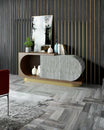
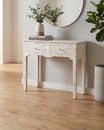
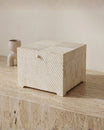
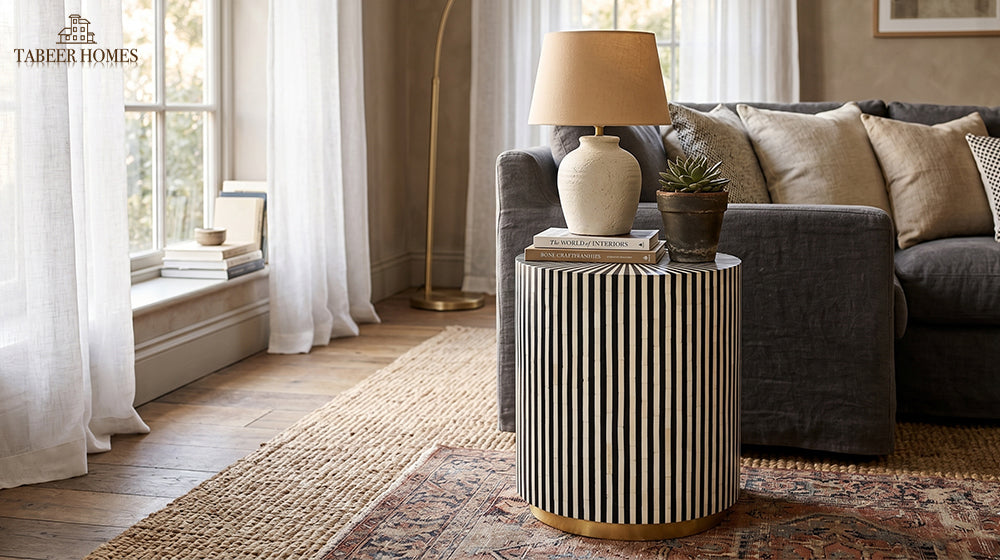
Tabeer Homes produces wooden side table pieces with hand-applied surface treatments including bone inlay and mother of pearl detailing on lacquered wood frames, positioned as the intersection between natural material warmth and decorative craftsmanship for UAE and GCC interiors.
Wooden Bedside Table: Sizing and Configuration for UAE Bedrooms
The wooden bedside table is the most specific application of the side table category, and it has a tighter set of requirements than a living room or sitting room piece because it operates in close physical relationship with the bed, the person using it, and the room's existing furniture.
Height is the primary sizing consideration. A wooden bedside table should sit level with or within 3 cm below the top of the mattress when the bed is made. This means the target height varies depending on the bed frame and mattress combination in the specific room. A platform bed with a low profile and a standard mattress may present a sleeping surface at 45 to 50 cm. A traditional bed frame with box spring and mattress may sit at 65 to 70 cm. Measuring before ordering is not optional for a bedside piece. Estimating produces the wrong result often enough to make it an avoidable mistake.
Width and depth at the bedside position are constrained by the gap between the bed and the wall or adjacent furniture. Standard secondary bedrooms in UAE apartment layouts present a side gap of 45 to 75 cm depending on the bed size and room width. A wooden bedside table of 40 to 50 cm wide and 35 to 45 cm deep fits most of these positions without eliminating the clearance needed to make the bed or access the room comfortably.
|
Bed Type and Height |
Target Bedside Table Height |
Recommended Surface Width |
Drawer Recommendation |
|
Platform bed, 45 to 55 cm |
42 to 55 cm |
40 to 50 cm |
Single drawer |
|
Standard frame, 55 to 65 cm |
52 to 65 cm |
40 to 55 cm |
Single or double drawer |
|
High frame or divan, 65 to 75 cm |
62 to 75 cm |
45 to 55 cm |
Single drawer or open shelf |
|
Adjustable or bespoke height |
Match mattress top precisely |
40 to 55 cm |
Based on storage need |
Solid Wood Side Table in Dubai and the UAE: What to Check Before Buying
The phrase solid wood is used inconsistently across UAE furniture retail, and understanding what it means in practice protects against paying a solid wood price for a piece that is solid wood only in its frame while the surfaces, drawer boxes, and back panels are MDF or particle board.
Genuine solid wood construction means the carcass panels, the top surface, and the drawer boxes are all cut from solid timber rather than engineered board. This matters for longevity, repairability, and how hardware holds up over years of use. A solid wood side table Dubai buyer paying a premium should confirm the following before purchasing: [INTERNAL LINK: anchor text suggestion "furniture buying guide UAE"]
- Ask specifically what the top surface, carcass sides, and drawer boxes are made from. A reputable retailer will answer this directly. Vague descriptions referencing solid wood in the product title without specifying which components are solid are a reliable indicator that the construction is mixed.
- Check the weight. A genuinely solid hardwood side table of standard dimensions feels substantially heavier than an MDF equivalent of the same size. If a piece described as solid teak or solid sheesham feels lightweight when lifted or moved, the construction warrants closer inspection.
- Look at the end grain on any exposed edge. Solid wood shows end grain at cut edges. MDF shows a fine, consistent, uniform surface at the edge with no grain. Veneer over MDF shows a thin layer of wood over the uniform board edge. These are visible distinctions on any piece where an edge is accessible.
- Check joinery at visible corners. Dovetail or mortise-and-tenon joinery at drawer corners and frame joints indicates solid wood construction built for long-term use. Metal brackets and stapled joints indicate cost-cutting at the structural level.
Frequently Asked Questions
What is the most durable wood for a side table in UAE conditions?
Teak is the most climate-resilient option for a wooden side table in UAE conditions due to its natural oil content, which makes it resistant to the moisture variation between outdoor humidity and air-conditioned interiors. Sheesham is the most practical alternative at a lower price point. Both species hold hardware securely over years of use and can be refinished if the surface requires attention. Avoid unsealed softwoods and poorly sealed mango wood in rooms with significant humidity variation.
How do I choose between a wooden side table with shelf and one with a drawer?
A wooden side table with shelf suits positions where the stored items are visually tidy enough to be on display, such as books, a plant, or a basket, and where open access without opening a drawer is useful. A side table with a drawer suits positions where the items being stored should be out of sight, such as a phone charger, reading glasses, or personal items at a bedside position. If storage volume is the primary concern, a piece with both a drawer and a lower shelf gives the most complete solution in the same footprint.
What height should a wooden bedside table be?
A wooden bedside table should sit level with or within 3 cm below the top of the mattress when measured from the floor. Mattress heights in UAE homes vary between approximately 45 cm for low platform beds and 75 cm for high-frame or divan configurations. Measuring the specific bed before ordering rather than estimating is the most reliable approach. A table that sits too low requires a downward reach that becomes uncomfortable over months of nightly use.
Is a rustic wooden side table suitable for a contemporary apartment in Dubai?
A rustic wooden side table can work in a contemporary Dubai apartment when it is supported by at least two or three other natural material elements in the room, such as a natural fibre rug, raw linen cushions, or woven textile throws. Without those supporting elements, a rustic piece in a room of smooth surfaces and polished finishes reads as inconsistent rather than characterful. The key is that the rustic piece should feel like part of a material direction, not an isolated contrast.
What is the difference between a solid wood side table and a wood veneer side table?
A solid wood side table is constructed from timber cut directly from the log, meaning all structural components are natural wood throughout their thickness. A veneer side table uses a thin layer of real wood applied over an engineered board core such as MDF or particle board. Veneer pieces can be visually identical to solid wood at a lower price, but they cannot be refinished if the surface is damaged and the engineered core is more susceptible to moisture exposure at edges and joins. For long-term use in a primary position, solid wood delivers better value over the life of the piece.
How do I style a wooden side table without it looking bare or overcrowded?
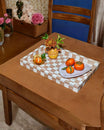
The most reliable approach is a three-object limit on the top surface of any wooden side table: one functional item such as a lamp or a glass, one decorative item such as a small vessel or a candle, and one item that bridges both categories such as a book with a strong cover or a small plant. This leaves a visible wood surface, which is part of what makes a wooden piece attractive. A tray corrals the objects and defines the decorative zone clearly, making it easier to clear the surface when the table needs to function fully.
Ending Thoughts
The wooden side table earns its position as the most versatile piece in any room through a combination of properties that trend-driven alternatives cycle through but rarely sustain. Wood adapts to the room around it. It improves in character with careful use. It repairs rather than degrades when the inevitable surface contact happens. Whether the priority is a solid wood side table Dubai buyers are choosing for a contemporary master bedroom, a wooden bedside table sized precisely for a specific bed height, a wooden side table with shelf that adds storage without consuming extra floor space, or a rustic wooden side table that anchors a room with natural material warmth, the buying framework is consistent. Identify the wood type for the climate and use intensity, confirm the construction before trusting the product description, size it precisely for the position, and let the finish work within those constraints. A wooden side table UAE homes invest in at that level of care is a piece that earns its place rather than waiting to be replaced.


Leave a comment
This site is protected by hCaptcha and the hCaptcha Privacy Policy and Terms of Service apply.