



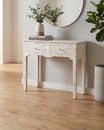
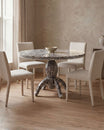

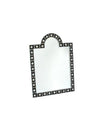

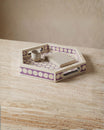


Before you read further, a scope note: what follows covers decorative, handcrafted mirrors suited to a bathroom's wall, vanity, or powder room area, not specialised fog-free or LED-backlit vanity mirrors with built-in demisting technology. If you're looking for a mirror with electronic anti-fog features, that's a different product category from the one this guide addresses.
Most bathroom mirrors are chosen the way a light fixture is chosen: functionally, quickly, and without much thought beyond "does it fit the wall." That default is worth questioning. A bathroom is one of the few rooms in a home where a mirror is guaranteed to be looked into daily, often at close range and in good light, which makes it one of the highest-impact places to place a genuinely well-made piece rather than a plain rectangle of glass in a thin metal frame.
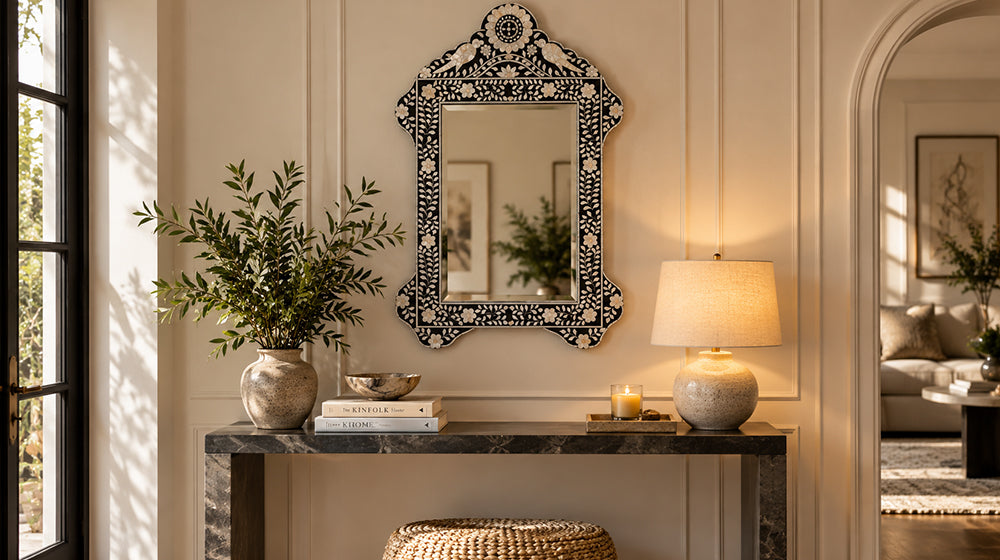
Unique bathroom mirrors , particularly handcrafted designs in bone inlay or mother of pearl, change that equation. They turn a fixture nobody consciously notices into a piece that sets the tone for the whole room. This guide walks through the design directions worth considering, what to check before buying a decorative mirror for a bathroom setting, and how to size and place one so it actually works in the space.
Why the Bathroom Mirror Deserves More Thought Than It Usually Gets
A living room or bedroom mirror is seen in passing. A bathroom mirror is seen head-on, under direct light, for a sustained period, multiple times a day. That difference in how a mirror is actually used means the frame, the finish, and the overall design register more strongly here than almost anywhere else in the home.
There's also a practical argument for treating the bathroom mirror as a design opportunity rather than an afterthought. Bathrooms, especially powder rooms and guest bathrooms, are often smaller and more tightly styled than living spaces, which means a single well-chosen piece, whether it's the mirror, a vanity light, or a tap fitting, carries proportionally more visual weight. A statement mirror in this kind of room does more design work per square centimetre than almost any other single object you could choose.
Designer Bathroom Mirror Styles Worth Considering
Mother of Pearl Inlay Mirrors
Mother of pearl inlay uses hand-set pieces of iridescent shell arranged into a pattern around the mirror's frame, catching light differently depending on the angle it's viewed from. Under bathroom lighting, which tends to be brighter and more direct than living room lighting, this shifting quality is especially noticeable, giving the mirror a subtle movement that a flat-painted or plain metal frame can't replicate.
The Iris Mirror is a clear example of this style done at full scale: a 90 cm wide, 200 cm tall rectangular mirror in mother of pearl inlay, available in white, pink, black and white, grey, and black colourways. At that height, it functions as a full-length mirror as much as a vanity mirror, which suits a larger master bathroom or a dressing area adjoining one. For a bathroom with less wall space, the Vitara Mirror offers the same mother of pearl inlay technique in a black and white finish at a more compact scale, suited to a single vanity wall rather than a full room.
Bone Inlay Mirrors
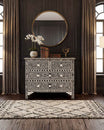
Bone inlay takes the same hand-setting technique as mother of pearl but uses cut and polished bone instead of shell, producing a more matte, ivory-toned pattern rather than an iridescent one. The effect reads as warmer and more understated, which suits a bathroom already built around natural materials such as wood vanities, woven textiles, or warm-toned tile.
The Ameerah Mirror, in a cream bone inlay finish, is a good example of this warmer register. The Maze Mirror takes a bolder approach, available in brown, blue, and black colourways with a more graphic inlay pattern, while the Yasmine Mirror and Trikon Mirror offer black, grey, and geometric-pattern options for buyers wanting a smaller, more restrained accent piece rather than a large-scale centrepiece. The Inayat Mirror, in a blue bone inlay finish, is another compact option suited to a powder room or secondary bathroom where a smaller mirror is more appropriate to the room's scale.
How Hand-Inlay Mirrors Are Actually Made
Understanding the construction process behind a bone inlay or mother of pearl mirror explains both the price difference from a mass-produced frame and why each piece looks slightly different from the next. The process starts with individual pieces of bone or shell, cut to a specific shape and size by hand, then set one at a time into a resin bed that has been laid over a wood substrate frame. Once the inlay pieces are set and the resin has cured, the surface is sanded flat so the inlay sits flush with the surrounding frame, then polished to bring out the material's natural sheen.
This is a slow process by design, and it's the reason no two hand-inlaid mirrors are perfectly identical, even within the same product line and colourway. A slight variation in how individual bone or shell pieces catch light, or minor differences in pattern spacing, is a normal feature of hand-set work rather than a manufacturing inconsistency. If you're ordering more than one mirror to hang as a matched pair, it's worth asking whether they can be sourced from the same production batch to minimise visible variation between the two.
Round and Arched Mirror Shapes for Bathrooms
Rectangular mirrors dominate the vanity mirror category because they're the most straightforward shape to size against a straight-edged counter, but round and arched mirrors are worth considering for a bathroom specifically, since the softer outline reads differently against tile, which is almost always laid in straight grid lines.
A round mirror breaks up a bathroom's otherwise rectilinear geometry, tile grout lines, a rectangular vanity, a square mirror cabinet, and this contrast is often what makes a round or geometrically patterned frame such as the Trikon Mirror feel more considered than a rectangular mirror in the same spot would. Round shapes also tend to suit smaller powder rooms particularly well, since a round mirror occupies less total wall area than a rectangular mirror of the same width, which matters when wall space is genuinely limited.
Arched or curved-top mirrors sit between the two, offering a softened silhouette while still providing more reflective surface area than a fully round mirror of similar width. This shape tends to suit a bathroom with a taller vanity backsplash or a narrower wall run, where a full rectangle would look boxy but a round mirror would leave awkward negative space above the vanity.
Decorative Bathroom Mirror: What Actually Changes the Room
A decorative bathroom mirror does two jobs at once: it reflects, and it decorates. Getting the balance right between those two functions is what separates a mirror that elevates a bathroom from one that simply sits on the wall.
The frame is doing most of the decorative work. A plain, frameless mirror reflects the room but adds nothing of its own to it. A hand-inlaid frame, whether in bone or mother of pearl, becomes a visible design element in its own right, which means it needs to be considered alongside the room's existing materials rather than treated as invisible. A cream or white bone inlay frame sits comfortably against warm stone or wood vanities. A black and white mother of pearl frame suits a more contemporary, higher-contrast bathroom with dark grout, black fittings, or patterned floor tile.
Shape matters almost as much as frame material. A rectangular mirror, such as the full-length Iris Mirror, suits a bathroom where the mirror needs to do double duty as a dressing mirror. A smaller, more compact mirror such as the Yasmine or Trikon suits a single vanity position where the mirror's job is purely to support grooming tasks rather than full-body viewing.
Handcrafted Mirror Construction: What to Ask Before Buying
A handcrafted mirror is only as good as the materials and process behind the visible pattern, and this matters more in a bathroom than in a drier part of the home because of the humidity a bathroom generates during regular use.
Ask specifically what the frame is built from. Tabeer's inlay mirrors typically combine the inlay material, whether bone or mother of pearl, with a resin setting layer over a wood substrate. Wood-backed frames perform best in bathrooms with reasonable ventilation, whether through an extractor fan or an openable window, since sustained high humidity without airflow can affect any wood-based product over time, not just inlay mirrors specifically. If your bathroom runs consistently steamy with limited ventilation, it's worth positioning the mirror away from the direct line of the shower spray or bath, rather than directly beside it, and confirming ventilation is adequate before committing to a piece with a wood-backed frame.
It's also worth checking the care instructions before buying. Inlay mirrors are generally maintained with a soft, dry microfiber cloth for regular dusting, with a lightly damp cloth acceptable for occasional cleaning as long as the surface is dried immediately afterward. Harsh chemical cleaners, abrasive pads, and acidic products should be avoided on the frame, since these can affect the inlay's finish over time in a way that plain glass or a metal frame wouldn't show.
Sizing a Statement Mirror for Your Bathroom
Getting the size right matters more in a bathroom than almost anywhere else, because bathroom wall space is usually fixed and limited by plumbing, tiling, and fixture placement in a way that living room wall space isn't.
For a single vanity position, a mirror roughly 60 to 75 percent of the vanity's width tends to look proportional, leaving visible wall or tile on either side rather than crowding the edges. For a double vanity, either one larger mirror spanning both basins or two matching smaller mirrors, one centred over each basin, both work, though matching pairs require more available wall height than a single wide mirror does.
For a full-length piece such as the 200 cm Iris Mirror, the placement decision is less about the vanity and more about whether the bathroom has a clear, uninterrupted wall run long enough to accommodate the full height without the mirror's base sitting awkwardly close to a bath, toilet, or door swing. This kind of mirror suits a larger ensuite or a dressing nook attached to a bathroom more than a compact guest powder room.
|
Bathroom Type |
Suggested Mirror Approach |
Example Style |
|
Single vanity, small bathroom |
Compact mirror, 60-75% of vanity width |
Yasmine, Trikon, Inayat |
|
Double vanity |
One wide mirror or matched pair |
Vitara, or two matching Maze pieces |
|
Master ensuite with dressing area |
Full-length statement mirror |
Iris Mirror, 90 x 200 cm |
|
Powder room / guest bathroom |
Smaller accent mirror as focal point |
Ameerah, Jade |
Placement and Lighting Considerations
A hand-inlaid mirror is designed to catch and reflect light, which means its position relative to your bathroom's light source matters more than it would for a plain mirror. Mother of pearl pieces in particular benefit from natural or warm artificial light hitting the frame at an angle, since this is what activates the shell's iridescent quality. A mirror placed directly under a single overhead downlight, with no side lighting, will show the reflective glass clearly but won't show the frame's inlay pattern at its best.
Where possible, position a mother of pearl or bone inlay mirror where it receives light from the side, whether from a window, a wall sconce, or vanity lighting mounted beside rather than only above the mirror. This single placement decision does more to make an inlay mirror look genuinely striking than almost any other factor in the room.
Mirror-to-mirror placement is also worth considering in larger bathrooms with more than one reflective surface, such as a mirrored cabinet alongside a decorative wall mirror. Positioning a hand-inlaid piece directly opposite a second mirror can create a distracting repeated reflection of the frame's pattern. Placing it on a wall perpendicular to, rather than facing, another mirror usually gives a cleaner result and lets the inlay pattern read as a single focal point rather than a repeated one.
Final Thoughts
A bathroom mirror is one of the few objects in a home guaranteed daily, close-range attention, which makes it a genuinely poor place to default to the plainest available option. Choosing a unique bathroom mirror in hand-set bone inlay or mother of pearl, sized correctly for the vanity or wall it will occupy and positioned to catch available light, turns a fixture most people never consciously notice into one of the most distinctive details in the room. The frame does the decorating; your job is simply to give it the right amount of wall, and the right amount of light, to do that well.
Frequently Asked Questions
Are handcrafted bone inlay and mother of pearl mirrors safe to use in a bathroom?
Yes, with reasonable ventilation. These mirrors typically combine a wood substrate with a resin-set inlay layer, and wood-based products generally perform best in spaces with adequate airflow, such as an extractor fan or openable window, rather than in a bathroom with persistent, unventilated steam. Positioning the mirror away from direct shower spray is a sensible precaution regardless of the frame material.
What size mirror works best above a single vanity?
A mirror roughly 60 to 75 percent of the vanity's width tends to look proportional, leaving a visible border of wall or tile on either side. Going much wider than the vanity itself can make the mirror look oversized relative to the counter beneath it.
Can a decorative bathroom mirror double as a full-length mirror?
Yes, if it's sized for it. A mirror such as the 90 cm by 200 cm Iris Mirror is tall enough to function as a full-length mirror as well as a vanity mirror, which makes it a practical choice for a master ensuite or a bathroom with an adjoining dressing area, rather than a small guest powder room.
How do I clean a hand-inlaid mirror frame without damaging the pattern?
Regular dusting with a soft, dry microfiber cloth is sufficient for most maintenance. For occasional deeper cleaning, a lightly damp cloth can be used on the frame as long as it's dried immediately afterward. Avoid harsh chemical cleaners, abrasive pads, and acidic cleaning products, since these can affect the inlay's finish in a way that wouldn't show on a plain glass or metal-framed mirror.
Does the mirror's frame colour need to match the rest of the bathroom exactly?
No, and in most cases an exact match looks flatter than a considered contrast. A cream or white bone inlay frame works well against warm stone or wood-toned vanities without matching them precisely, while a black and white mother of pearl frame can add contrast to a bathroom with lighter walls and fittings rather than needing to match the existing colour scheme.
Is it normal for a hand-inlaid mirror to look slightly different from the product photo?
Yes. Because each piece is set by hand, individual bone or shell segments vary slightly in size, spacing, and how they catch light from one mirror to the next, even within the same colourway. This variation is a feature of genuine handcraft rather than a defect, though it's worth keeping in mind if you're ordering two pieces and expect them to look identical side by side.
Should I choose a round or rectangular mirror for a small guest bathroom?
A round mirror generally suits a small guest bathroom or powder room better than a rectangular one of similar width, since it occupies less total wall area and softens a room that's usually dominated by straight grout lines and a compact rectangular vanity. A rectangular mirror still works well if the room has a wider, uninterrupted wall run to work with.

Leave a comment
This site is protected by hCaptcha and the hCaptcha Privacy Policy and Terms of Service apply.