


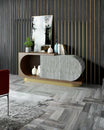
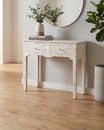
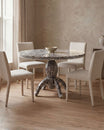

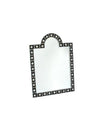

You are standing in front of a dining room wall with a tape measure in one hand and three browser tabs open, and every retailer seems to call the same shape of furniture something different. One listing says buffet, the next says sideboard, and a third calls it a buffet cabinet. If you have asked yourself what is a buffet table while trying to furnish a Dubai or GCC dining room, you are not missing something obvious. The naming genuinely is inconsistent, and knowing the real distinctions will save you from ordering a piece that is the wrong height for the way you actually plan to use it.
What Is a Buffet Table, Exactly?
A buffet table (also called a buffet cabinet) is a long, low storage piece placed against a dining room wall, built with a flat top for serving food and enclosed storage below for tableware. The core buffet table meaning comes from its function rather than its shape: it exists to hold dishes during a meal and store dinnerware between meals.
Traditionally, a buffet sits slightly taller than a sideboard because it was designed for standing service. Guests would set down platters or plate food directly from the surface, so the height needed to sit close to counter level rather than coffee-table level. That single design decision, taller legs for standing use, is still the clearest way to tell a true buffet from its close relative, the sideboard.
A Short History of the Buffet Table
Understanding where these pieces came from explains why the naming is so tangled today. In 18th-century English homes, what we now call a sideboard began life as a long table pushed against a dining room wall, used by servants to set down dishes between courses. Over the following decades, drawers and enclosed cabinets were added below the tabletop, and decorative legs replaced the plain trestle base. The name never fully updated even as the piece changed shape, which is part of why a modern dining buffet still carries a name rooted in table, not cabinet.
The word buffet followed a slightly different path, borrowed from the French term for a sideboard used to display and serve food at a gathering. As the two pieces evolved in parallel, taller versions built specifically for standing service picked up the buffet name, while shorter, general storage versions kept the sideboard label. In American usage today, the two terms are used almost interchangeably, while sideboard remains more common in British English and in higher-end furniture catalogs.
Buffet Vs Sideboard: Where the Confusion Comes From
Retailers rarely apply the terms consistently, which is the main source of the confusion. The distinction below is what most furniture historians and manufacturers still use as a reference point, even if online listings blur it.
The table below breaks down the practical differences you can actually measure and feel in a room.
|
Feature |
Buffet Table |
Sideboard |
|
Typical height |
86 to 97 cm (34 to 38 in) |
71 to 91 cm (28 to 36 in) |
|
Leg style |
Taller, raised legs |
Shorter legs or base flush to floor |
|
Primary purpose |
Standing food service |
General storage and display |
|
Best placement |
Dining room, near the table |
Dining room, living room, hallway, entryway |
|
Formality |
Traditionally more formal |
More versatile, casual to formal |
A buffet's extra four to ten centimeters of height changes how the piece feels against the wall and how comfortable it is to plate food without leaning over. A sideboard, sitting lower, reads more like a display and general storage piece that happens to also work for serving when needed.
Standard Buffet Table Sizes
Before ordering, it helps to know what "standard" actually looks like in centimeters rather than in vague size descriptions like small, medium, or large.
- Width : Most buffet tables run between 150 and 180 cm, sized to sit comfortably against a dining wall without crowding the room.
- Depth : A working range of 40 to 55 cm keeps the piece out of the walking path while still holding full-size serving platters.
- Height : 86 to 97 cm is the standard range built for standing service.
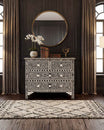
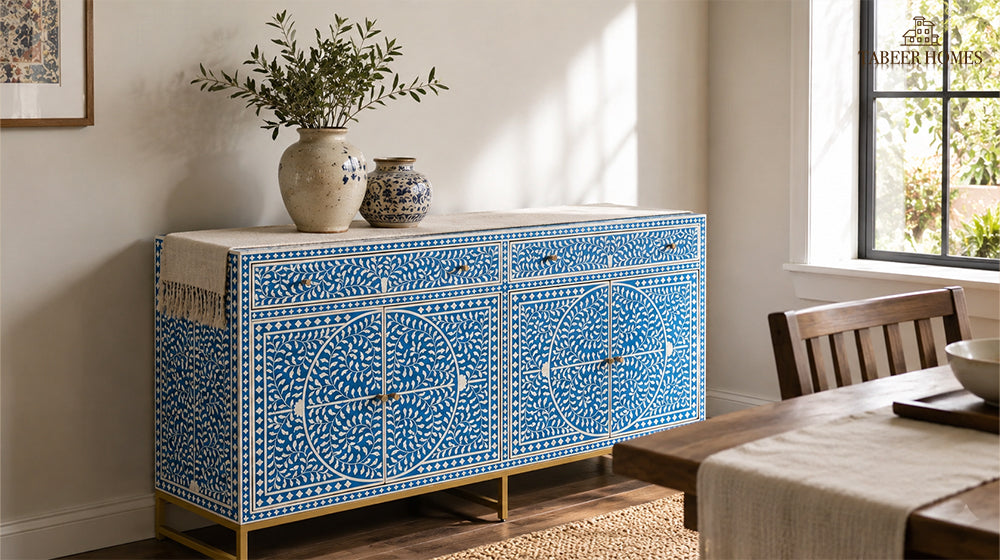
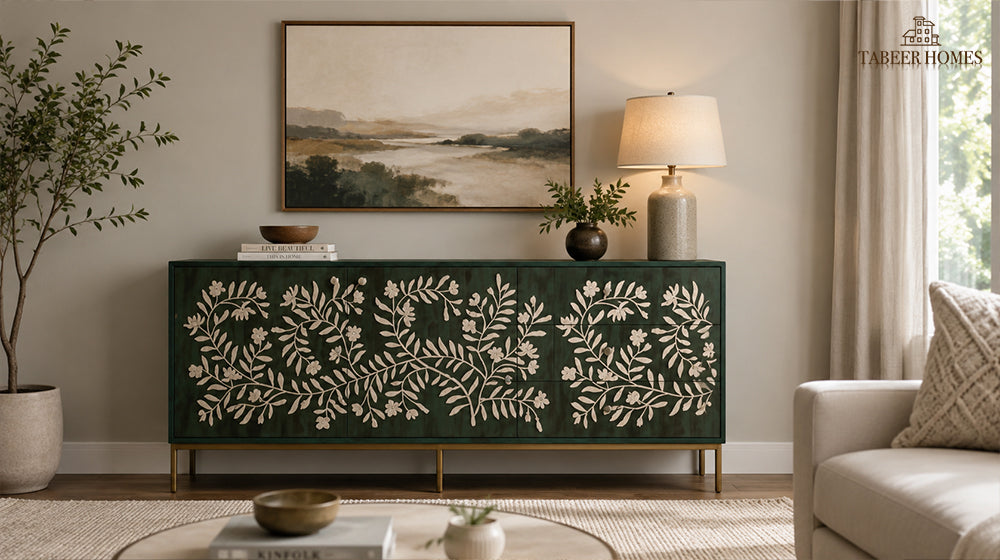
Tabeer Homes' own Yasmine Sideboard Buffet measures 160 cm wide, 50 cm deep, and 90 cm tall in grey bone inlay, and the Maze Sideboard Buffet comes in slightly narrower at 150 cm wide, 50 cm deep, and 90 cm tall in a black bone inlay checkerboard pattern. Both sit inside the standard height band for standing service, which confirms they function as true buffets rather than lower display sideboards.
Matching Buffet Size to Table Size
A buffet or sideboard reads as proportional when its length equals roughly 60 to 75 percent of the dining table's length, and its height sits at or slightly above the dining table's height. Since most dining tables measure close to 75 cm tall, a buffet in the 86 to 97 cm range creates a natural visual step up rather than competing with the table for attention.
Materials Used in Buffet Cabinets and Sideboards
Material choice affects both the look and the long-term maintenance of a dining buffet, and it is worth understanding the main categories before comparing finishes.
Solid Wood Frames
Most buffet cabinets and sideboards, including bone inlay pieces, are built on a solid wood frame, commonly mango wood in handcrafted Indian-made furniture. Solid wood is durable and takes finishing well, but it does expand and contract slightly with humidity changes, which matters in a coastal GCC climate where indoor humidity can swing between air-conditioned interiors and more humid outdoor air.
Bone Inlay and Mother of Pearl
Bone inlay furniture is made by embedding hundreds of individually cut and polished pieces of camel bone into a resin base set into the wood frame, a technique practiced for generations by artisans in the Rajasthani region of India. Mother of pearl inlay follows a similar process using shell instead of bone, producing a slightly more luminous, iridescent surface. Both techniques are labor-intensive, which is why bone inlay and mother of pearl buffet cabinets sit at a higher price point than plain lacquered or veneered pieces, and why slight irregularities in the pattern are normal rather than a manufacturing flaw.
Marble and Mixed Tops
Some buffet cabinets pair a wood or inlay cabinet base with a marble top, which adds a cool, non-porous serving surface that resists heat marks better than a lacquered wood top. Marble does require more caution around acidic spills like citrus juice or wine, since these can etch the surface if left too long.
Mirrored and Glass-Panel Finishes
A separate finish category worth knowing about is the mirrored buffet cabinet, which uses beveled mirror panels on the front or sides instead of solid wood or inlay. The reflective surface bounces light around the room, which makes this style a popular pick for dining areas that get limited natural light or that feel visually heavy with dark wood dining furniture. Mirrored finishes trade some of the tactile warmth of bone inlay for a lighter, more contemporary look, and they need only occasional glass cleaner in addition to the usual dusting routine.
How to Measure Your Dining Wall for a Buffet Table
Getting the sizing right before ordering avoids the most common and most expensive mistake buyers make with this category of furniture.
- Measure the full wall length where the piece will sit, then subtract at least 15 cm on either side for visual breathing room and for door or drawer swing clearance.
- Measure your dining table's length and height , then apply the 60 to 75 percent width ratio and the "at or slightly above" height rule described above.
- Check the depth against your walkway. Leave at least 90 cm of clear floor space in front of the piece so chairs can be pulled back and people can pass while serving.
- Note any obstructions , including skirting boards, light switches, or windows that sit low enough to interfere with the top surface or an open door.
How a Buffet Cabinet Gets Used in a GCC Dining Room
A buffet earns its keep through daily function, not just at dinner parties. Common uses include:
- Serving station during gatherings , especially for Ramadan iftars, Eid lunches, or larger family dinners where the dining table alone cannot hold every dish.
- Everyday dinnerware storage , keeping plates, cutlery, and table linens close to the dining table instead of in a separate kitchen cabinet.
- Display surface , using the top for a runner, decorative bowls, or a centerpiece between meals.
- Drinks and coffee staging , particularly useful in homes that entertain guests regularly and need a fixed spot for a coffee or tea setup.
Caring for Bone Inlay and Wood Buffet Cabinets
Bone inlay and mother of pearl pieces need gentler handling than plain wood furniture, since both the inlay and the resin holding it in place are more sensitive to moisture, heat, and abrasive cleaning.
- Dust weekly with a soft, dry microfiber cloth , wiping in the direction of the inlay pattern rather than across it to avoid loosening individual pieces.
- Clean spills immediately by blotting rather than rubbing, since standing liquid can seep into the resin and cause discoloration over time.
- Keep the piece out of direct sunlight where possible, since prolonged UV exposure can yellow pale inlay tones, while brief exposure has less impact.
- Avoid placing the buffet near AC vents or in high-humidity rooms , since the wood and the inlay expand and contract at slightly different rates, and repeated humidity swings can loosen individual bone or shell pieces at the edges.
Tabeer Homes covers this in more depth in its own guide to maintaining and cleaning bone inlay furniture , which is worth a read before your first deep clean.
Common Buyer Mistakes When Choosing a Buffet or Sideboard
A handful of mistakes account for most of the returns and regretted purchases in this category.
- Buying by listing title instead of dimensions. Since retailers use buffet and sideboard interchangeably, relying on the category name alone tells you almost nothing about the actual height or depth you are getting.
- Underestimating walkway clearance. A piece that fits the wall length perfectly can still make a room feel cramped if there is not enough floor space to pull out chairs or pass behind someone serving food.
- Ignoring humidity exposure at the point of placement. Positioning a bone inlay piece directly under an AC vent or beside a frequently opened balcony door accelerates wear that proper placement would have avoided.
- Choosing height based on the room instead of the dining table. A buffet that looks proportional in an empty showroom can look mismatched once it sits beside your actual table, which is why the height and length ratios matter more than general room size.
- Matching finish to the wrong room. A heavily patterned bone inlay piece can overwhelm a small dining nook, while a plain lacquered finish can look flat in a room built around statement furniture. Matching the finish to the scale and style of the room prevents both problems.
Buffet Cabinet, Sideboard, or Console: A Quick Gut Check
If you are still unsure which term applies to the piece you are looking at, a short physical test settles it faster than reading more listings.
- If the top surface sits close to your wrist when you stand beside it, you are looking at a buffet .
- If the top surface sits closer to your hip, you are looking at a sideboard .
- If the piece is noticeably shallower and meant for an entryway rather than a dining wall, it is likely a console instead of either.
This three-point check works regardless of what the seller has labeled the listing, since dimensions do not lie the way category names sometimes do. For a deeper side-by-side comparison, Tabeer Homes has a dedicated post on buffet cabinet vs sideboard differences and a separate one comparing sideboard buffet cabinets against console tables for living room placement specifically.
Choosing Between a Dining Buffet and a Sideboard for Your Space
A dining buffet makes sense when the room is used often for hosting and standing service matters. A sideboard makes more sense when the piece needs to double as a living room or hallway storage solution, since its lower profile fits more spaces without looking out of place. For a home that hosts guests frequently, particularly during Ramadan or Eid gatherings, the taller standing height of a true buffet earns its space. For a home where the same piece needs to move between rooms or serve a quieter, everyday storage role, a lower sideboard is the more flexible pick.
Whichever term ends up on the listing, the piece that actually works in your home is the one sized correctly for your wall, your table, and how often you plan to use the top surface for serving rather than just display. Tabeer Homes catalogs both true buffet cabinets and shorter sideboards under overlapping names, so checking the stated dimensions before checking the product title will save you a returned order.
Frequently Asked Questions
Is a buffet table the same as a sideboard?
Not exactly, though the terms are often used interchangeably by retailers. A true buffet table is taller (86 to 97 cm) and built for standing food service, while a sideboard sits lower (71 to 91 cm) and serves a more general storage and display role.
What is the standard height of a buffet table?
Most buffet tables measure between 86 and 97 cm tall, a height chosen to make standing food service comfortable without guests needing to bend over the surface.
How wide should a buffet cabinet be for a dining room?
A buffet cabinet works best at 60 to 75 percent of the dining table's length, which for most standard tables lands somewhere between 150 and 180 cm wide.
Can a sideboard be used as a buffet table?
Yes. Many households use a sideboard as a serving surface during meals even though its lower height was not originally designed for standing service. The tradeoff is comfort during longer serving sessions rather than function.
What is a dining buffet used for besides serving food?
Beyond serving, a dining buffet typically stores plates, cutlery, table linens, and serving dishes, and its top surface often doubles as a display space for decor between meals.
Do buffet cabinets and sideboards need different depths?
Not significantly. Both typically fall in the 40 to 55 cm depth range, though shallower sideboards exist for hallway or entryway placement where floor space is limited.

Leave a comment
This site is protected by hCaptcha and the hCaptcha Privacy Policy and Terms of Service apply.