


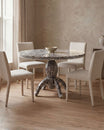


A marble dining table Dubai buyers choose tends to be a longer-term decision than most furniture purchases, and for good reason. A dining table is used daily, seen constantly, and, unlike a sofa or a rug, rarely replaced on a whim once it's in place. Marble raises the stakes on that decision a little further: it's a genuine natural stone with real maintenance considerations, a significant price point, and a look that either anchors a dining room beautifully or feels mismatched if chosen without enough thought.
This guide covers what actually matters when buying a marble dining table, sizing it correctly for an 8-seater arrangement or smaller, understanding marble's practical upkeep, and where the format currently sits within Dubai's furniture market.
Why Marble Remains the Default Choice for a Formal Dining Table
Marble has held its position as the material most associated with a formal, elevated dining room for a reason that goes beyond trend cycles. Its veining is genuinely unique to each slab, which means a marble dining table carries a one-of-a-kind quality that a manufactured surface, however well finished, can't fully replicate. It also photographs and reads beautifully under the kind of bright, direct lighting common in Dubai dining rooms, where natural light through large windows or strong overhead fixtures picks out the stone's depth and veining in a way that flatter, more muted materials don't achieve.
There's also a practical dimension. Marble is a cool material to the touch and doesn't retain heat the way a dark wood or lacquered surface can under direct sun exposure, which is a genuine consideration in a region where dining areas near large windows or balcony doors see significant natural light throughout the day. That combination of visual weight and physical coolness is part of why marble consistently reads as the more formal choice among dining table materials, even when the room around it is otherwise fairly relaxed in style.
Sizing a Marble Dining Table for Your Household
Before comparing specific pieces, it helps to establish the size bracket you actually need, since marble dining tables represent enough of an investment that resizing later isn't a casual decision the way it might be with a lower-cost table.
As a general guide, each diner needs roughly 60 cm of table edge for comfortable elbow room, whether the table is round, rectangular, or oval. For a rectangular table, this translates to the following typical length ranges by seat count.
|
Seating Capacity |
Typical Table Length |
Typical Width |
|
4 people |
120 to 150 cm |
80 to 90 cm |
|
6 people |
160 to 190 cm |
90 to 100 cm |
|
8 people |
220 to 240 cm |
100 to 110 cm |
|
10 or more |
250 cm and above |
100 to 120 cm |
An 8 seater marble table generally needs to fall in the 220 to 240 cm length range to seat eight people without crowding along the long edges, assuming three diners per side plus one at each end. If the table will only ever be used with diners along the two long sides, without end seating, the effective capacity of a table in this length range is closer to six, so it's worth deciding upfront whether end-seat use is part of the plan.
Room Clearance for a Large Marble Table
An 8-seater table is a substantial piece of furniture, and the room needs to accommodate not just the tabletop but the full clearance required to use every seat comfortably. Allow at least 90 cm of clearance between the table's edge and the nearest wall or furniture piece on every side where chairs will be pulled out, and closer to 105 to 120 cm on the side where a sideboard or serving console also needs walk-behind access.
For a 230 cm table, this means the total footprint including clearance runs closer to 410 to 440 cm in length, which is worth measuring against the actual room before committing to this size bracket. A common error with large marble tables specifically is underestimating this clearance requirement, since the table's visual weight and price point can make buyers focus on whether the room "looks big enough" rather than measuring the precise clearance a full 8-seat arrangement demands.
Marble Colours and What They Suit
Marble dining tables aren't limited to the classic white-with-grey-veining look most people picture first, and the colour choice has a real effect on how formal or casual the finished table reads in a room.
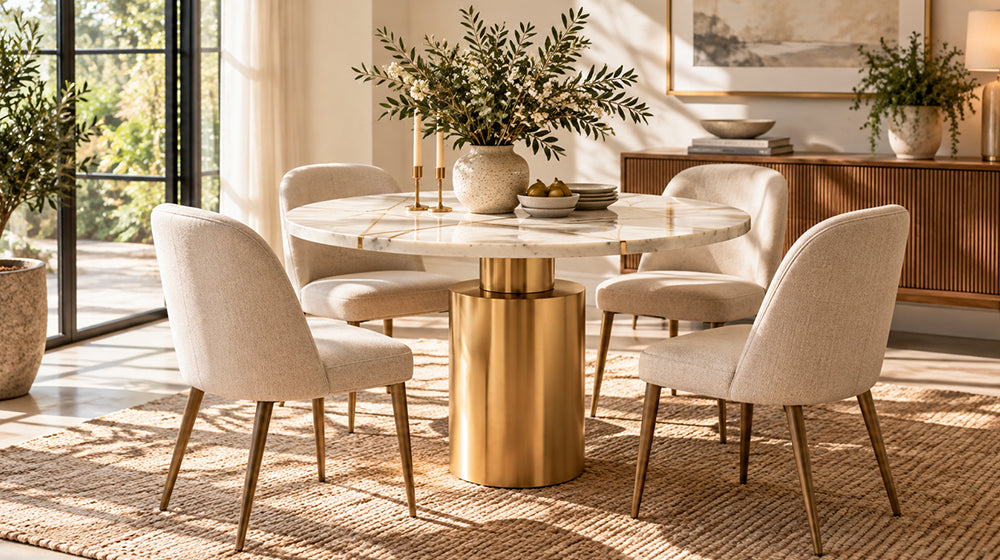
White marble with soft grey veining remains the most versatile option, pairing comfortably with almost any wall colour, wood tone, or metal finish used elsewhere in the room, which is part of why it dominates the category. Black marble, by contrast, reads as considerably more dramatic and formal, and works best in a dining room that already has some darker tones in the flooring, lighting, or wall colour to balance against rather than sitting as the sole dark element in an otherwise pale room. Warmer marble tones, cream, beige, or a stone with gold-toned veining, bridge between the two, suiting a dining room built around warmer wood furniture or brass fixtures where a stark white or black surface would feel like a harder contrast than the room calls for.
Veining pattern is worth considering alongside colour. A marble slab with fine, subtle veining reads as calmer and more restrained, while bold, dramatic veining with strong colour contrast becomes a visual feature in its own right, closer in effect to a piece of art laid flat than a purely functional surface. Neither is inherently better, but a bold-veined slab asks more of the surrounding room, since it draws attention on its own and can clash with an already busy rug, wallpaper, or art arrangement nearby.
Base Design for a Marble Dining Table
The base supporting a marble dining table matters both structurally, given the material's weight, and visually, since the base's material and shape set the overall tone of the piece as much as the marble top itself.
Metal bases, typically in brushed brass, gold, or black powder-coated steel, are the most common pairing for marble dining tables at this scale, since metal offers the load-bearing strength a heavy tabletop needs without adding excessive additional visual weight of its own. A brass or gold base tends to warm up an otherwise cool white or grey marble top, softening the overall effect, while a black metal base reinforces a more contemporary, high-contrast look, particularly effective under a lighter-veined marble surface.
Pedestal and trestle base configurations both appear in this category, each with a different practical trade-off. A central pedestal or double-pedestal base, similar to the configuration common on round tables, keeps legroom clear along the full length of the table, which matters more at 8-seater scale than it does on a smaller table, since more diners are seated along each side. A four-legged trestle base is typically a more affordable construction to produce at this scale but requires more careful measurement to ensure no leg falls directly in a seated diner's legroom, particularly important given how many seats a table this size needs to accommodate along its length.
What to Ask Before Ordering
Given the investment involved in a marble dining table at 8-seater scale, a short list of direct questions to the retailer before ordering will save more disappointment than any amount of general research. Confirm whether the specific piece uses a solid slab or a marble-clad construction, since this affects both price and the repair options available if the surface is ever damaged. Ask to see a photo of the actual slab or cladding panels being used for your order rather than relying solely on a generic product photo, since natural stone veining varies significantly piece to piece and the exact piece you receive may differ visibly from a representative image. Confirm the sealing process used and whether re-sealing is something the retailer offers as an aftercare service or something you'll need to arrange independently after a year or two of use. And confirm lead time clearly, since a large marble piece, particularly one that's made to order rather than held in ready stock, can carry a production and delivery timeline measured in weeks rather than days.
What "Marble Clad" Actually Means
Marble dining tables are typically constructed in one of two ways, and understanding the difference matters both for price and for how the table should be cared for. A solid marble slab table uses a single continuous piece of stone as the tabletop, supported by a base built to handle the weight, which for a table of 8-seater scale can run into several hundred kilograms.
A marble-clad table, a more common construction at the dining table scale specifically, uses thinner marble panels applied over a structural core, giving the visual and tactile properties of marble, veining, coolness, weight, at the tabletop surface while keeping the overall structure lighter and more manageable to produce, deliver, and support than a solid slab equivalent. Tabeer's Ava Dining Table, offered as an 8-seater marble-clad piece, follows this construction approach. If the distinction between solid slab and marble-clad matters to your specific buying decision, whether for weight, price, or long-term repair considerations, it's worth confirming directly with the retailer which construction a specific piece uses before ordering, since this detail isn't always spelled out clearly in a product listing at a glance.
Marble Dining Table Care: What Daily Use Actually Requires
Marble is porous, which is the single fact that shapes almost every care recommendation for the material. A properly sealed marble surface resists everyday spills reasonably well, but the seal is a maintenance layer, not a permanent property of the stone, and it wears down gradually with use.
The practical implications for a dining table specifically, where spills, hot dishes, and acidic foods are a daily reality rather than an occasional risk, are worth taking seriously before committing to the material. Wipe spills, particularly wine, coffee, citrus juice, and vinegar-based dressings, promptly rather than letting them sit, since acidic liquids can etch a marble surface even through a sealed finish if left long enough. Use trivets or heat-resistant mats under hot serving dishes rather than placing them directly on the marble, since sudden heat exposure can affect both the stone and its sealant over time. Avoid dragging plates, serving trays, or decorative objects across the surface, since marble is a relatively soft stone as natural materials go and can pick up fine scratching from repeated abrasive contact.
None of this makes a marble dining table impractical for daily use, but it does mean the material asks for slightly more day-to-day awareness than a lacquered wood or bone inlay surface would, where the finish tends to be more forgiving of the same everyday contact.
Marble Versus Bone Inlay for a Dining Table
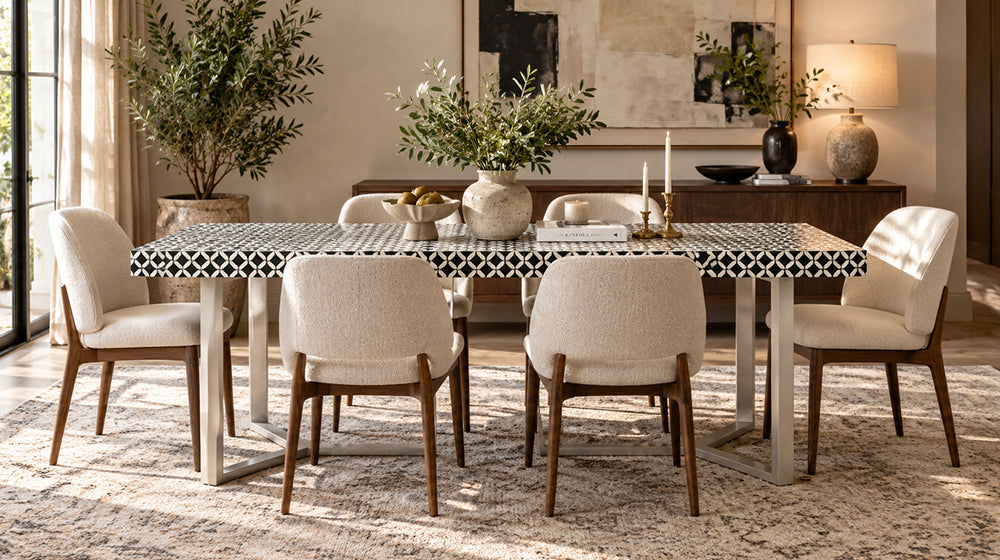
For buyers weighing marble against Tabeer's bone inlay dining tables, such as the Nova, Ray, or Orbit lines, the decision usually comes down to which visual language suits the room and which maintenance profile the household is comfortable with, rather than one material being objectively superior.
Marble reads as cool, architectural, and formal, and tends to suit a dining room already built around a neutral, contemporary palette, glass, brushed metal, pale walls. Bone inlay reads as warm and handcrafted, with a hand-set pattern that gives the tabletop itself decorative interest beyond its function as a flat surface. On the maintenance side, bone inlay's lacquered finish is generally more forgiving of everyday spills and heat than marble's porous surface, though it comes with its own considerations around avoiding harsh chemical cleaners on the inlay pattern.
Price is a further factor. A marble-clad dining table and Tabeer's bone inlay dining tables occupy broadly comparable price territory at the larger end of each range, so the decision is more reasonably framed around look and maintenance preference than budget alone.
Where to Buy a Marble Dining Table in Dubai
Marble dining tables are stocked across a range of Dubai and Abu Dhabi furniture retailers, from large-format international brands to specialist regional makers. What varies significantly between retailers is depth of choice within the marble dining category specifically, as opposed to a single marble piece included within a broader, mostly non-marble catalogue.
At the time of writing, Tabeer Homes' dining table range centres its marble offering on the Ava Dining Table, an 8-seater marble-clad piece, alongside a considerably larger selection of bone inlay and mother of pearl round and rectangular dining tables. If marble is the material you've settled on specifically, it's worth confirming current stock, exact dimensions, and finish options directly before ordering, since this is a narrower category within the current collection than bone inlay, and availability in any single format shifts as new pieces are introduced.
Final Thoughts
A marble dining table earns its place as a long-term centrepiece when the size is matched honestly to how the table will actually be used, not just the room's visual capacity, and when the household buying it understands the day-to-day care the material genuinely requires. For an 8-seater arrangement specifically, get the length, clearance, and construction type, solid slab versus marble-clad, confirmed before ordering rather than after, since a piece at this scale and price point is not a casual resize decision once it's in the room.
Frequently Asked Questions
What size marble dining table do I need for 8 people?
An 8 seater marble table typically needs to be between 220 and 240 cm long and 100 to 110 cm wide, assuming three diners along each long side and one at each end. If the table will only be used with diners along the two long sides, the practical seating capacity of a table this size is closer to six.
Is a marble dining table hard to maintain compared to wood?
Marble requires more day-to-day attentiveness than a sealed wood or lacquered surface, mainly around wiping spills promptly and avoiding direct contact with hot dishes or acidic liquids. It isn't impractical for daily use, but it asks for more consistent care habits than a more forgiving material.
What's the difference between a solid marble slab table and a marble-clad table?
A solid slab table uses one continuous piece of stone as the tabletop, which is heavier and generally more expensive. A marble-clad table applies thinner marble panels over a structural core, giving the same visual and tactile surface properties while keeping the overall piece lighter to produce and support. Most marble dining tables at the larger, 8-seater scale use the clad construction rather than a solid slab.
How much floor space does an 8-seater marble dining table actually need?
Beyond the table's own footprint, allow at least 90 cm of clearance on every side where chairs will be pulled out, and closer to 105 to 120 cm on any side that also needs walk-behind access to a sideboard. For a 230 cm table, this puts the total required floor space at roughly 410 to 440 cm in length, which is worth measuring against the room directly rather than estimating.
Should I choose marble or bone inlay for a dining table?
This comes down to the room's existing style and how much day-to-day care attentiveness you want from the surface. Marble suits a cooler, more architectural dining room and asks for consistent spill and heat awareness. Bone inlay suits a warmer, more handcrafted aesthetic and is generally more forgiving of everyday contact, though its own care instructions around chemical cleaners still apply.

Leave a comment
This site is protected by hCaptcha and the hCaptcha Privacy Policy and Terms of Service apply.