


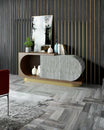


Shop for dining room storage across different regions and retailers, and the same basic piece of furniture picks up a different name depending on where the listing is written. A buffet cabinet in one store is a buffet server in another and a buffet cupboard in a third, all describing essentially the same long, low storage piece built to hold dinnerware and serve food during meals. This guide focuses on what actually defines the category, how much storage capacity to expect, and the practical decisions that matter once you have settled on the naming confusion.
What Is a Buffet Cabinet?
A buffet cabinet is a long, low storage piece built for a dining room, combining a flat top surface for serving food with enclosed cabinet space below for dinnerware, serving pieces, and table linens. The "cabinet" in the name refers specifically to the enclosed storage, cabinet doors rather than open shelving, distinguishing it from more open server-style pieces within the same broader furniture family. Most buffet cabinets stand tall enough for comfortable standing use during meals, typically in the 86 to 97 cm height range, since the format historically developed for staff or hosts to serve food while standing rather than seated.
Buffet Cabinet Vs Sideboard: The Short Version
We covered the full comparison between these two closely related pieces in detail in our guide on what a buffet table is and how it differs from a sideboard , so here is the short version relevant to a buying decision. A buffet cabinet typically stands a few centimeters taller than a sideboard, built for standing service, while a sideboard sits lower and serves a broader, more general storage role across multiple rooms. In practice, the two terms are used inconsistently enough across retailers that checking the actual height and cabinet configuration matters more than relying on whichever term a specific listing uses.
Regional Naming: Buffet Server, Buffet Cupboard, and Other Terms
The same basic furniture piece carries different names depending on region and retailer, which explains much of the confusion buyers encounter while shopping. A buffet server typically describes a piece with more open shelving or a hutch element above the main cabinet, often including a mix of open display space and enclosed storage rather than fully closed cabinet doors throughout. A buffet cupboard , more common in British and Australian English, refers to essentially the same enclosed storage piece that American listings would call a buffet cabinet, with no meaningful functional difference beyond the regional vocabulary. A dining storage cabinet functions as a more generic, catch-all term covering any enclosed storage piece built for a dining room, encompassing buffet cabinets, sideboards, and buffet servers alike without specifying the more particular distinctions between them. Understanding these regional variations matters most when shopping across international retailers or comparing listings that use unfamiliar terminology, since the underlying furniture often overlaps considerably despite different naming conventions. This inconsistency also shows up in search behavior itself: a shopper in one region searching for a buffet cabinet may see largely the same product results as a shopper in another region searching for a buffet cupboard, which is worth knowing if you find yourself comparing listings that seem to describe identical furniture under completely different category names.
Storage Capacity: What a Buffet Cabinet Actually Holds
Beyond naming, the practical question most buyers care about is genuine storage capacity, and this varies more within the buffet cabinet category than the consistent exterior dimensions might suggest. A standard buffet cabinet typically offers two to four cabinet doors, each opening to an interior space suited to stacking plates, storing serving platters, or holding table linens. Interior configuration matters as much as door count: a cabinet with adjustable shelving offers more flexibility for varying item heights than one with fixed shelves, while a cabinet including at least one drawer provides better organization for smaller items like cutlery or napkin rings that would otherwise sit loose on an open shelf. Buyers with a large dinnerware collection or those who host frequently should prioritize interior volume and shelf flexibility over exterior dimensions alone, since two cabinets with identical outer measurements can offer meaningfully different genuine storage capacity depending on interior layout. Interior depth also deserves attention beyond the cabinet's overall depth measurement, since wall thickness and shelf construction can reduce usable interior space by several centimeters compared to the exterior dimension listed in a product description, a detail worth confirming directly with a retailer for buyers planning to store specific oversized items like large serving platters or a full punch bowl set.
How to Choose the Right Size Buffet Cabinet
Sizing a buffet cabinet correctly involves both the room it will occupy and the dining table it will most likely serve. As a general rule, a buffet cabinet's length should run 60 to 75 percent of the dining table's length, creating proportional balance between the two pieces rather than a cabinet that looks oversized or undersized relative to the table it accompanies. Depth typically falls between 40 and 55 cm, shallow enough to avoid crowding the room's walking clearance while still holding full-size serving platters comfortably. Before finalizing a size, measure the actual wall space available, leaving at least 15 cm of clearance on either side of the cabinet for visual breathing room, and confirm at least 90 cm of clear floor space in front of the piece so chairs can be pulled back and guests can pass comfortably during use.
Matching a Buffet Cabinet to Your Dining Room Style
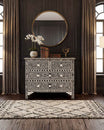
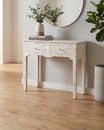
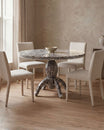
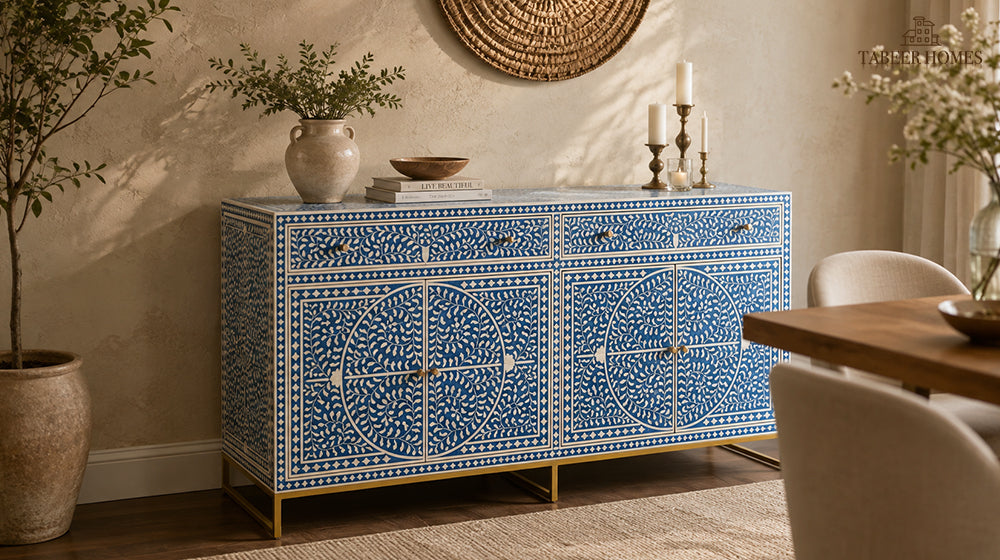
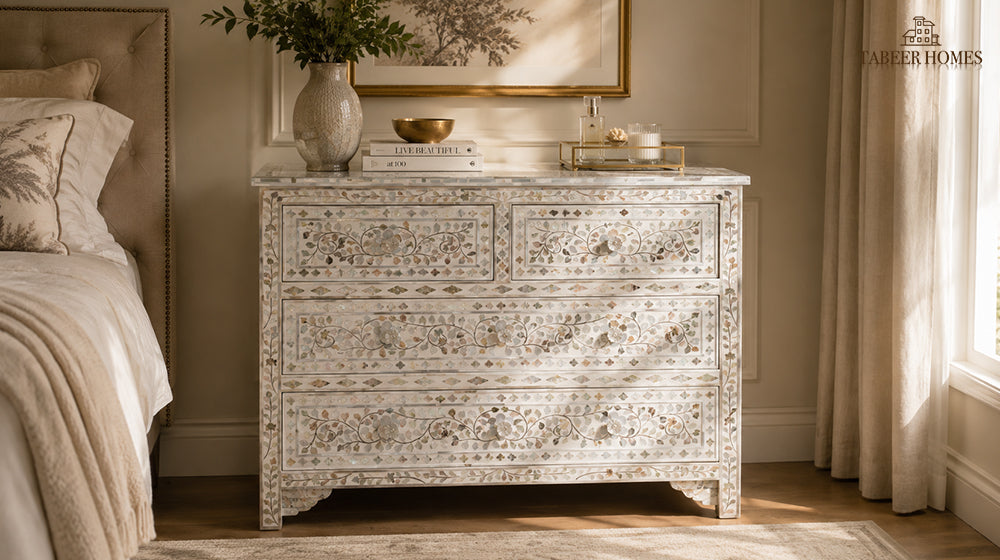
A buffet cabinet's material and finish should complement the dining table and chairs it serves, since the two pieces typically sit in close visual proximity and get viewed together during most meals. A traditional dining room, built around carved wood furniture and richer color tones, suits a buffet cabinet with similar wood detailing or classic hardware, maintaining a cohesive, period-appropriate look. A more contemporary dining room, with clean lines and a simpler material palette, suits a buffet cabinet with a plainer lacquered or veneered finish, or alternatively a bold, handcrafted statement piece like a bone inlay or mother of pearl cabinet used deliberately as a contrast against otherwise minimal surroundings. For a dining room already built around a patterned rug, artwork, or an accent wall, a simpler buffet cabinet finish generally reads better than adding another heavily patterned element, since two strong focal points in close proximity tend to compete rather than complement each other.
Buffet Cabinet Hardware and Construction Quality
A handful of construction details separate a buffet cabinet built to last from one that will show wear within a few years of regular use. Cabinet door hinges should open and close smoothly without excessive resistance or looseness, since this hardware sees frequent use during meal preparation and cleanup. Interior shelving, particularly if adjustable, should hold weight securely without sagging once loaded with dinnerware or serving pieces. Drawer construction, where included, benefits from dovetail joinery over simple glued or stapled joints, holding up considerably better to the weight of stacked linens or cutlery over years of daily use. The wood base underneath any decorative finish, whether plain lacquer or handcrafted inlay, should be solid wood rather than particleboard or MDF, affecting both the piece's long-term durability and how well it resists warping from a dining room's typical humidity and temperature fluctuations. Finish quality on visible surfaces also deserves a close look before purchase, whether in a showroom or through detailed product photos, since an uneven lacquer coat or visible seams in a veneer finish are early signs of lower-quality construction that will likely become more noticeable with years of regular use and cleaning.
Buffet Cabinet Placement and Room Flow
Positioning a buffet cabinet correctly within a dining room affects both its function during meals and how comfortably the room flows during everyday use. Placing the cabinet against the wall most convenient to the kitchen, when the room's layout allows, minimizes the distance staff or hosts need to travel while serving food during a meal. Leaving adequate clearance in front of the cabinet, at least 90 cm as mentioned earlier, ensures chairs can be pulled back fully without anyone needing to squeeze past the cabinet during a seated meal. In dining rooms that double as a passage between other areas of the home, positioning the cabinet along a wall that does not intersect the room's main walking path prevents the piece from becoming a daily obstacle outside of mealtimes.
Open Shelving Vs Fully Enclosed Storage
A meaningful functional distinction within this category, sometimes obscured by naming alone, is whether a piece offers fully enclosed cabinet storage or a mix of open and closed sections. Fully enclosed buffet cabinets keep the entire contents out of view behind cabinet doors, offering the cleanest visual presentation and the most protection from dust, well suited to a formal dining room where a tidy, uncluttered look matters most. Pieces with a partially open design, a hutch section, open shelving above the main cabinet, or glass-front doors on part of the piece, allow for display of decorative china, glassware, or serving pieces alongside the enclosed storage below, suited to a household that wants to showcase part of its collection rather than keeping everything hidden. Buyers should also consider maintenance implications: open shelving requires more regular dusting than enclosed cabinet space, since displayed items accumulate dust at the same rate as any other exposed surface in the room, a genuine ongoing consideration for anyone choosing this configuration primarily for its display value.
Buffet Cabinets in Small Vs Large Dining Rooms
Room size affects buffet cabinet selection considerably beyond the basic length-to-table-ratio guideline already covered. In a smaller dining room, or one that also serves as a passage between other spaces, a narrower or shallower buffet cabinet, closer to 120 to 150 cm in length and 40 cm in depth, keeps the piece from dominating a room where floor space is already limited. In a larger, more formal dining room, a wider cabinet in the 180 to 220 cm range can serve as a genuine anchor for the space without appearing undersized against a longer table and larger seating arrangement. Ceiling height also plays a role less commonly considered: a very tall buffet cabinet in a room with lower ceilings can feel visually oppressive, while the same cabinet in a room with higher ceilings reads as appropriately scaled, making it worth considering the full vertical proportions of the room rather than floor space alone when selecting cabinet height for a particularly grand or particularly modest dining room.
Common Buying Mistakes to Avoid
A handful of recurring errors account for most of the regretted buffet cabinet purchases.
- Choosing based on exterior dimensions alone, ignoring interior configuration. Two cabinets with identical outer measurements can offer meaningfully different genuine storage capacity depending on shelf and drawer layout.
- Underestimating clearance needed in front of the cabinet. A buffet cabinet sized correctly for the wall can still make the room feel cramped if there is not enough space to pull out chairs comfortably.
- Assuming all regional terms describe identical furniture. Since buffet cabinet, buffet server, and buffet cupboard sometimes refer to meaningfully different configurations, particularly regarding open versus closed storage, checking the actual product description matters more than the listing title alone.
- Ignoring the dining table's proportions when choosing cabinet length. A buffet cabinet that is too long or too short relative to the table it serves disrupts the room's overall visual balance regardless of how attractive the cabinet is individually.
Bringing It All Together
A buffet cabinet earns its place in a dining room through genuine storage function paired with a style that complements the table and chairs it serves, regardless of which regional term, buffet cabinet, buffet server, or buffet cupboard, happens to describe it in a particular listing. Prioritizing interior configuration and construction quality over exterior dimensions alone, and confirming adequate clearance for both the cabinet and the chairs around your dining table, prevents the most common disappointments in this category. Buyers comparing listings across multiple retailers benefit from looking past the specific product title entirely and instead checking three consistent factors, actual height, interior storage configuration, and construction quality, since these tell you considerably more about how a piece will actually perform in your dining room than whichever regional term happens to appear in the listing. For the deeper comparison between a buffet cabinet and its closest relative, see our guide on what a buffet table is and how it differs from a sideboard , and for material-specific options bringing genuine handcrafted detail to this category, our guide on bone inlay versus mother of pearl furniture covers the practical differences between the two finishes in more depth.
Frequently Asked Questions
What is the difference between a buffet cabinet and a buffet server?
A buffet server typically includes more open shelving or a hutch element above the main storage, while a buffet cabinet generally features fully enclosed cabinet doors throughout its storage space.
Is a buffet cupboard the same as a buffet cabinet?
Yes, buffet cupboard is more commonly used in British and Australian English to describe the same enclosed dining storage piece that American listings typically call a buffet cabinet.
How much storage does a buffet cabinet typically offer?
Storage varies by interior configuration rather than exterior size alone, with most buffet cabinets offering two to four cabinet doors and sometimes a drawer, suited to dinnerware, serving pieces, and table linens.
What size buffet cabinet should I buy for my dining table?
As a general rule, choose a buffet cabinet with a length equal to 60 to 75 percent of your dining table's length, keeping the two pieces visually proportional to each other.
How much clearance does a buffet cabinet need in front of it?
Leave at least 90 cm of clear floor space in front of the cabinet so dining chairs can be pulled back fully and guests can pass comfortably during meals.
What should I check for construction quality in a buffet cabinet?
Confirm smooth-operating door hinges, secure adjustable shelving, dovetail drawer joinery where applicable, and a solid wood base rather than particleboard or MDF underneath any decorative finish.

اترك تعليقًا
This site is protected by hCaptcha and the hCaptcha Privacy Policy and Terms of Service apply.