




A dresser holds more of daily life than almost any other bedroom furniture piece, clothing, accessories, the small objects that accumulate on top of it, and yet it rarely gets chosen with the same care as a bed or a statement headboard. A mother of pearl dresser changes that calculation, bringing genuine handcrafted shimmer to a piece that would otherwise blend quietly into the background. This guide covers sizing, storage configuration, and styling for this category, along with the care habits that keep its shimmer intact through years of daily clothing storage and use.
What Is a Mother of Pearl Dresser?
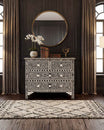
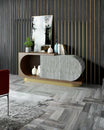
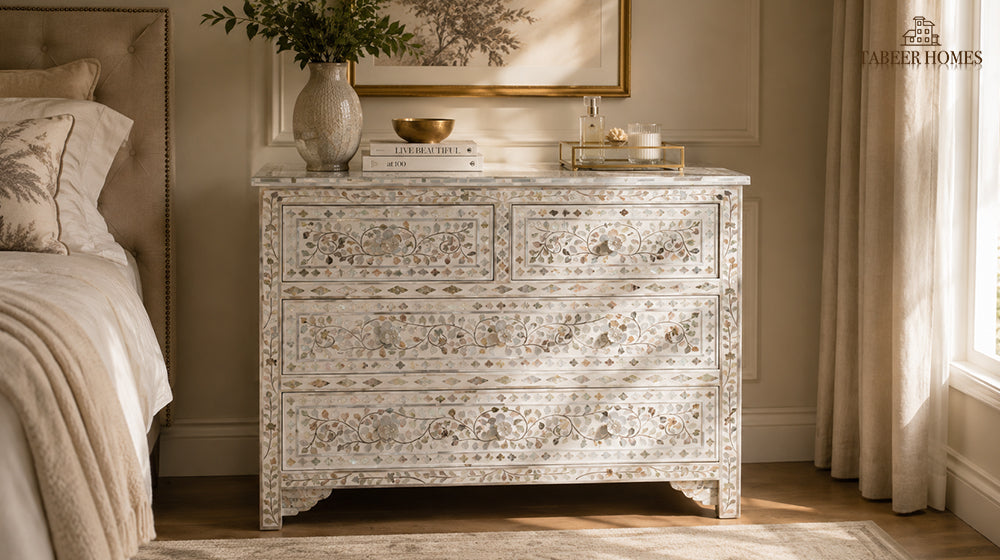
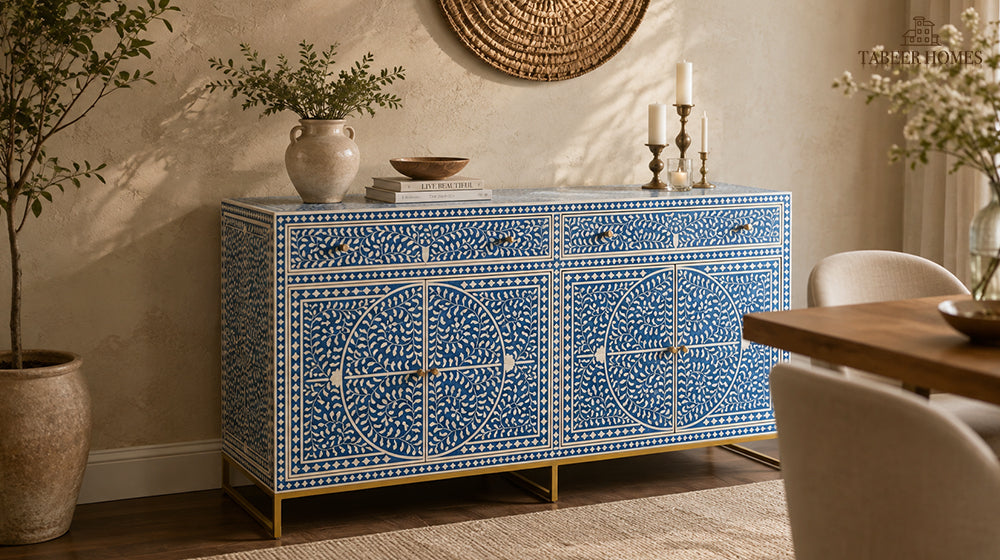
A mother of pearl dresser pairs a wood base, typically mango wood, with hand-cut shell segments set into resin across its drawer fronts and exterior panels, producing the same light-reactive shimmer found across other mother of pearl furniture at a scale built for genuine clothing storage. An MOP dresser differs from a plain painted or veneered piece primarily in this surface treatment, since the underlying drawer construction and storage function remain largely consistent regardless of finish. Because every shell segment is individually placed by hand, no two dressers in this category carry an identical pattern, and small natural variations in tone and spacing are a mark of genuine craftsmanship rather than a flaw.
Inlay Dresser Vs Chest of Drawers: A Quick Distinction
The terms inlay dresser and chest of drawers overlap considerably in furniture listings within this material category, and Tabeer Homes' own product naming reflects this overlap directly, describing pieces like the four-drawer Iris Chest of Drawers as an "elegant and sturdy dresser." In practice, a dresser generally implies wider, multi-column drawer storage, while a chest of drawers traditionally suggests a taller, narrower single-column format, though the two terms are used interchangeably often enough that checking actual dimensions matters more than the specific product name. For the fuller comparison between dressers, chests of drawers, and nightstands as a category, our guide on chest of drawers versus dresser versus nightstand covers the practical differences in more depth.
Standard Sizes for a Mother of Pearl Dresser
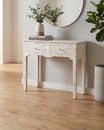
Sizing within this category varies depending on whether a piece functions as a taller storage chest or a wider, lower dresser. Tabeer Homes' Iris Chest of Drawers in grey mother of pearl measures 108 cm in width, built with four drawers suited to genuine clothing storage in a bedroom of nearly any size. For a piece that doubles as both storage and a styling surface, the Iris Dresser Console & Stool in white mother of pearl combines dresser-style storage with a paired stool, functioning as much as a vanity as a traditional dresser. The Iris Mini Dresser Console in grey mother of pearl offers a more compact footprint, well suited to a smaller bedroom or a secondary storage spot alongside a larger primary dresser. Across this range, buyers should prioritize matching width to available wall space first, since a dresser too wide for its intended spot undermines the room's walking clearance regardless of how well-proportioned the piece looks individually. Height across this category stays relatively consistent regardless of width variation, generally landing in a range comfortable for reaching the top drawers without a step stool while still offering enough vertical storage capacity to justify the format, a detail worth confirming against your own reach and comfort level rather than assuming every dresser in the category sits at an identical height.
Mother of Pearl Chest Vs Full-Width Dresser: Which to Choose
Choosing between a taller mother of pearl chest format and a wider, full dresser configuration comes down primarily to available floor space versus surface area needs. A chest of drawers format, growing vertically rather than horizontally, suits a smaller bedroom or a narrow wall section where a wide dresser would crowd the room's walking clearance. A full-width dresser offers more surface area on top, useful for a mirror, a jewelry tray, or a lamp, alongside its wider drawer storage, making it a better fit for a larger bedroom with a dedicated wall willing to accommodate its footprint. Households with extensive clothing storage needs but limited floor space sometimes find the best solution in combining a taller chest with a smaller dresser console, splitting storage across two pieces rather than relying on a single oversized dresser that may not fit the room's actual proportions. This combination approach also offers a practical advantage during future moves or room reconfigurations, since two smaller pieces are generally easier to reposition or relocate to a different room than a single large dresser committed to one specific wall, giving the overall bedroom layout more long-term flexibility than a single monolithic storage solution would provide.
Storage Configuration: Drawers, Shelves, and Mixed Layouts
Interior configuration matters as much as a dresser's exterior dimensions when it comes to genuine daily usefulness. A dresser with several shallow drawers suits buyers who prefer sorting smaller folded items, t-shirts, undergarments, accessories, into distinct, easily browsable compartments. A dresser with fewer, deeper drawers works better for bulkier items like sweaters or linens that benefit from more vertical space per drawer. Some mother of pearl dressers, particularly the console-style formats, also include open shelving alongside enclosed drawers, offering quick-access storage for frequently used items without requiring a drawer to be opened for something used daily. Households transitioning from a larger wardrobe system to a single dresser, common when downsizing or moving into a smaller home, benefit from taking stock of actual clothing volume before committing to a specific configuration, since underestimating storage needs at this stage often leads to a second purchase within a year rather than choosing appropriately the first time around.
Pearl Inlay Bedroom Styling: Building the Vignette on Top
The surface of a mother of pearl dresser functions as one of the more visible styling surfaces in a pearl inlay bedroom , and a few principles keep the arrangement looking intentional rather than cluttered. Anchoring the wall above with a mirror or art gives the surface a clear focal point before any smaller objects are added. Grouping decorative items in odd numbers, a candle, a small dish, and a single framed photo rather than an even, symmetrical spread, tends to read as more considered. Leaving genuine open surface space matters as much here as on any other styled furniture piece, since a dresser top completely covered in objects loses both its practical function and its visual clarity. For a dresser also serving as a light vanity surface, keeping one section clear for actual daily use, applying makeup, setting down keys, ensures the styling does not interfere with the piece's practical role.
Coordinating a Mother of Pearl Dresser With the Rest of the Bedroom
A mother of pearl dresser rarely needs every other piece of bedroom furniture to match its finish exactly, and in most cases a degree of material contrast produces a more considered result than an overly matched set. Against a plain wood bed frame, the dresser's shimmer introduces welcome visual interest without competing with an already patterned headboard or bedding. Against a more heavily patterned or upholstered headboard, a simpler nightstand pairing helps prevent the room from feeling overloaded with competing focal points. Repeating just one element, a shared metal accent finish, a related color note, or a nearby mirror frame in the same material family, is usually enough to tie the dresser into the broader room without requiring a fully matched bedroom set. Rug and curtain choices also interact with a shimmering dresser more than buyers sometimes expect, since a rug in a color that echoes the dresser's base tone, whether white, grey, or pink, helps ground the piece within the room's overall palette rather than leaving it feeling like an isolated accent disconnected from the floor and window treatments around it.
Caring for a Mother of Pearl Dresser
A dresser's daily use, opened and closed drawers, clothing storage, objects placed on top, calls for a consistent care routine to keep its shimmer intact over years of use.
- Dust regularly with a soft, dry microfiber cloth , following the direction of the inlay pattern rather than wiping across it.
- Check drawer glides periodically , since a dresser sees more frequent opening and closing than most other inlay furniture, making smooth hardware function relevant to long-term daily use.
- Keep the dresser away from direct sunlight and AC vents , since both prolonged UV exposure and repeated humidity swings can affect the shell's iridescence and the resin bond over time.
- Wipe spills or cosmetic product marks immediately , particularly if the dresser top also serves as a light vanity surface for daily beauty routines.
- Avoid placing heavy or sharp objects directly against the inlaid surface , since the shimmer finish can scratch more visibly than a plain lacquered alternative.
Hardware and Finish Details Worth Checking
Beyond the inlay pattern itself, a handful of construction details separate a well-made mother of pearl dresser from one that will show wear prematurely under daily use. Drawer hardware, whether handles, knobs, or the jewel-cut glass knobs sometimes paired with this material, should feel securely attached and move smoothly without catching, since this hardware sees repeated contact multiple times a day in most households. Drawer glide mechanisms matter considerably for long-term function: metal ball-bearing glides move more smoothly and resist sagging under load better than basic wood-on-wood construction, particularly relevant for deeper drawers holding heavier folded items. The finish on interior, non-inlaid surfaces should feel smooth and fully sealed, since a rough or unfinished drawer interior can snag on stored fabrics over years of regular use. For dressers including a tray table or shelf as part of the design, confirming this additional surface is stable and properly secured to the main structure, rather than a loosely attached add-on, protects against wobble or eventual detachment under regular use.
Positioning a Mother of Pearl Dresser for Best Light
Because a mother of pearl dresser's visual appeal depends heavily on how light interacts with its surface, placement within the bedroom affects how much of that shimmer actually registers during daily life. A dresser positioned along a wall that receives natural daylight, even indirectly, shows off its shimmer considerably more than one tucked into a consistently shadowed corner. For bedrooms without strong natural light reaching the dresser's location, a nearby lamp or wall sconce recreates some of that effect during evening hours, ensuring the piece continues to read as a genuine focal point after dark. Warm-toned lighting generally flatters mother of pearl's natural iridescence more than cool white LEDs, producing a softer, more flattering glow that complements the shell's coloring rather than washing it out with a harsher light source. Buyers arranging a full bedroom layout from scratch benefit from considering this lighting question before finalizing furniture placement entirely, since a stunning dresser positioned in the room's dimmest corner delivers considerably less visual return than the same piece placed where light can actually reach it.
Common Buying Mistakes to Avoid
A handful of recurring errors account for most of the regretted mother of pearl dresser purchases.
- Choosing width without confirming actual wall clearance. A dresser that fits the wall on paper can still crowd a bedroom's walking path if the surrounding furniture arrangement is not accounted for.
- Underestimating storage needs before choosing between a chest and a wider dresser format. A household with extensive clothing storage needs may find a single dresser insufficient regardless of how attractive the piece is individually.
- Ignoring drawer depth relative to actual wardrobe contents. Deeper drawers suit bulky items like sweaters, while shallower drawers work better for folded t-shirts and smaller accessories.
- Assuming every product in a collection offers identical dimensions. Since dresser, chest, and console formats vary considerably even within the same material family, confirming exact measurements before ordering avoids a mismatch with your specific bedroom.
Bringing It All Together
A mother of pearl dresser earns its place in a bedroom through genuine daily storage function paired with handcrafted shimmer that changes character throughout the day as light moves across it. Taking the time to measure your bedroom's actual wall space, assess genuine storage needs before choosing between chest and dresser formats, and confirm hardware quality prevents the most common regrets in this category. Tabeer Homes' Iris Chest of Drawers in grey mother of pearl offers a proven four-drawer format at 108 cm wide, while the Iris Dresser Console & Stool combines storage with a matched vanity setup, and the Iris Mini Dresser Console provides a more compact option for smaller bedrooms. Matching format, storage configuration, and finish to your actual bedroom layout and daily habits will do more for long-term satisfaction than choosing on shimmer alone. For a broader look at how mother of pearl compares to its closest material relative before building a full bedroom around either, our guide on bone inlay versus mother of pearl furniture covers the practical differences in more depth.
Frequently Asked Questions
What is a mother of pearl dresser made from?
A mother of pearl dresser pairs a wood base, typically mango wood, with hand-cut shell segments set into resin across its drawer fronts and exterior, producing a shimmering finish with natural pattern variation.
Is a mother of pearl dresser the same as a chest of drawers?
The terms overlap considerably, though a dresser generally implies wider, multi-column storage while a chest of drawers suggests a taller, narrower single-column format, with actual dimensions mattering more than the product name.
How wide should a mother of pearl dresser be for my bedroom?
Width depends on available wall space, but most dressers in this category range from roughly 90 to 120 cm, with narrower chest formats suiting smaller rooms and wider dressers suiting larger bedrooms.
Can a mother of pearl dresser double as a vanity?
Yes, some models like the Iris Dresser Console & Stool combine dresser-style storage with a paired stool, functioning as both a clothing storage piece and a light vanity surface.
How do I style the top of a mother of pearl dresser?
Anchor the wall above with a mirror or art, group decorative objects in odd numbers, and leave genuine open surface space so the arrangement reads as intentional rather than cluttered.
How do I care for a mother of pearl dresser?
Dust regularly with a soft dry cloth, check drawer glides periodically, keep the piece away from direct sunlight and AC vents, and wipe spills or product marks immediately to protect the resin finish.

اترك تعليقًا
This site is protected by hCaptcha and the hCaptcha Privacy Policy and Terms of Service apply.