





A chest of drawers holds more of daily life, folded clothing, linens, the accumulated contents of a bedroom, than almost any other single piece of furniture, and yet it rarely gets the same design attention as a bed or a statement headboard. A bone inlay chest of drawers changes that, bringing genuine hand-carved detail to a piece built for serious storage rather than pure display. This guide covers sizing, pattern styles, and construction quality within this category, along with the care habits that keep a heavily used piece looking sharp for years.
What Is a Bone Inlay Chest of Drawers?
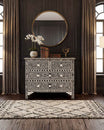
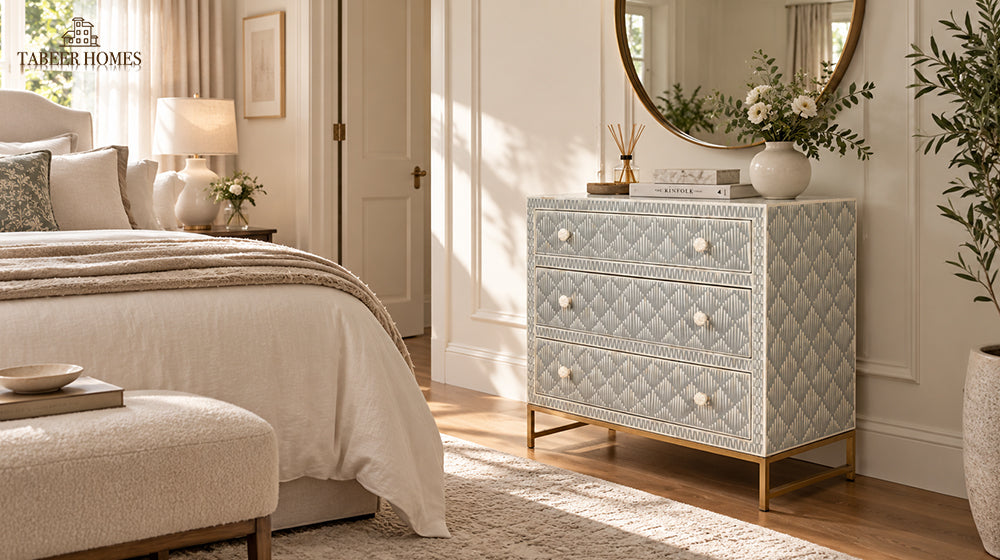
A bone inlay chest of drawers pairs a wood base, typically mango wood, with hand-carved bone segments set into resin across its drawer fronts and exterior panels, producing the same matte, textured pattern found across other bone inlay furniture at a scale built for genuine clothing storage. Bone inlay drawers carry small natural variations in pattern and tone between individual pieces, since every segment of bone is cut and placed by hand rather than printed or molded, a mark of authentic craftsmanship rather than a manufacturing flaw. Most chests in this category combine several stacked drawers in a single vertical column, prioritizing floor-space efficiency over the wider footprint of a full dresser.
Compact Vs Statement-Scale: Choosing the Right Size
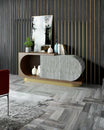
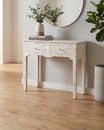
Bone inlay chests of drawers span a considerable size range, and matching the right scale to your bedroom matters more than defaulting to whichever piece looks most dramatic in a product photo. Tabeer Homes' Seema Chest of Drawers in white bone inlay offers a compact option at 96 cm wide, 45 cm deep, and 85 cm tall, built with three drawers suited to a smaller bedroom or a secondary storage spot alongside a larger primary piece. At the other end of the range, the Ameerah Chest of Drawers in white bone inlay runs considerably larger at 175 cm wide and 45 cm deep, built with nine drawers across what functions as a genuine modern dresser rather than a compact chest, suited to a larger bedroom needing substantial clothing storage capacity in a single piece. Choosing between these scales comes down primarily to available wall space and actual storage needs, since a household with extensive clothing volume genuinely benefits from the Ameerah's nine-drawer capacity, while a smaller bedroom or a household with more modest storage needs is better served by the Seema's compact footprint. Between these two extremes, mid-size options in the 120 to 150 cm range with five to seven drawers offer a middle ground for buyers whose storage needs and available space fall somewhere between a compact secondary piece and a full statement dresser.
Common Patterns on a Patterned Chest of Drawers
A patterned chest of drawers in bone inlay typically falls into one of a few recognizable pattern families, each suited to a different bedroom mood.
- Checkerboard patterns , alternating bone and resin squares in a bold, high-contrast grid, common across drawer fronts where the repeating geometry reads clearly even at a distance.
- Geometric and linear patterns , using straight-edged bone segments arranged into diamonds or repeating stripes, suited to a more contemporary bedroom than a dense floral design.
- Floral and vine patterns , using curved, petal-shaped segments for a softer, more traditional look, generally the most labor-intensive pattern family within this category.
- Two-tone black and white patterns , delivering maximum contrast and a distinctly modern, graphic presence regardless of the underlying geometric layout, well suited to a bedroom already built around a bold, high-contrast palette.
Bone Inlay Drawers: What to Check for Quality
Since a chest of drawers experiences more frequent daily use than most decorative bone inlay furniture, construction quality matters more here than for a purely display-oriented piece. Drawer joinery should use dovetail construction rather than simple glued or stapled joints, holding up considerably better to the weight of folded clothing and repeated opening over years of daily use. Drawer glide mechanisms, ideally metal ball-bearing glides rather than basic wood-on-wood construction, move more smoothly and resist sticking or misalignment as the piece ages. The wood base underneath the bone inlay finish should be solid wood, typically mango wood, rather than particleboard or MDF, affecting both the piece's long-term durability and how well it holds the carved channel work the inlay itself depends on. Hardware, whether pulls or knobs, should feel securely attached and complement the bone inlay's own pattern rather than clashing with it visually. Buyers evaluating a piece in person can perform a simple check by opening and closing several drawers in succession, since genuine quality construction should feel consistent across every drawer rather than smooth on some and sticking or misaligned on others, a variation that often signals inconsistent manufacturing standards within the same piece.
Inlay Chest Vs Bone Inlay Dresser: A Terminology Note
The terms inlay chest and bone inlay dresser are frequently used interchangeably in furniture listings, and understanding the subtle distinction helps when comparing options across different retailers. A chest of drawers traditionally implies a taller, narrower single-column format, growing vertically to maximize storage within a smaller floor footprint. A dresser generally implies a wider, lower format with drawers arranged in multiple columns side by side, offering more surface area on top at the cost of a larger floor footprint. In practice, as Tabeer Homes' own product descriptions illustrate, referring to a nine-drawer chest as an "elegant and sturdy modern dresser," these terms overlap enough that checking actual dimensions and drawer arrangement matters more than relying on whichever specific term appears in a product title.
Choosing Where to Place a Bone Inlay Chest of Drawers
Placement affects both how the piece functions daily and how prominently its pattern registers in the room. Positioned against a narrow wall or in a bedroom corner, a bone inlay chest of drawers takes advantage of its vertical, space-efficient format without crowding the room's walking clearance. Positioned opposite the bed, where it receives the most direct daily viewing, the piece's bold pattern gets the most visual attention, making this placement particularly effective for buyers who chose the piece specifically for its handcrafted detail rather than purely for storage function. Confirming at least 70 to 80 cm of clearance in front of the chest allows drawers to open fully without obstruction, a detail worth checking against the specific piece's drawer depth rather than assuming a standard clearance applies universally.
Styling the Top Surface
A bone inlay chest of drawers' top surface offers a smaller but genuinely useful styling opportunity, distinct from the piece's primary storage function below.
- Keep the surface relatively clear. Since bone inlay's own pattern already provides visual interest, a heavily styled top can compete with rather than complement the piece's inherent detail.
- Add one anchor object. A single lamp, a small decorative box, or a framed photo gives the surface a clear focal point without overwhelming it.
- Consider a mirror above. For a chest positioned against a wall with available space above, a mirror adds both function and a visual anchor that ties the piece into the broader room.
- Leave room for daily use. If the chest doubles as a spot for keys, a watch, or jewelry at the end of the day, keeping a portion of the surface intentionally clear supports this practical role alongside any decorative styling.
Caring for a Bone Inlay Chest of Drawers
A chest of drawers' frequent daily use, opening and closing drawers, storing and retrieving clothing, calls for a consistent care routine to protect its finish over years of use.
- Dust regularly with a soft, dry microfiber cloth , moving in the direction of the inlay pattern rather than wiping across it.
- Check drawer glides periodically , since this hardware sees more frequent use than almost any other component of bone inlay furniture in a typical home.
- Keep the piece away from direct sunlight and AC vents , since both prolonged UV exposure and repeated humidity swings can affect the bone's tone and the resin bond over time.
- Avoid overloading drawers beyond their intended capacity , since excessive weight strains both the drawer construction and the glide mechanism faster than moderate, intended use.
- Clean spills or marks on the top surface immediately , particularly if the chest also serves as a catch-all for daily items like keys or jewelry.
Matching a Bone Inlay Chest to Your Bedroom's Existing Furniture
A bone inlay chest of drawers rarely needs every other piece in the bedroom to match its pattern, and in most cases a degree of contrast produces a more considered result than an overly matched room. Against a plain wood bed frame or simple upholstered headboard, the chest's bold pattern gets to function as the room's clear focal point without competing for attention. Against a more heavily patterned or upholstered headboard, a simpler bone inlay pattern, a linear stripe rather than a dense checkerboard, helps prevent the room from feeling visually overloaded. Nightstands do not need to match the chest exactly, but repeating one element, a shared wood tone, a related color note, or matching hardware finish, ties the pieces together as a coordinated room rather than a collection of unrelated furniture bought separately over time. Curtains and bedding in a solid or subtly textured fabric tend to let a bold bone inlay chest read most clearly, while heavily patterned textiles elsewhere in the room compete with the chest's own detail rather than supporting it.
Bone Inlay Chest of Drawers for Different Bedroom Sizes
Room dimensions should influence chest selection as much as personal style preference. In a compact bedroom, particularly one shared with a smaller bed frame or limited wall space, a narrower chest like the Seema at 96 cm keeps the room from feeling crowded while still offering genuine three-drawer storage capacity. In a larger primary bedroom with a dedicated wall willing to accommodate a wider footprint, the Ameerah's 175 cm width and nine-drawer capacity make far better use of the available space than a compact chest would, avoiding the underused feeling a too-small piece can create in a genuinely spacious room. For bedrooms that fall between these two extremes, considering how the chest's width relates to the bed frame's own width helps gauge proportional balance, since a chest that reads as either dramatically smaller or dramatically larger than the room's other furniture can disrupt the space's overall visual harmony regardless of how attractive the piece is on its own.
Common Buying Mistakes to Avoid
A handful of recurring errors account for most of the regretted bone inlay chest of drawers purchases.
- Choosing size without confirming genuine storage needs. A household with extensive clothing volume may find a compact chest insufficient regardless of how attractive the piece is individually.
- Underestimating drawer clearance for daily use. A chest positioned too close to a wall or other furniture can make fully opening drawers genuinely difficult, undermining the piece's practical function.
- Assuming all bone inlay finishes handle daily use identically. A chest intended for genuine daily clothing storage benefits from confirming drawer construction quality more closely than a purely decorative piece would need.
- Overlooking pattern density relative to the bedroom's existing style. A dense checkerboard or floral pattern can overwhelm a room that already carries several other bold patterns nearby, while a simpler design complements a busier room more comfortably.
Bringing It All Together
A bone inlay chest of drawers earns its place in a bedroom through genuine storage function paired with handcrafted detail that turns a purely practical piece into a genuine design statement. Taking the time to match size to actual storage needs, confirm construction quality through drawer joinery and glide mechanisms, and consider how the piece's pattern relates to the rest of the room prevents the most common regrets in this category. Tabeer Homes' Seema Chest of Drawers in white bone inlay offers a compact 96 cm option well suited to a smaller bedroom, while the Ameerah Chest of Drawers , available in both white and black and white bone inlay, brings substantial nine-drawer capacity at 175 cm wide for buyers needing significant storage in a single statement piece. Matching size, pattern density, and construction quality to your actual bedroom and storage needs will do more for long-term satisfaction than choosing on pattern alone. For a deeper look at the craft behind these pieces, our guide on what bone inlay furniture is and how it's made covers the full carving and setting process in more depth.
Frequently Asked Questions
What is a bone inlay chest of drawers made from?
A bone inlay chest of drawers pairs a wood base, typically mango wood, with hand-carved bone segments set into resin across its drawer fronts and exterior, producing a matte, textured finish with natural pattern variation.
How many drawers does a bone inlay chest typically have?
Drawer count varies by size, ranging from around three drawers in a compact chest to nine or more in a larger, statement-scale piece functioning more like a full dresser.
Is a bone inlay chest of drawers the same as a bone inlay dresser?
The terms overlap considerably in product listings, though a chest traditionally implies a taller, narrower single-column format while a dresser suggests a wider, multi-column layout, with actual dimensions mattering more than the specific term used.
What should I check for quality in a bone inlay chest of drawers?
Confirm dovetail drawer joinery, smooth metal drawer glides, a solid wood base rather than particleboard, and securely attached hardware that complements the bone inlay's own pattern.
How much clearance does a bone inlay chest of drawers need?
Leave at least 70 to 80 cm of clearance in front of the piece so drawers can open fully without obstruction during daily use.
How do I care for a bone inlay chest of drawers?
Dust regularly with a soft dry cloth, check drawer glides periodically, keep the piece away from direct sunlight and AC vents, and avoid overloading drawers beyond their intended capacity.

Leave a comment
This site is protected by hCaptcha and the hCaptcha Privacy Policy and Terms of Service apply.