








You are furnishing a bedroom from scratch, and every product listing seems to use the words chest of drawers, dresser, and nightstand as if they are interchangeable, then charges wildly different prices for pieces that look almost identical in a thumbnail photo. They are not the same furniture wearing different names. The chest of drawers vs dresser question, along with where a nightstand fits into the picture, comes down to height, footprint, and the specific job each piece is actually built to do in a bedroom.
The Quick Answer: Three Different Jobs, Not Three Names for the Same Thing
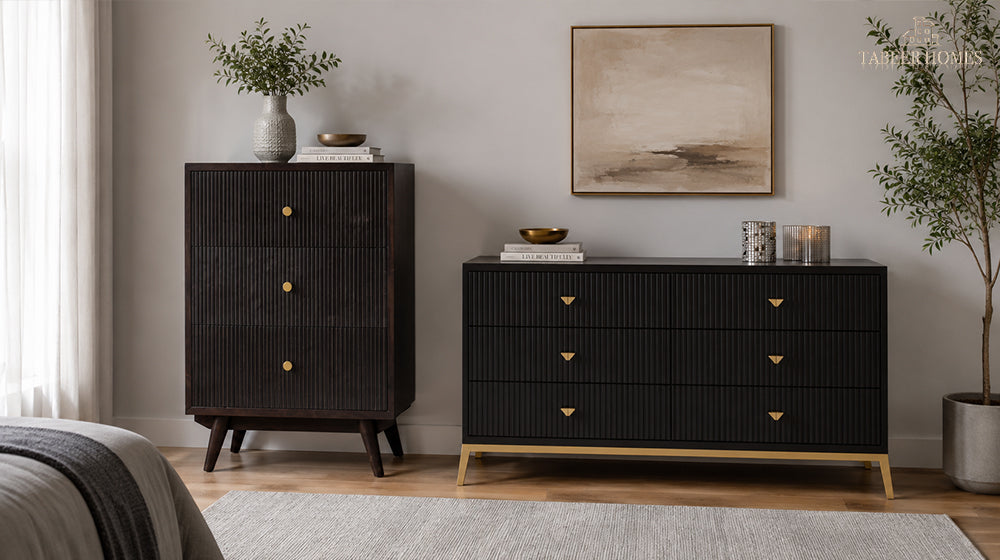
A chest of drawers is tall and narrow, built to maximize vertical clothing storage in a small footprint. A dresser is wide and low, built to offer a broad, waist-height surface alongside its storage, often paired with a mirror. A nightstand is the smallest of the three, sized specifically to sit beside a bed within easy reach of the mattress. All three store folded items behind drawer fronts, but their proportions are built around different priorities, floor space, surface area, and bedside convenience, respectively.
What Is a Chest of Drawers?
A chest of drawers is a tall, narrow piece of bedroom storage furniture with drawers stacked vertically in a single column, typically standing 112 to 152 cm tall, 60 to 100 cm wide, and 45 to 55 cm deep. Because the piece grows upward rather than outward, it uses noticeably less floor space than a dresser of comparable storage capacity, which makes it a common choice for smaller bedrooms, apartments, or narrow wall sections where a wide dresser simply will not fit. The drawers themselves tend to be deeper and narrower than a dresser's, well suited to bulkier folded items like sweaters, jeans, and off-season clothing that stack neatly in a taller compartment. A chest of drawers rarely comes with a matching mirror, since its height puts the top surface above comfortable mirror-viewing range, and the top itself usually only accommodates a lamp, a small tray, or a few decorative objects rather than serving as a full display surface.
What Is a Dresser?
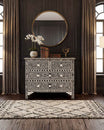
A dresser is a wide, low piece of bedroom storage furniture, typically standing 76 to 91 cm tall, 100 to 200 cm wide, and 45 to 55 cm deep, with drawers arranged in two or three columns side by side rather than stacked in a single tower. Its waist-height top surface is one of its defining advantages, functioning as a spot for a jewelry box, a lamp, framed photos, or a mounted mirror for getting ready in the morning. Because dressers sit lower and spread wider, they generally suit larger bedrooms better than compact ones, where a long dresser can anchor an entire wall the way a sideboard anchors a dining room. Dresser drawers also tend to vary more in size than a chest's, mixing shorter drawers for accessories with longer ones for folded clothing or linens.
What Is a Nightstand?
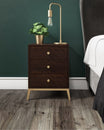
A nightstand, sometimes called a bedside table, is the smallest of the three, typically standing 56 to 76 cm tall with a compact footprint of 40 to 55 cm in both width and depth, and usually holding one to three drawers or a mix of a drawer and open shelving. Its defining measurement is not its own height in isolation but its height relative to the mattress it sits beside, ideally within a few centimeters of the mattress top so that a lamp, phone, or glass of water stays within comfortable reach without requiring you to sit up and lean over. Unlike a chest of drawers or dresser, a nightstand's storage capacity is almost never the main selling point; its job is proximity and convenience rather than volume.
Bureau, Highboy, and Other Names You Might Encounter
Beyond chest of drawers, dresser, and nightstand, a few other terms show up in furniture listings and can add to the confusion. A bureau traditionally referred to a piece combining a fold-down writing surface with drawers, though in modern retail use the term is often applied loosely to either a dresser or a tall chest, particularly in British English. A highboy is essentially a tall chest of drawers, sometimes set on a separate base with legs, a style more common in traditional or antique furniture than contemporary collections. A lingerie chest is a narrower, taller variation built specifically for smaller folded items, while a media chest adds an open top shelf suited to a television or decor display above its drawer storage. None of these terms describes a fundamentally different storage logic from the three core pieces covered here; they are largely regional or stylistic variations on the same height-versus-width tradeoff.
Chest of Drawers Vs Dresser: Side-By-Side Comparison
Reading the two pieces side by side makes the underlying tradeoff clear: floor space versus surface space.
|
Feature |
Chest of Drawers |
Dresser |
|
Height |
112 to 152 cm |
76 to 91 cm |
|
Width |
60 to 100 cm |
100 to 200 cm |
|
Drawer arrangement |
Single stacked column |
Multiple columns side by side |
|
Mirror compatibility |
Rarely, height is impractical |
Common, often included or wall-mounted above |
|
Best suited to |
Small bedrooms, narrow walls, apartments |
Larger bedrooms, wide walls, dressing stations |
|
Top surface use |
Limited, a lamp or small tray |
Generous, jewelry, TV, mirror, or display items |
Cost also tends to track these proportions. A chest of drawers generally uses less material and floor-level joinery than a comparably storied dresser, which is part of why chests are often priced somewhat lower than an equivalent-capacity dresser from the same collection.
Nightstand Vs Chest of Drawers: Why Height and Placement Matter Most
The nightstand vs chest of drawers comparison is really a question of function rather than storage capacity, since the two pieces are almost never competing for the same spot in a room.
- Purpose : A nightstand exists for bedside convenience, lamps, books, phone chargers, a glass of water, while a chest of drawers exists for genuine clothing storage capacity.
- Height logic : A nightstand's height is dictated entirely by the mattress it sits beside, while a chest of drawers' height is dictated by how much vertical storage the room can accommodate.
- Typical drawer count : A nightstand usually holds one to three drawers, sometimes with an open shelf below, while a chest of drawers typically holds four to six.
- Placement : A nightstand sits immediately beside the bed on one or both sides, while a chest of drawers is positioned against a separate wall, often in a corner or a narrow gap that a wider dresser could not fill.
Most complete bedrooms end up using both pieces together rather than choosing one over the other, since a nightstand cannot realistically substitute for a full chest of drawers' clothing capacity, and a chest of drawers placed beside a bed sits at an impractical height for reaching a lamp or phone without sitting up.
Nightstand Storage Styles: Drawers, Shelves, and Cabinets
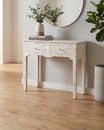
Not every nightstand is built the same way internally, and the configuration matters for daily function almost as much as its height. A single-drawer nightstand with an open shelf below suits someone who wants quick access to a book or reading glasses without opening anything, keeping frequently used items visible rather than tucked away. A nightstand with a closed cabinet door instead of an open shelf hides clutter more effectively, useful for anyone who prefers a tidier surface but does not want visible storage on display. A two-drawer configuration splits the difference, offering a shallow top drawer for small items like chargers or jewelry and a deeper lower drawer for bulkier objects. Mother of pearl and bone inlay nightstands frequently combine a drawer with a lower cabinet in this way, pairing the decorative pattern on the front with genuinely useful, mixed-format storage rather than a single drawer alone.
Choosing the Right Bedroom Storage for Your Room Size
Room dimensions should drive the choice between a chest of drawers and a dresser more than personal preference alone. In a bedroom smaller than roughly 3.5 by 3.5 meters, a chest of drawers typically makes better use of the available floor space, since a wide dresser can eat significantly into the walking clearance needed around a bed. A general rule of at least 75 to 90 cm of clearance in front of any storage piece, enough room to fully open a drawer and stand comfortably while doing so, helps decide whether a dresser will genuinely fit or simply look correct in a showroom photo. In a larger master bedroom with a long, otherwise empty wall, a dresser earns its wider footprint, particularly when paired with a wall-mounted mirror to double as a dressing station. Nightstands scale to the bed itself rather than the room, so their sizing decision is largely separate from the chest-versus-dresser question, governed mainly by available space on either side of the bed frame. It is also worth measuring the path furniture will travel to reach the bedroom, doorways, hallway turns, and staircases, since a wide dresser that fits the room perfectly can still become a problem if it cannot physically get through the entrance in one piece.
Can You Mix Materials and Finishes Across the Three Pieces?
Coordinating a chest of drawers, dresser, and nightstand does not require all three to match exactly, though a shared material or finish family generally reads as more intentional than three unrelated pieces placed in the same room. A bedroom built around a mother of pearl nightstand , for instance, does not necessarily need a matching mother of pearl chest of drawers to feel cohesive; repeating just one or two elements, the same wood tone, a similar hardware finish, or a shared color palette, is usually enough to tie the pieces together visually. Mixing a patterned inlay nightstand with a simpler, plainer chest of drawers can also help avoid the room feeling overly busy, since two heavily patterned pieces in close proximity tend to compete rather than complement each other, the same principle that applies to sideboard and console styling in other rooms of the home.
Buying Guide: What to Check Before You Purchase Bedroom Storage
A few practical checks matter more for bedroom storage than for most other furniture categories, given how frequently these pieces get opened, closed, and loaded with weight.
- Drawer joinery quality. Dovetail joints hold up to significantly more weight and repeated use than simple glued or stapled joints, particularly relevant for a chest of drawers' deeper, heavier-loaded compartments.
- Weight capacity and top-heaviness. A tall chest of drawers loaded with heavy items in its upper drawers becomes top-heavy more easily than a low, wide dresser, making proper wall anchoring a genuine safety consideration rather than an optional extra, especially in households with children.
- Nightstand height relative to your specific mattress. Since mattress heights vary considerably between bed frames and mattress types, matching a nightstand's height to your actual setup, ideally within a few centimeters of the mattress top, matters more than any general standard size.
- Drawer depth versus what you plan to store. Deeper drawers of 18 to 20 cm suit bulky sweaters and linens, while shallower 10 to 12 cm drawers work better for folded t-shirts, socks, and smaller accessories, so matching drawer depth to actual wardrobe contents avoids wasted or insufficient space.
- Delivery access and pathway measurements. Confirming that a chest of drawers or dresser can pass through your front door, hallway turns, and bedroom doorway before ordering avoids the frustrating scenario of a piece that fits the room but never makes it inside.
Common Mistakes When Choosing Bedroom Storage Furniture
A handful of recurring errors account for most of the regretted bedroom furniture purchases.
- Buying a dresser for a small bedroom because it "looked fine" in a showroom. Showroom floors rarely replicate the tighter walking clearance of an actual bedroom, so a dresser that seemed proportional in a large retail space can crowd a smaller room considerably.
- Skipping wall anchoring on a tall chest of drawers. Given how top-heavy a loaded chest can become, especially with children or pets in the home, anchoring is a safety step that should never be treated as optional.
- Choosing a nightstand based on style alone, ignoring mattress height. A beautifully styled nightstand that sits noticeably below or above the mattress top makes reaching a lamp or phone awkward every single night.
- Assuming a chest of drawers and dresser are interchangeable. Since the two pieces solve different space problems, floor space versus surface space, choosing one without considering which constraint actually applies to your room leads to either a cramped bedroom or wasted storage potential.
Bringing the Comparison Together
None of these three pieces is a strict upgrade or downgrade from the others, each solves a different bedroom storage problem, and most well-furnished bedrooms end up using all three together rather than picking just one. The most common mistake in bedroom planning is treating this as a single furniture decision rather than three separate ones, choosing a beautiful dresser and then discovering there is nowhere left for a nightstand, or buying a nightstand that does not match the eventual chest of drawers because the two were purchased months apart without a shared plan. Tabeer Homes' Iris Chest of Drawers in white mother of pearl inlay, built with four drawers, demonstrates how a chest of drawers can carry genuine handcrafted detail while still serving its core vertical-storage role. For bedside use, the Iris Side Drawer in pink mother of pearl inlay functions specifically as a nightstand, combining a drawer with cupboard storage at bedside height rather than the fuller clothing capacity of a chest or dresser. Matching the piece to the actual constraint in your bedroom, floor space, surface space, or bedside convenience, will do more for the final result than choosing based on style alone.
Frequently Asked Questions
What is the main difference between a chest of drawers and a dresser?
A chest of drawers is tall and narrow with drawers stacked in a single column, while a dresser is wide and low with drawers arranged in multiple columns side by side, typically with a broader top surface.
Can a nightstand replace a chest of drawers?
No. A nightstand is built for bedside convenience with only one to three drawers, while a chest of drawers offers significantly more storage capacity for folded clothing and is placed against a separate wall rather than beside the bed.
How tall should a nightstand be compared to the bed?
A nightstand should sit within a few centimeters of the mattress top, allowing comfortable reach for a lamp, phone, or glass of water without needing to sit up or lean over.
Is a chest of drawers better for a small bedroom than a dresser?
Generally yes. Because a chest of drawers uses vertical rather than horizontal space, it fits more comfortably into a small bedroom or narrow wall section than a wide dresser would.
Do a chest of drawers, dresser, and nightstand need to match?
Not exactly, though sharing one or two elements, wood tone, hardware finish, or a color palette, helps the pieces feel coordinated even if their materials or patterns differ.
What should I check before buying bedroom storage furniture?
Check drawer joinery quality, weight capacity and wall-anchoring needs for tall pieces, nightstand height relative to your specific mattress, and drawer depth relative to what you actually plan to store.

Leave a comment
This site is protected by hCaptcha and the hCaptcha Privacy Policy and Terms of Service apply.