




The clothes are washed, folded, and on the floor again by Tuesday. Not because the child is deliberately difficult, but because the storage does not work for them. A drawer that requires two hands and significant resistance to open is not a drawer a six-year-old will use independently. A chest positioned at adult height, with a surface they cannot see over, becomes irrelevant to how they actually move through their room. A childrens chest of drawers that is chosen with a child's height, reach, and daily habits in mind gets used. One that is chosen purely for how it looks in a product photograph does not. This guide covers every factor that separates the two.
Why a Children's Chest of Drawers Requires Different Thinking
Adult bedroom furniture is designed around adult proportions, adult habits, and adult expectations of what furniture should do. A childrens chest of drawers sits in a fundamentally different context, and treating it as simply a smaller version of an adult piece leads to predictable problems.
Children interact with furniture at speed and without care. They pull drawers open with one hand while holding something in the other. They push drawers shut with their hip. They climb on low surfaces when they think no one is watching. They put things away in whatever drawer is nearest, not the designated one. Any chest of drawers going into a child's room needs to be built and configured around these realities, not around the assumption that the child will behave like a careful adult. The safety requirements, the sizing logic, and the storage configuration for a children's piece all follow from accepting this from the outset.
Safety First: What a Children's Dresser with Safety Features Actually Requires
Safety is the non-negotiable filter that should be applied before any aesthetic consideration. A children's dresser with safety features is not a marketing category. It is a construction standard that every piece going into a child's room should meet before it is considered further.
The primary safety risk with tall furniture in children's bedrooms is tip-over. A child pulling on an open drawer uses the drawer as a step, or leans their full body weight against an extended drawer front, shifting the centre of gravity of the piece forward. If the chest is not anchored to the wall, it can tip. This is not a theoretical risk. It is the most frequently cited furniture-related injury involving children across global safety reports from consumer protection bodies including the US Consumer Product Safety Commission.
Before placing any chest of drawers in a child's room, confirm the following:
- Wall anchoring hardware is included or available. A tip-over restraint strap or L-bracket that connects the top rear of the chest to a wall stud is the minimum requirement. Confirm whether the furniture comes with this hardware or whether it needs to be purchased separately.
- Drawer stops are present. Each drawer should have a built-in stop that prevents full extension and accidental removal. A drawer pulled completely clear of the carcass by a child pulling hard can fall onto them. Drawer stops prevent this.
- No sharp edges or exposed hardware at child height. Drawer pulls at lower drawer positions sit at face height for a toddler or young child. Pulls with projecting points, sharp edges, or small detachable parts are a hazard at this level.
- Anti-slam soft-close mechanism on drawers. Soft-close runners prevent fingers being caught in a closing drawer. In a child's room this is not a luxury feature. It is a daily-use safety component.
A children's dresser with safety features that passes all four of these criteria is the starting point. Everything else, finish, colour, size, configuration, is chosen after this box is ticked.
Sizing a Kids Chest of Drawers for the Right Age Group
The proportions of a childrens chest of drawers should change as the child ages, and getting the height right for the current age group determines whether the child will actually use the piece independently or rely on an adult to retrieve things for them.
Children aged two to five operate most comfortably with furniture that sits between 55 and 70 cm tall. At this height, the top surface is visible and reachable, the top drawer is at comfortable arm height, and the lowest drawer is accessible by crouching rather than lying flat on the floor. A standard adult chest at 90 to 100 cm height means the top two drawers are out of reach entirely for this age group.
Children aged six to ten can manage a chest up to 80 to 90 cm comfortably. By this age the top drawer of a standard height chest is reachable, and a slightly taller piece makes more sense as the child will grow into it over the following years.
| Child's Age Group | Recommended Chest Height | Practical Drawer Count | Surface Usability |
|---|---|---|---|
| 2 to 5 years | 55 to 70 cm | 3 to 4 drawers | Top surface reachable |
| 6 to 10 years | 70 to 90 cm | 4 to 5 drawers | Top surface and top drawers accessible |
| 10 to 14 years | 85 to 100 cm | 5 to 6 drawers | Adult-standard height appropriate |
| 14 years and above | 90 to 110 cm | 5 to 7 drawers | Full adult sizing appropriate |
Width matters for a different reason in children's rooms than in adult bedrooms. Kids bedroom storage Dubai and UAE apartment layouts often involve secondary bedrooms of 10 to 14 square metres. In these rooms, a wide chest competes with the bed, study desk, and wardrobe for floor space. A narrower chest of 60 to 75 cm wide with more drawers stacked vertically is frequently a better solution than a wide, lower configuration that consumes more wall length.
Material and Construction: What Holds Up to Children
Children's furniture takes more abuse than adult furniture. Drawers are slammed. Surfaces are drawn on, scratched, and occasionally used as a platform. The material and construction of a kids chest of drawers UAE and kids chest of drawers Saudi Arabia families use in primary and secondary children's bedrooms needs to hold up to this without constant repair or replacement.
Solid wood is the most durable option and the easiest to repair. A scratch on a painted solid wood chest can be touched up. A dent can be steamed out and refinished. The same damage on a thin MDF laminate piece leaves a chip that exposes the particleboard underneath and cannot be repaired cleanly.
MDF with a quality lacquer finish is a reasonable mid-range choice when the finish is applied thickly enough to resist minor impact. The key distinction is edge and corner thickness. Thin MDF with a film wrap finish will chip on impact at every corner within months of a child's daily use. Thicker MDF with a sprayed lacquer finish holds significantly better.
|
Material |
Durability for Children's Use |
Repairability |
Weight |
Price Range AED |
|
Solid hardwood, painted |
Excellent |
High |
Heavy |
1,400 and above |
|
Solid pine, painted |
Good |
Medium to high |
Medium |
800 to 1,800 |
|
MDF with thick lacquer |
Good |
Low to medium |
Medium |
600 to 1,400 |
|
MDF with film laminate |
Poor at edges |
Very low |
Light to medium |
350 to 900 |
|
Solid mango wood |
Good, seal required |
Medium |
Medium heavy |
700 to 1,600 |
Avoid particle board for any furniture going into a room that will see daily intensive use by a child under ten. Particle boards hold screws poorly, which means hinges, drawer runners, and anchoring hardware become loose within a year of regular use. Once the screw holes in particle board are stripped, the fix is temporary at best.
Colourful Chest of Drawers for Kids: Making It Work Without Overwhelming the Room
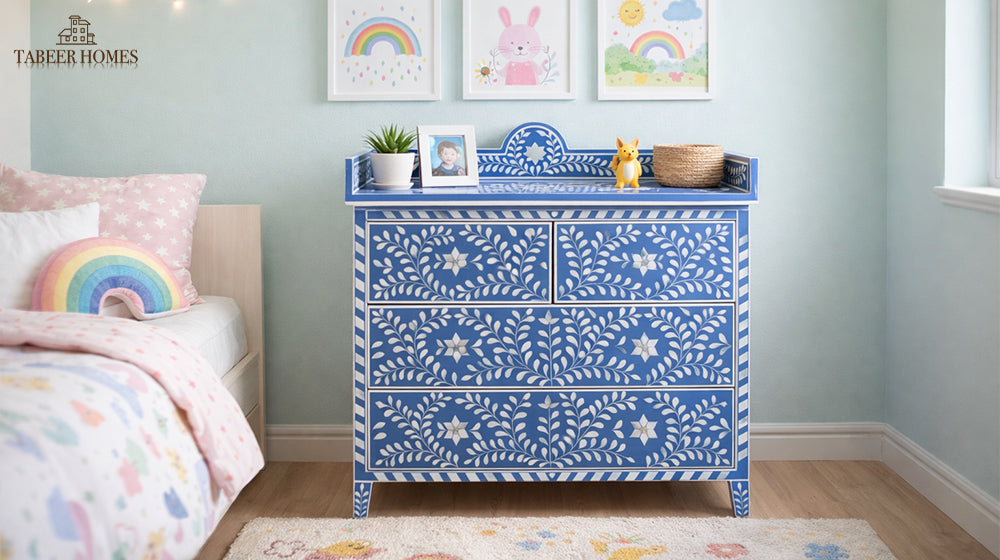
Colour in a child's bedroom is genuinely useful, not just decorative. Children respond to visual cues, and a colourful chest of drawers for kids can serve as a functional landmark in the room. Designating specific drawer colours for specific clothing categories, one colour for tops, another for bottoms, another for pyjamas, works as an organisational system for children who are not yet reading drawer labels reliably.
The practical approach to colour in this context is more restrained than most children's furniture marketing suggests. A chest with four or five different brightly coloured drawer fronts on a neutral white or natural wood carcass reads as playful without making the room feel visually saturated. A chest where the carcass, the drawer fronts, the pulls, and the frame are all in competing colours is difficult to design around as the child ages and the room changes.
Approaches that work consistently for colourful chest of drawers for kids in homes across kids bedroom storage Dubai and UAE setups:
- Neutral carcass (white, natural wood, grey) with colour confined to drawer fronts only, allowing drawer fronts to be repainted as preferences change
- A single bold colour used for the entire chest, treated as an accent piece against neutral walls and bedding
- Multi-coloured drawer fronts in a graduated tone family (blues from pale to navy, for example) rather than unrelated colours, which reads as designed rather than random
Tabeer Homes produces painted and lacquered chest of drawers pieces that can be specified in coordinated colourways for children's bedrooms, offering the option to treat the chest as the room's primary colour statement against a more restrained background.
Storage Configuration Ideas for Different Ages
The internal configuration of a childrens chest of drawers can be adapted to serve different storage purposes at different ages without replacing the piece. This makes the initial investment more durable across the child's growth stages.
For children under five, the priority is accessibility at low height and containment of small items that get lost in deep drawers. Shallow drawers with internal dividers or organisers keep small items grouped and visible. At this age, folded clothing fits in fewer, shallower drawers.
For school-age children, the storage load changes significantly. Uniforms, sportswear, casual clothing, and seasonal items all need a place. A kids chest of drawers UAE and kids chest of drawers Saudi Arabia families rely on during school years benefits from at least one deep drawer for bulkier items like hoodies and sports kits, alongside shallower drawers for daily uniform items.
Practical storage configuration by age:
- Ages 2 to 5: Three to four shallow drawers, internal fabric dividers for small items, top surface kept clear as a display and dressing surface
- Ages 6 to 10: Four to five drawers of mixed depth, one deep base drawer for sports and seasonal items, remaining drawers for daily clothing categories
- Ages 10 and above: Five to six drawers approaching adult configuration, with the chest functioning as the primary folded clothing storage alongside a wardrobe for hanging items
Buying a Kids Chest of Drawers in the UAE: Practical Checklist
Whether purchasing from a physical showroom or ordering online for delivery across the UAE or Saudi Arabia, several checks apply specifically to children's furniture that differ from the adult furniture buying process.
Before confirming an order for any kids chest of drawers UAE or kids chest of drawers Saudi Arabia delivery, verify:
- Wall anchoring hardware is included. If not included, identify compatible restraint straps before the piece is delivered and install them the same day.
- All hardware is child-safe at drawer height. Check pulls, knobs, and hinges at the lower drawer positions specifically.
- Drawer runner type. Metal undermount runners with soft-close are the standard to request. Confirm this in the product specification, not just the product description.
- Finish is non-toxic. For children's furniture, confirm that paints and lacquers are certified low-VOC or non-toxic. This is particularly relevant for imported pieces where the certification standard may differ from UAE or GCC requirements.
- Returns and exchange policy. Children's rooms change faster than adult rooms. A chest that suits a four-year-old may need to be supplemented or replaced by age eight. Understand the after-sale position before committing.
Frequently Asked Questions
What height should a childrens chest of drawers be for a toddler or young child?
For children aged two to five, a chest of drawers between 55 and 70 cm tall is the most practical range. At this height, the top surface is visible and accessible, the top drawer sits at comfortable reaching height, and the child can use the piece independently without adult assistance. A standard adult chest at 90 to 100 cm places the upper drawers entirely out of reach for this age group.
What safety features should a children's dresser have?
A children's dresser with safety features should include wall anchoring hardware to prevent tip-over, drawer stops that prevent full drawer extension and accidental removal, soft-close mechanisms to protect fingers from slamming drawers, and no sharp edges or small detachable hardware at lower drawer positions where a child's face is at height. Wall anchoring is the single most important feature and should be installed immediately on delivery.
Are colourful chest of drawers for kids practical or do they date quickly?
A colourful chest of drawers for kids remains practical longer when the colour is confined to drawer fronts on a neutral carcass rather than applied to the entire piece. Drawer fronts can be repainted relatively easily as the child's preferences change. A chest where the entire structure is a bold single colour requires more significant repainting or replacement when tastes shift, which typically happens between ages eight and twelve.
What is the best material for a kids chest of drawers in UAE conditions?
Solid painted hardwood or solid pine are the most durable choices for a kids chest of drawers in UAE conditions. Both materials withstand the impact of daily use, can be repaired if damaged, and hold anchoring hardware securely over years of use. MDF with a thick lacquer finish is a reasonable mid-range alternative. Avoid particle board and thin film laminate constructions, which chip and degrade quickly under children's typical usage patterns.
How do I organise a chest of drawers for a young child so they use it independently?
Assign one category of clothing to each drawer and use a visual label rather than a written one for children who are not yet reading. A small picture of a t-shirt on the top drawer, shorts on the second, and pyjamas on the third is more effective than text labels. Keep the most frequently used items in the middle drawers where reach is easiest, and reserve the lowest drawer for bulkier or less-used items like extra bedding or seasonal clothing.
What size chest of drawers works in a small kids bedroom in a Dubai or UAE apartment?
In a secondary bedroom of 10 to 14 square metres, which is a common size across Dubai apartment layouts, a chest of 60 to 75 cm wide and 70 to 90 cm tall works best. This width preserves enough wall space for a single bed, a small wardrobe, and a study area without the chest dominating the floor plan. A taller, narrower chest with five to six drawers gives more storage volume than a wider, lower configuration in the same footprint.
Ending Words
A childrens chest of drawers chosen around safety first, proportions second, and aesthetics third will outperform a piece chosen the other way around on every measure that matters in daily use. Whether the priority is a colourful chest of drawers for kids that makes the room feel energetic, a solid kids chest of drawers UAE apartment bedrooms can accommodate in limited floor space, or a children's dresser with safety features that a toddler can use without supervision, the framework is consistent. Get the safety specification right, size it for the child using it now, choose a material that holds up to real use, and let the colour and finish work within those constraints rather than override them.


Leave a comment
This site is protected by hCaptcha and the hCaptcha Privacy Policy and Terms of Service apply.