


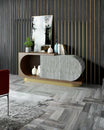
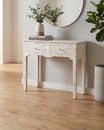
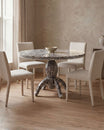

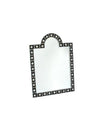

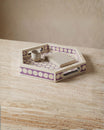
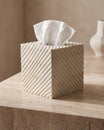
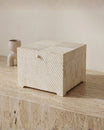
You run a hand across the surface of a mirror frame in a showroom, and it feels cooler and smoother than plastic, with faint variations you can only feel, not quite see. The shopkeeper tells you it is bone inlay, hand-carved, and you nod, though you are not entirely sure what that means or why it costs several times more than the plain wooden frame beside it. If you have ever asked yourself what is bone inlay furniture while standing in front of a piece like this, the short answer involves centuries of Rajasthani craftsmanship, a raw material you would not expect, and a production process that has barely changed since it began.
What Is Bone Inlay Furniture, Exactly?
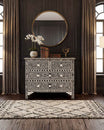
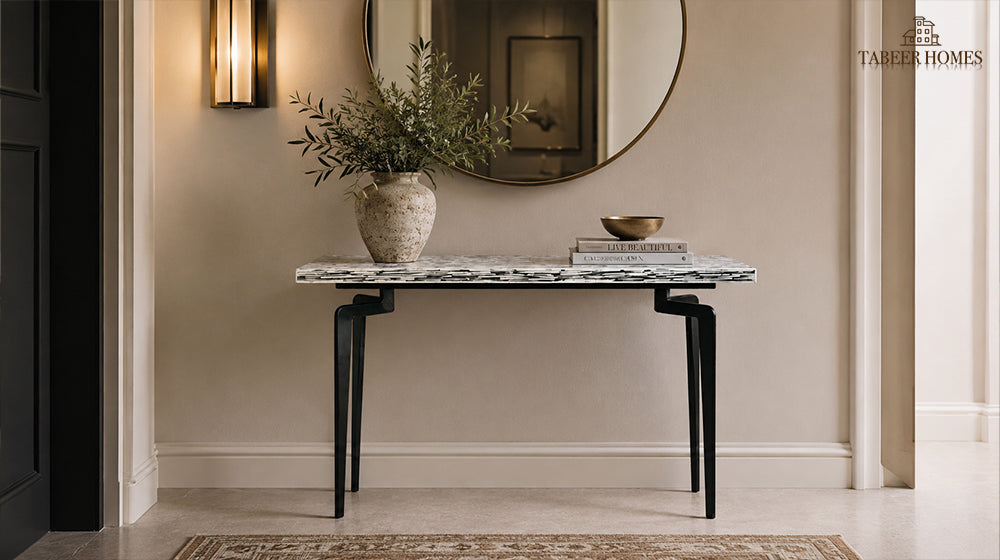
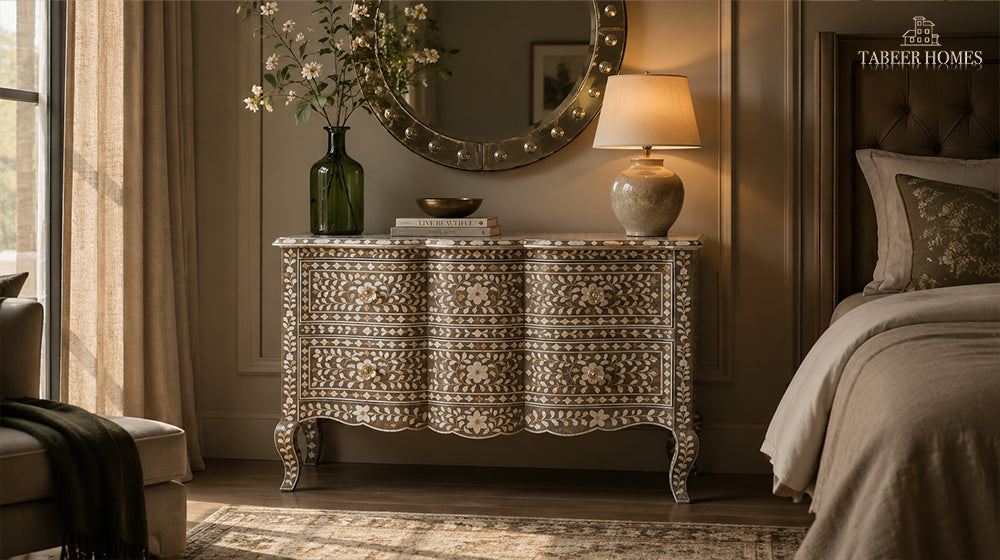
Bone inlay furniture is a decorative technique in which small, individually hand-carved pieces of bone are set into a resin bed cut into a solid wood surface, forming detailed geometric or floral patterns. The core bone inlay meaning comes from this embedding process itself: bone is not painted onto the surface or applied as a veneer, it is physically inlaid, carved to shape and pressed into channels cut directly into the wood, then sealed with colored resin and polished flush with the surface.
The result is a textured, slightly cool surface with a matte finish, since bone does not reflect light the way polished shell or metal does. Every piece carries small natural irregularities in the bone's shape and tone, which is a mark of the handwork behind it rather than an inconsistency to be concerned about.
The History of Bone Inlay Furniture
Bone inlay's clearest documented roots trace to Mughal India, where royal workshops commissioned artisans to decorate furniture, doors, and architectural elements with intricate inlay work as a display of wealth and refinement. From there, the craft took root most firmly in Rajasthan, and specifically in the cities of Jodhpur and Udaipur, where it has been practiced continuously for more than 400 years rather than revived after any interruption. The apprenticeship model in these cities never stopped, meaning many artisan families working today are continuing skills passed down within the same lineage across generations.
The craft did not stay confined to Indian palaces. Trade routes carried bone inlay designs into the Middle East, where artisans in cities like Damascus and Marrakesh developed their own regional variations, often favoring bolder color contrasts and geometric patterns influenced by Islamic design traditions. As trade expanded further, bone inlay furniture found its way into royal collections and noble estates across the Gulf, and it remains a recognizable presence in traditional and contemporary GCC interiors today.
Bone as a decorative inlay material actually predates the Mughal era by centuries. Ancient Egyptian artisans used bone to decorate furniture and small objects, working within a broader tradition of embedding contrasting materials into wood that also appears in ancient Chinese craftsmanship. It was under Mughal patronage, however, that the technique reached the level of detail and scale most associated with bone inlay furniture today, with entire cabinet doors, headboards, and tabletops covered in dense, repeating patterns commissioned specifically for palace interiors.
The craft's reach extended into Europe during the colonial period, when traders and diplomats brought Rajasthani inlay pieces back to England and France, where they were collected as exotic curiosities among wealthy households. That collector interest never fully disappeared, and bone inlay furniture from this era still surfaces in antique auctions today, valued both for its craftsmanship and its historical association with the trade routes that carried it across continents.
The Raw Material: Camel Bone and Its Alternatives
Camel bone inlay is the material most associated with the craft, prized for its fine texture and pale, even tone that lends itself to delicate, detailed patterns. Camel bone is a byproduct of the meat industry in the regions where the craft is practiced, and reputable workshops describe their sourcing as ethical for this reason, using bone that would otherwise go to waste rather than harvesting animals specifically for inlay production.
Buffalo bone is a common alternative, offering a slightly darker, more robust material better suited to larger furniture pieces or areas that see heavier daily use. Cow bone is also used in some workshops, generally as the most accessible and cost-effective option, producing a natural white tone with slightly less fine detail capability than camel bone. All three materials go through the same essential carving and setting process, and the choice between them affects durability and cost more than it affects the overall visual style of the finished piece.
How Handmade Bone Inlay Furniture Is Made
Producing a single piece of handmade bone inlay furniture is a slow, multi-stage process that can take anywhere from a few weeks to over a month depending on the size and complexity of the design.
- Design sketching. The artisan or workshop first sketches the intended pattern directly onto the wood surface, whether a repeating geometric grid, a floral medallion, or a custom motif requested by the buyer.
- Building the wood frame. The base furniture piece, typically built from mango wood, is constructed to its final shape and dimensions before any inlay work begins.
- Carving the channels. Following the sketched design, artisans carve narrow channels into the wood surface, precise enough to hold each individual bone piece once it is shaped.
- Cutting and shaping the bone. Each piece of bone is individually cut and carved by hand to match the exact shape needed for its position in the pattern, a process that accounts for much of the labor time behind a finished piece.
- Setting the bone into the channels. Artisans press each carved bone piece into its corresponding channel by hand, building the pattern one segment at a time.
- Filling with colored resin. Once the bone is set, colored resin fills the remaining gaps around each piece, both securing the bone in place and creating the contrasting background color.
- Sanding and polishing. The entire surface is sanded flat and polished until the bone and resin sit flush together, producing the smooth, matte finish characteristic of finished bone inlay.
Common Bone Inlay Patterns
The physical shape of carved bone segments naturally suits certain pattern families, and recognizing them helps when comparing pieces from different workshops. The table below breaks down the most common pattern types and where they typically appear.
|
Pattern |
Visual Character |
Common On |
|
Floral |
Curved, petal-shaped segments forming blossom or vine motifs |
Cabinet doors, mirrors, headboards |
|
Geometric / Chevron |
Straight-edged pieces forming diamonds, zigzags, or grids |
Sideboards, console tops |
|
Checkerboard |
Alternating bone and resin squares in a bold grid |
Buffet cabinets, sideboards |
|
Fish scale |
Overlapping curved segments for a layered texture |
Decorative panels, small accent furniture |
|
Zebra line |
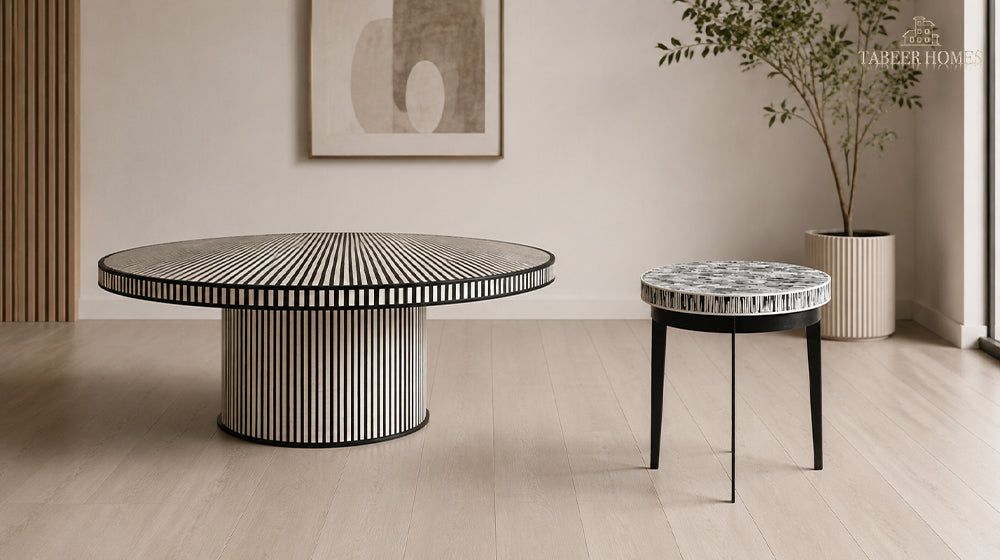
Repeating parallel stripes |
Side drawers, trays |
Floral patterns tend to be the most labor-intensive of the group, since curved bone segments are harder to cut accurately than straight-edged geometric pieces, which is part of why floral-pattern furniture often commands a premium over an equivalently sized checkerboard or chevron design. Buyers furnishing a room with an existing pattern language, a patterned rug or textile, generally do better picking a bone inlay piece from the geometric family, since floral bone inlay can compete visually with other floral or organic patterns already in the room.
Bone Inlay Furniture Types You'll Commonly Find
The technique has been applied to a wide range of furniture categories over the centuries, and knowing the common formats helps when browsing a collection.
- Sideboards, buffet cabinets, and consoles. These larger, flat-surfaced pieces give artisans the most room to work with dense, repeating patterns, making them the most common starting point for buyers new to the craft.
- Chests of drawers and dressers. Smaller front panels on drawers suit tighter geometric or linear patterns, and the format works well in bedrooms where a full sideboard would feel oversized.
- Mirrors and picture frames. These decorative accessories carry inlay work at a much smaller scale, often used as an entry point for buyers who want the look without committing to a large furniture purchase.
- Trays and small decor objects. Bone inlay trays, boxes, and coasters extend the craft into functional tabletop accessories, frequently sold alongside larger furniture collections.
- Beds and headboards. Full bed frames and headboards represent some of the most labor-intensive applications of the craft, given the scale of surface area involved.
- Doors and architectural elements. Historically the most prestigious application, inlaid doors and panels continue to appear in high-end residential and hospitality projects across the Gulf.
Why Bone Inlay Costs More Than Standard Furniture
The price gap between a bone inlay piece and an equivalent plain wood piece comes down almost entirely to labor rather than raw material cost. Camel, buffalo, and cow bone are all relatively inexpensive as raw materials, but converting them into finished inlay requires many hours of hand-cutting, shaping, and setting work per piece, performed by artisans with skills built up over years of apprenticeship rather than automated in any way.
A single sideboard-sized piece can involve thousands of individually cut bone segments, each shaped and placed by hand before the resin filling and polishing stages even begin. This is also why production timelines for bone inlay furniture typically run into several weeks rather than the days or single week common for standard factory-made furniture, and why reputable workshops are generally upfront about longer lead times, particularly for custom or pre-order pieces. Buyers comparing two similarly sized pieces at very different price points should treat that gap as a direct signal of how much genuine hand-labor went into each one, rather than assuming the cheaper option is simply a better deal.
How to Identify Genuine Handmade Bone Inlay
Not every piece marketed as bone inlay is made using the full hand-carving process described above, and a few checks help separate genuine handmade work from a lower-quality imitation.
- Look for natural irregularities. Genuine hand-carved bone will show slight variation in shape, spacing, or tone between segments. A pattern that looks mechanically uniform down to the millimeter is a signal to ask more questions about how it was made.
- Check the surface temperature and texture. Real bone feels cool and slightly textured to the touch, distinct from the warmer, more uniform feel of printed or molded plastic imitations.
- Ask about the wood base. Genuine pieces are typically built on solid wood, most often mango wood, rather than particleboard or MDF, which affects both longevity and how well the piece takes the carved channel work in the first place.
- Ask directly about sourcing. Reputable workshops are generally transparent about using ethically sourced bone as a byproduct of the meat industry, and hesitation or vagueness on this question is worth taking as a caution sign.
- Compare the price against production time. A piece priced far below what several weeks of skilled hand labor would reasonably cost is a signal that shortcuts, whether in material, process, or both, are likely somewhere in the production.
Caring for Bone Inlay Furniture
Bone inlay requires gentler handling than plain wood furniture, since both the bone and the resin holding it in place are sensitive to moisture, heat, and abrasive cleaning.
- Dust weekly with a soft, dry microfiber cloth , following the direction of the pattern rather than wiping across it.
- Clean spills immediately by blotting , since standing liquid can seep into the resin seams and cause discoloration.
- Keep pieces away from direct sunlight and AC vents , since both prolonged UV exposure and repeated humidity swings can affect the bone's tone and the resin bond over time.
Tabeer Homes covers this in more depth in its guide to maintaining and cleaning bone inlay furniture for anyone setting up a longer-term care routine.
Sustainability and Ethical Sourcing in Bone Inlay
Ethical sourcing is a recurring question for buyers new to the craft, and it is worth addressing directly rather than assuming. Camel and buffalo bone used in inlay work comes from animals raised for meat production in the regions where the craft is practiced, meaning the bone itself is a byproduct rather than the primary reason for raising the animal. Workshops that describe their materials as ethically sourced are typically referring to this distinction, using bone that would otherwise be discarded rather than commissioning it as a standalone product.
This byproduct sourcing model also connects bone inlay to a broader shift toward handcrafted, small-batch furniture that buyers increasingly favor over mass-produced alternatives. A single bone inlay piece, built from waste material and hours of skilled labor rather than industrial processes, sits differently in a sustainability conversation than furniture built from newly harvested materials and automated manufacturing. That said, buyers who want full confidence in a specific piece's sourcing should ask the retailer directly, since sourcing standards can vary between workshops even within the same region.
Where Bone Inlay Furniture Fits in a Modern Home
Bone inlay's bold, matte pattern works well as a statement piece rather than something used sparingly across every surface in a room. A single bone inlay sideboard, console, or cabinet, paired with simpler, plainer furniture around it, tends to read as intentional rather than overwhelming. In a majlis or formal living area, a larger bone inlay cabinet or sideboard can anchor the room against darker wood tones and richer textiles. In a bedroom, a smaller inlaid chest of drawers or a bone inlay mirror frame introduces the same craftsmanship at a scale that does not overwhelm a more restful space. Entryways benefit from a compact piece, since the pattern makes a strong first impression without requiring the floor space a full sideboard would need.
Tabeer Homes' Saphed Side Drawers in white bone inlay (60 x 45 x 57 cm) demonstrates how the craft translates to a smaller-scale piece, using a linear stripe pattern suited to a bedroom, entryway, or reading nook rather than a full dining wall. For a broader comparison of how bone inlay sits alongside its closest material relative, see our guide on bone inlay versus mother of pearl furniture .
Frequently Asked Questions
What is bone inlay furniture made from?
Bone inlay furniture is made by hand-carving small pieces of camel, buffalo, or cow bone and setting them into a resin bed cut into a solid wood base, most commonly mango wood.
Is bone inlay furniture ethically made?
Reputable workshops source bone as a byproduct of the meat industry rather than harvesting animals specifically for inlay work, and transparency about sourcing is a good sign of a legitimate handmade piece.
How long does it take to make a bone inlay furniture piece?
Production time varies with size and pattern complexity, but a single piece typically takes several weeks from initial design sketch through carving, setting, and final polishing.
Where does bone inlay furniture come from?
The craft's clearest documented roots lie in Mughal India, with Jodhpur and Udaipur in Rajasthan serving as continuous production centers for more than 400 years.
How can you tell if bone inlay furniture is handmade?
Genuine handmade pieces show slight natural irregularities in bone shape and spacing, a cool matte texture to the touch, and a solid wood base, unlike the uniform look and warmer feel of machine-made imitations.
Does bone inlay furniture need special care?
Yes. It should be dusted with a soft dry cloth, kept away from direct sunlight and high humidity, and cleaned with only a slightly damp cloth for deeper cleaning to protect the resin and bone from damage.

Leave a comment
This site is protected by hCaptcha and the hCaptcha Privacy Policy and Terms of Service apply.