


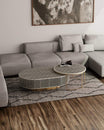
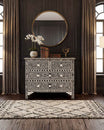
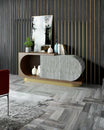
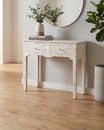
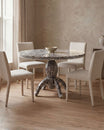

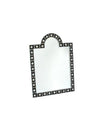

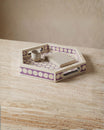
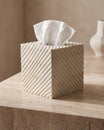
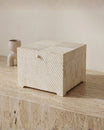
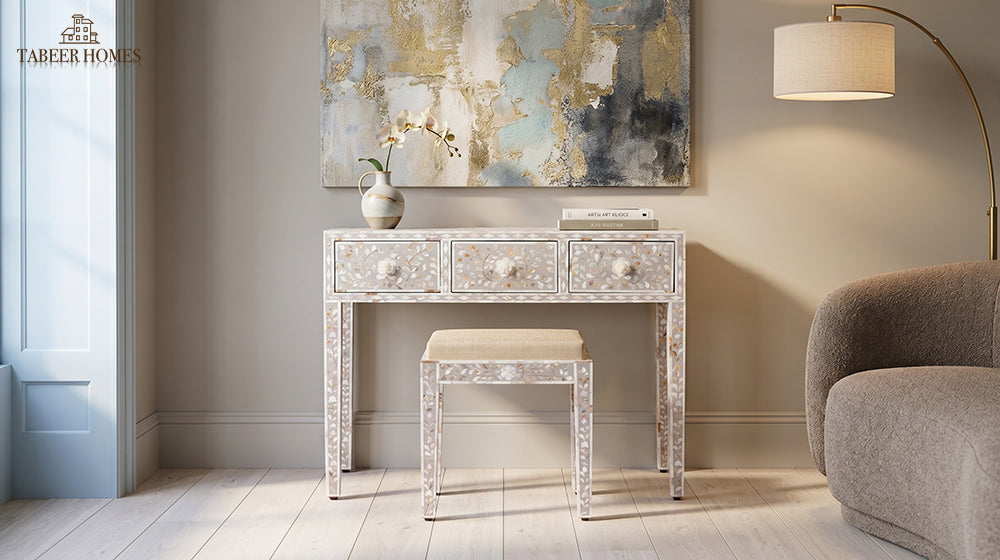
Run your hand across a mother of pearl furniture surface and the experience is immediately different from anything a manufactured finish delivers. The shell fragments catch light at slightly different angles from each other, producing a depth that shifts as you move around the piece. No two surfaces are identical.
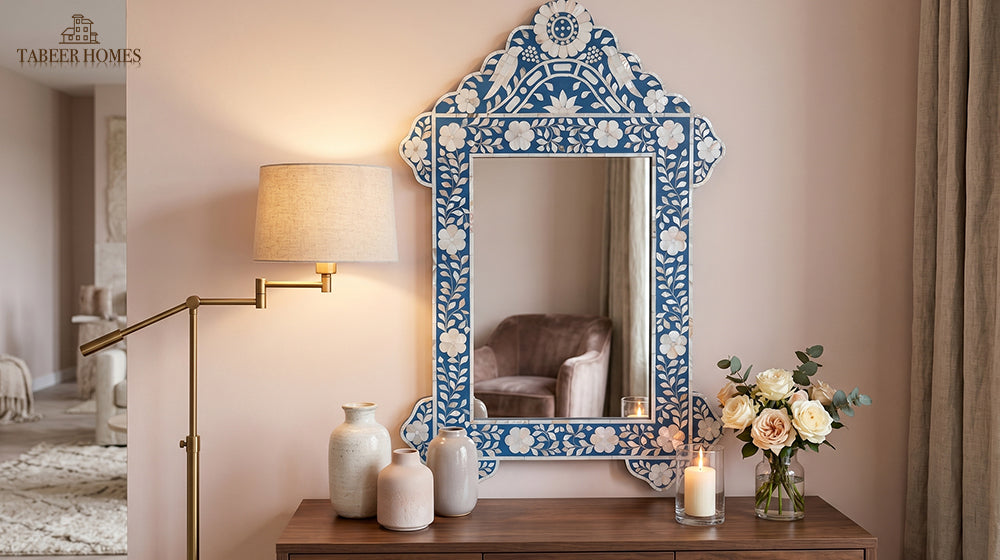
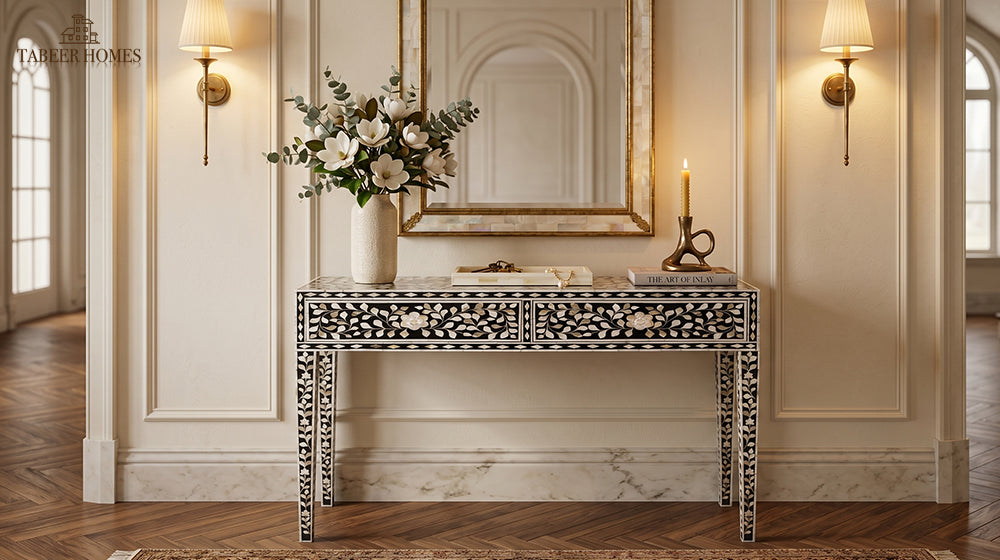
The pattern is geometric or organic depending on the maker's hand, and the iridescence is a property of the material itself rather than something applied over it. That combination of tactile quality, visual depth, and genuine handcraft is why mother of pearl furniture Dubai and UAE buyers have consistently sought out these pieces for primary rooms, and why the category commands the prices it does in the regional luxury furniture market.
What Mother of Pearl Furniture Actually Is
Mother of pearl furniture is a broad term that covers a specific craft tradition: the application of nacre shell pieces to a furniture surface, typically over a lacquered wood base, to create a decorative panel that forms the drawer front, tabletop, cabinet door, or headboard of the finished piece.
Nacre, the material commonly called mother of pearl, is the iridescent inner lining of certain mollusc shells. The species most commonly used in furniture production include the white-lip pearl oyster, the black-lip oyster for darker tonal variations, and the freshwater mussel for thinner, more translucent inlay work. The shell is cut into small pieces, shaped, and set into the furniture surface by hand. The setting process involves applying the shell fragments to a prepared lacquered ground, filling the gaps between pieces with a contrasting or matching filler, and then levelling and polishing the entire surface until the inlay sits flush with the ground.
This is not a fast process. A single drawer front in a traditional geometric pattern can require several hours of setting work. A full cabinet with multiple panels represents days of skilled handwork. The time investment is one of the primary reasons mother of pearl furniture price sits where it does across legitimate handcraft production.
The distinction between genuine handcraft and mechanically assisted production matters when evaluating pieces at different price points, and the section on pricing below covers this directly.
The Relationship Between Mother of Pearl and Bone Inlay
Bone inlay and mother of pearl furniture are frequently discussed together and sometimes confused, but they are distinct craft traditions that produce visually different results and suit different design contexts.
Bone inlay uses camel or buffalo bone that has been cleaned, bleached, cut into geometric shapes, and set into a lacquered surface in precisely arranged patterns. The bone is opaque, which means the colour of a bone inlay piece comes from the dye applied to the bone pieces and the lacquered ground between them. A bone inlay chest in teal and white achieves its colour through pigment. The surface reads as flat, graphic, and pattern-forward.
Mother of pearl furniture uses shell rather than bone, and the shell is naturally iridescent. The colour of a mother of pearl surface shifts with the angle of light, producing a luminous quality that bone inlay does not replicate. Mother of pearl inlay tends to read as richer and more complex visually, while bone inlay reads as more graphic and pattern-precise.
The two techniques are sometimes combined in a single piece, where bone inlay provides the structural pattern geometry and mother of pearl fragments are set within or alongside the bone to introduce iridescent highlights. Bone inlay and mother of pearl furniture produced this way represents the most technically demanding version of the combined craft and commands the highest prices within the handcrafted furniture category.
Tabeer Homes produces pieces across both traditions, including side tables, chests of drawers, and cabinets in pure mother of pearl inlay, pure bone inlay, and combined surface treatments on lacquered frames.
Where Mother of Pearl Furniture Is Made and Why It Matters
The majority of handcrafted mother of pearl furniture UAE , Dubai, and Saudi Arabia originates from a small number of production centres where the craft has been practised across generations. Rajasthan in India, particularly the cities of Jodhpur and Jaipur, is the most significant production region globally. Workshops there have been producing inlay furniture for export markets for over a century, and the accumulated craft knowledge within these workshops represents genuine, multigenerational expertise.
Syrian craft production, centred in Damascus, has a longer documented history of mother of pearl inlay work on furniture and architectural elements, though the disruption of the past decade has significantly reduced active production from that region. Syrian-made mother of pearl pieces reaching the market today are predominantly pre-existing stock or pieces produced by craftspeople who relocated during the conflict period.
Vietnamese and Chinese production facilities have entered the market more recently, producing mother of pearl furniture at lower price points through a combination of mechanised cutting, faster setting processes, and lower labour costs. These pieces are not necessarily poor quality, but the production method and craft investment differ from Rajasthani or Syrian handcraft, and the price reflects this.
How to Evaluate Quality in Mother of Pearl Furniture
Quality in mother of pearl furniture Dubai and mother of pearl furniture UAE retail is visible at the surface level when you know what to look for. These are the indicators that distinguish well-made pieces from those that photograph similarly but perform differently over time.
Surface Levelling and Flush Setting
Run a finger across the surface of a mother of pearl panel. In a well-made piece, the shell fragments and the filler between them should be level with each other and with the lacquered ground. No piece should feel raised or recessed at the shell edges. Uneven setting causes the surface to collect dust at the recessed points and creates a texture that reads as unfinished rather than handcrafted.
Shell Quality and Consistency
The shell fragments used in mother of pearl furniture vary in quality. Higher-grade nacre carries consistent iridescence across the full surface of each piece. Lower-grade shell, or shell from less valuable species, may carry strong iridescence at certain angles but read as flat or dull under others. Examine the surface under both direct light and oblique light to assess the iridescence range.
Pattern Precision
Geometric patterns in mother of pearl inlay should be precise at the corners and junctions. Where two lines of inlay meet at a right angle or a diagonal, the shell pieces should meet cleanly without visible gaps or misalignment. Pattern irregularities at junction points indicate rushed setting rather than deliberate craft variation.
Lacquer Base Quality
The lacquered frame and ground on which the inlay sits should be smooth, consistently coloured, and free of brush marks, drips, or orange-peel texture. The lacquer quality affects the longevity of the inlay setting because the lacquer acts as the adhesive bed. A thin or poorly applied lacquer base will allow inlay pieces to loosen over time, particularly in rooms with significant temperature and humidity variation.
Mother of Pearl Furniture Price: What Different Levels of the Market Deliver
Mother of pearl furniture price varies considerably across the UAE and Saudi Arabia retail market, and understanding what different price brackets actually reflect helps buyers evaluate whether a piece represents genuine value or a significant overpayment.
|
Price Range (AED) |
Production Type |
Shell Quality |
Pattern Complexity |
Longevity |
|
300 to 800 |
Machine-assisted, fast-set |
Variable |
Simple, repetitive |
3 to 7 years with care |
|
800 to 2,000 |
Semi-handcraft, supervised workshop |
Good |
Moderate geometric |
7 to 15 years |
|
2,000 to 5,000 |
Full handcraft, skilled artisan |
High |
Complex geometric or organic |
15 to 25 years |
|
5,000 and above |
Master craft, premium shell, bespoke |
Premium nacre |
Custom, highly detailed |
25 years and above |
The price differential between the lower and upper ends of this range is not primarily a function of materials cost. Shell is relatively accessible as a raw material. The price differential reflects the hours of skilled labour invested in setting, levelling, and finishing the surface, and the quality of the lacquer base and structural frame that supports the inlay over decades of use.
A mother of pearl furniture price in the 2,000 to 5,000 AED range for a side table or chest of drawers from a verified handcraft producer represents a reasonable market rate for genuinely skilled production. Pieces at this price point from retailers who can identify the producing workshop and the production method are worth the investment. The same price point from a retailer who cannot provide production provenance warrants closer examination of the surface quality indicators described in the previous section.
Luxury handcrafted furniture Saudi Arabia buyers, particularly in Riyadh and Jeddah, where villa interiors frequently allocate significant budgets to statement pieces in primary reception rooms, typically engage at the upper end of this range, commissioning bespoke panels and coordinated sets rather than purchasing standard catalogue configurations.
Where Mother of Pearl Furniture Works Best in a Home
Placement matters for mother of pearl furniture in a way it does not for most other furniture categories, because the iridescent quality of the surface depends on light reaching it from the right angle.
A mother of pearl piece placed in a dark corner, beside a heavily draped window, or behind other furniture that blocks the primary light source loses much of what makes it worth choosing. The iridescence activates under direct and oblique light. In a position where light reaches the surface from multiple angles across the day, the piece changes character depending on the time and the light source, which is part of what makes it compelling in a room.
Positions where mother of pearl furniture UAE pieces perform best:
- A side table or console in a living room where natural light from a window reaches the surface directly for part of the day
- A chest of drawers on a bedroom wall that faces or is adjacent to the room's primary window
- A cabinet in an entrance hall where artificial lighting can be directed specifically at the surface
- A headboard in a master bedroom where bedside lamps on either side create oblique light across the surface each evening
Positions to avoid for the same reasons:
- Alcoves or recessed wall sections where light enters only from directly above
- Rooms where heavy window treatments block natural light for most of the day
- Positions directly beside or below an air conditioning vent, which creates a drying micro-climate that stresses the lacquer base over time
Caring for Mother of Pearl Furniture in UAE and GCC Homes
Mother of pearl furniture Dubai and UAE homes maintain well with straightforward care. The surface does not require specialist products or professional maintenance under normal indoor conditions.
Daily and routine care:
- Wipe the surface with a soft, dry or very slightly dampened microfibre cloth. Avoid abrasive cloths entirely, as they produce micro-scratches on the lacquered surface that become visible over time.
- For sticky marks or light grease, use a cloth with a small amount of mild soap solution, applied and immediately dried. Do not allow water to sit on the surface.
- Keep hot cups, plates, and bowls off the surface without a heat-resistant pad underneath. The lacquer base is vulnerable to heat marking at sustained contact.
- Polish the surface two to three times per year with a furniture wax appropriate for lacquered surfaces. This maintains the protective layer over the lacquer and keeps the surface depth looking its best.
Conclusion
Mother of pearl furniture occupies a specific and genuinely earned position in the handcrafted furniture category. The iridescent surface quality is not a styling choice that will date within a design cycle. It is a material property of nacre shell that has been valued in furniture and architecture for centuries across the Gulf, South Asia, and the Levant.
Understanding what the craft involves, how to evaluate quality before buying, what mother of pearl furniture price reflects at different market levels, and how to place and care for these pieces converts a purchase that might otherwise feel risky into one made with confidence.
Frequently Asked Questions
What is the difference between mother of pearl furniture and bone inlay furniture?
Mother of pearl furniture uses iridescent nacre shell set into a lacquered surface, producing a surface that shifts in colour and luminosity with changing light angles. Bone inlay and mother of pearl furniture comparisons show that bone inlay uses opaque, pigment-dyed bone set in geometric patterns, producing a flat, graphic result. Mother of pearl reads as richer and more luminous. Bone inlay reads as more precisely patterned and graphic. Both are handcrafted traditions, and both are produced in coordinated ranges by makers including Tabeer Homes.
What should I expect to pay for a genuine handcrafted mother of pearl side table in Dubai?
Mother of pearl furniture price for a genuine handcrafted side table from a verified production workshop in Dubai retail ranges from approximately 1,800 to 4,500 AED depending on the surface complexity, shell quality, and frame construction. Pieces significantly below this range in the UAE market are typically produced through machine-assisted or fast-set processes rather than traditional handcraft. Pieces above this range from bespoke producers reflect custom design work and premium shell selection.
Is mother of pearl furniture suitable for everyday use or only for display?
Mother of pearl furniture UAE pieces are suitable for everyday use when basic care is followed. The surface holds up well to normal handling, wiping, and daily contact. Heat and sustained moisture are the two conditions to avoid. Hot cups and plates should always use a protective pad, and water should be dried immediately rather than left to sit on the surface. Under these conditions, a well-made piece will hold its surface appearance and structural integrity for decades.
How do I verify that a mother of pearl furniture piece is genuinely handcrafted?
Run a finger across the surface and examine the pattern at junction points. Genuine handcraft shows slight, natural variation in shell piece size and setting at close range, which distinguishes it from mechanically placed inlay where every piece is identical and set to machine precision. Ask the retailer to identify the producing workshop and region. A retailer selling genuine handcraft can answer this question directly. Surface levelling quality, lacquer consistency, and frame construction are the physical indicators described earlier in this guide.
Does mother of pearl furniture work in contemporary interiors or only traditional ones?
Mother of pearl furniture Dubai and UAE buyers across contemporary, traditional, and transitional interior styles use these pieces effectively. In a contemporary interior, a single mother of pearl side table or cabinet functions as a material contrast against smooth, neutral surfaces. In a traditional or heritage-influenced room, a coordinated set of mother of pearl pieces fits naturally within the existing design language. The key in a contemporary context is restraint: one or two pieces used as deliberate accents rather than as the dominant material throughout the room.
What is luxury handcrafted furniture and how does mother of pearl fit within it?
Luxury handcrafted furniture Saudi Arabia and UAE definitions centre on three criteria: verified material quality, skilled artisan production, and surface or structural complexity that machine production cannot replicate. Mother of pearl furniture meets all three criteria when sourced from legitimate handcraft producers. The nacre shell is a genuine natural material. The setting process requires skilled hand labour that has no fully mechanical equivalent for complex patterns. And the surface result, the shifting iridescence of well-set nacre, cannot be replicated by any printed or applied finish at any price point.

Leave a comment
This site is protected by hCaptcha and the hCaptcha Privacy Policy and Terms of Service apply.