





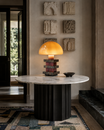
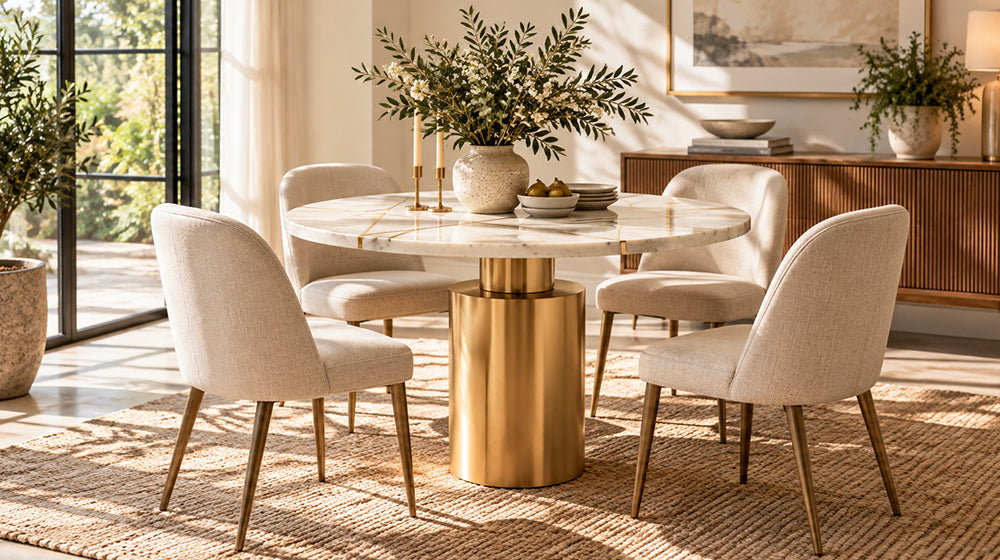
A round dining table Dubai apartments and villas increasingly favour solves a problem that rectangular tables create by default: awkward corners that eat into circulation space, and a shape that forces every guest to sit in a fixed position relative to the table's edges. A round table removes both problems. There are no corners to navigate around, and seating around a circle naturally distributes conversation rather than stretching it down a single long axis.
This guide covers how to size a round dining table correctly against your seating needs and room dimensions, compares the materials available, and looks at what a genuine 6-seater round table requires in terms of diameter and clearance.
Why Round Tables Suit Dubai's Apartment and Villa Layouts
Dubai dining spaces split fairly cleanly into two categories: compact apartment dining areas, often adjoining an open-plan kitchen or living space, and larger villa dining rooms with more generous floor area. Round tables perform well in both, for different reasons.
In an apartment, a round table's lack of corners is a genuine circulation advantage. A rectangular table of equivalent seating capacity needs more total floor clearance around it, because chairs pulled out at the corners require more room to manoeuvre past than chairs pulled out along a curved edge. A round dining table UAE buyers choose for a smaller footprint typically reclaims 15 to 20 cm of usable walking space compared with a rectangular table seating the same number of people.
In a villa dining room, the advantage shifts from space efficiency to social dynamics. A long rectangular table seating eight or ten naturally splits conversation into two separate threads, one at each end. A round table of the same capacity keeps everyone roughly equidistant, which tends to produce a single shared conversation rather than two parallel ones. This is part of why round tables are specifically associated with more intimate or family-style entertaining, rather than the more formal, seating-plan-driven dinners a long rectangular table suits.
Sizing a Round Dining Table by Seat Count
Diameter, not table height or base style, is the number that determines how many people a round table can seat comfortably. As a general guide, each seated diner needs roughly 60 cm of table edge to avoid elbow-to-elbow crowding, which sets a fairly predictable relationship between diameter and seat count.
|
Diameter |
Typical Seating |
Best Suited To |
|
90 to 100 cm |
4 people |
Compact apartments, breakfast nook, secondary dining area |
|
110 to 120 cm |
4 to 6 people |
Standard apartment or mid-sized villa dining room |
|
130 to 150 cm |
6 to 8 people |
Larger villa dining rooms, frequent entertaining |
|
160 cm and above |
8 or more |
Formal dining rooms, large family gatherings |
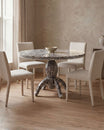
A 6 seater round table generally needs a diameter between 130 and 150 cm to seat six people without crowding, though a 120 cm table can accommodate six at a squeeze if the chairs used have slim arms or no arms at all. The Iris Dining Table, a round table finished in black mother of pearl inlay, measures 120 cm in diameter, which comfortably seats four to six depending on chair choice, making it a practical benchmark for this size bracket.
Room Size and Clearance: What the Table Alone Doesn't Tell You
Diameter tells you how many people fit at the table. It doesn't tell you whether the table fits your room, which depends on the clearance needed around the full seated arrangement, not just the tabletop itself.
The standard rule is to allow at least 90 cm of clearance between the table's edge and the nearest wall or piece of furniture, measured on all sides where chairs will be pulled out. This clearance needs to account for both the pushed-in chair and the space required to pull it out and sit down comfortably. For a 120 cm round table, this means the total footprint including clearance is closer to 300 cm across, not 120 cm, which is the figure that actually determines whether the table fits the room.
A common mistake is measuring only the available floor area and matching it to the tabletop diameter, without accounting for this clearance margin. A room that looks like it comfortably fits a 150 cm round table on paper may feel cramped once chairs are pulled out on all sides, particularly if the room also needs to accommodate a sideboard, a walkway to the kitchen, or a door swing.
The most reliable way to check before ordering is to mark the full footprint, tabletop plus clearance, directly on the floor with tape before the table arrives. This takes a few minutes and catches sizing problems that are far harder to notice from a tape measure reading alone, particularly in a room with an irregular shape, an island, or a doorway positioned close to the intended dining area.
Shape Comparison: Round Versus Rectangular for the Same Seat Count
It's worth pausing on why a round table and a rectangular table seating the same number of people can feel so different in practice, beyond the corner argument already covered. A rectangular table seating six typically runs 150 to 180 cm long and around 90 cm wide, a long, narrow footprint that suits a room with one dominant length-wise dimension, such as a galley-style dining area running alongside a kitchen island. A round table seating the same six people needs roughly 130 to 150 cm of diameter in every direction, which suits a room that's closer to square, or an open-plan space where the dining area isn't constrained to a single wall run.
This means the room's proportions, not just its total square footage, should guide the shape decision as much as the sizing table above. A long, narrow dining nook will generally fit a rectangular table more efficiently than a round one of equivalent capacity, while a squarer room, or one where the dining area is meant to feel like a central gathering point rather than a corridor-adjacent function, tends to suit round tables better.
Materials: Bone Inlay, Mother of Pearl, and Marble Round Tables
Bone Inlay Round Dining Tables
Bone inlay is the most represented material among round dining tables in Tabeer's collection. The Nova Dining Table, a round table with a starburst bone inlay pattern set on a tapered pedestal base, measures 120 by 120 cm and is available in a black and white colourway. The Ray Dining Table takes a similar round silhouette with a sunburst inlay pattern set against a brass-finished base, giving it a warmer, more metallic presence than Nova's cooler black and white palette. Several further colourways within this same round pedestal family, including Orbit, Sol, Axis, Elan, and Orea, extend the pattern and colour options across green, orange, and additional black and white variations, all sharing a broadly similar scale and construction.
Bone inlay round tables generally suit a dining room where the table itself is meant to be the room's primary decorative statement, since the hand-set pattern across a full tabletop surface is considerably more visible on a dining table than on a smaller side table or mirror.
Mother of Pearl Round Dining Tables
The Iris Dining Table is the clearest example of a mother of pearl round dining table in the current collection, finished in black mother of pearl inlay at 120 cm in diameter, supported by a sculptural pedestal base that carries the same inlay detailing as the tabletop. The Astra Dining Table extends this material into a larger format at a higher price point, also in black mother of pearl inlay.
Mother of pearl's iridescent quality is especially noticeable on a dining table surface, since it's viewed from directly above under typically brighter dining room lighting, which brings out the shell's light-catching properties more than a wall-mounted piece viewed at an angle would.
Marble Round Dining Tables
A marble round table Dubai buyers search for is a less commonly stocked format than bone inlay or mother of pearl in Tabeer's current dining table range, where marble is more strongly represented in the side table and console table categories than in round dining tables specifically. The marble dining pieces currently available, such as the Ava Dining Table, are built for larger seating counts and a different silhouette rather than the compact round format. If a round marble-topped dining table is specifically what you're after, it's worth confirming current stock and any custom or made-to-order options directly, since availability in this exact combination shifts as new pieces are added to the collection.
Comparing the Three Materials for a Round Dining Table
|
Material |
Visual Effect |
Typical Price Band |
Best Suited To |
|
Bone inlay |
Warm, pattern-forward, handcrafted |
11,999 to 24,999 AED |
Statement dining rooms, eclectic interiors |
|
Mother of pearl |
Luminous, iridescent, glamorous |
7,879 to 19,999 AED |
Glamorous or maximalist dining spaces |
|
Marble |
Cool, smooth, architectural |
Varies by piece and size |
Contemporary, minimalist dining rooms |
Prices reflect Tabeer Homes' current dining table collection and vary by finish, size, and whether a piece is in stock or made to order.
Base Styles and Why They Matter for a Round Table
A round tabletop is only half the design decision. The base beneath it affects both how many people can actually sit comfortably and how the table reads visually in the room.
A single pedestal base, as used on the Nova, Ray, and Iris tables, is the most common configuration for a round dining table, and for good reason. Unlike a four-legged base, a central pedestal leaves the legroom beneath the table completely unobstructed, which matters more around a round table than a rectangular one, since diners are seated at every point around the circumference rather than only along two long edges. A four-legged base on a round table risks putting a leg directly in a diner's legroom depending on where they're seated, which a central pedestal avoids entirely.
The trade-off is stability at larger diameters. A pedestal base needs a sufficiently wide foot to support a large tabletop without wobbling, and on tables above roughly 140 cm in diameter, a well-engineered pedestal or a reinforced double-pedestal design becomes more important to check before buying, since an undersized base can make a large round tabletop feel less stable than it should.
Where to Buy a Round Dining Table in Dubai
Once the size, material, and base style are settled, sourcing the actual piece comes down to whether a retailer stocks round dining tables as a genuine category rather than a single token option within a broader rectangular-dominated range. Specialist bone inlay and mother of pearl retailers such as Tabeer Homes carry multiple round dining tables across several colourways and price points within this shape alone, which gives more room to compare finishes side by side than a generalist furniture retailer typically offers.
Lead time is worth checking early in the process rather than after you've settled on a specific piece, since several round dining tables in this category are made to order rather than held in constant ready stock, and hand-inlaid pieces in particular can carry a production lead time of several weeks.
It's also worth thinking about chairs before finalising the table itself, since chair choice materially affects how many people a given diameter can actually seat. Armchairs and chairs with wider frames need closer to 65 to 70 cm of table edge per person rather than the 60 cm baseline, which can effectively drop a 120 cm table from a six-seat to a four or five-seat table depending on the chairs used. If you already own dining chairs you intend to keep, measure their width at the widest point, typically across the arms if they have any, before committing to a table diameter based on the general sizing guide alone.
Round Tables With Leaf Extensions
For households that want a compact everyday table but need extra capacity for occasional larger gatherings, an extendable round table is worth considering as a middle path between the sizing categories above. A leaf extension typically converts a round table into an oval shape when in use, adding 40 to 60 cm of additional length and one or two extra seats without permanently occupying the larger footprint of a fixed 150 cm table.
This configuration suits households that host infrequently but want the option available, since it avoids the trade-off of either living with a permanently oversized table for daily use or being unable to seat extra guests when the occasion calls for it. Not every round dining table in a given collection offers this option, so it's worth asking specifically whether a leaf extension exists for a piece you're considering, rather than assuming it as a standard feature across every round table style.
Final Thoughts
Choosing a round dining table Dubai homes will use daily comes down to matching diameter to genuine seat count, checking the clearance the room actually has rather than the clearance the tabletop alone suggests, and picking a base style that keeps legroom clear around the full circumference. Whether the direction is a bone inlay piece built as the room's central statement, a mother of pearl table that catches the light at every dinner, or a search for a round marble top that may take some direct confirmation with the retailer to track down, the sizing principles stay the same: measure the room before the table, and size for the seat count you'll actually use, not the maximum the diameter could technically fit.
Frequently Asked Questions
What size round dining table seats 6 people comfortably?
A 6 seater round table typically needs a diameter between 130 and 150 cm to give each diner roughly 60 cm of table edge without crowding. A 120 cm table can seat six at a tighter fit, particularly with slim or armless chairs, but 130 cm and above gives more comfortable spacing for regular use.
How much clearance space does a round dining table need around it?
Allow at least 90 cm of clearance between the table's edge and the nearest wall or furniture on every side where chairs will be pulled out. For a 120 cm round table, this brings the total required floor footprint to roughly 300 cm across, which is the figure to check against your room's actual dimensions rather than the tabletop size alone.
Is a round or rectangular dining table better for a small Dubai apartment?
A round table generally suits a small apartment better, since it requires less total clearance for chairs to be pulled out compared with a rectangular table seating the same number of people, and it removes the sharp corners that eat into walking space in a compact, open-plan layout.
Are marble round dining tables available in Dubai?
Round marble dining tables are less commonly stocked than bone inlay or mother of pearl round tables, where marble tends to be more strongly represented in side tables and consoles. If a round marble dining table is specifically what you want, confirm current availability directly with the retailer, since stock in this particular shape and material combination shifts as new pieces are added.
What base style works best for a round dining table?
A single pedestal base is generally the best choice for a round table, since it leaves the legroom beneath the table unobstructed at every seated position around the circumference, unlike a four-legged base which can place a leg directly where a diner needs legroom. For tables above roughly 140 cm in diameter, check that the pedestal base is sufficiently reinforced to support the larger tabletop without wobbling.

Leave a comment
This site is protected by hCaptcha and the hCaptcha Privacy Policy and Terms of Service apply.